







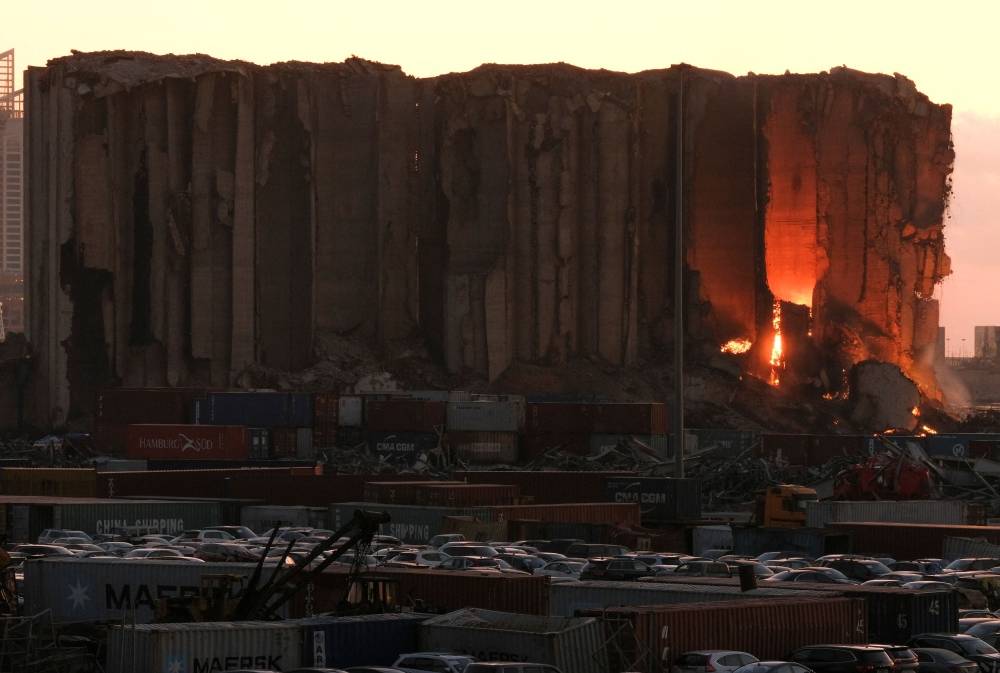
A view shows fire in Beirut grain silos on July 13, 2022. The silos were badly damaged in the August 2020 port blast. (Credit: Emilie Madi/Reuters)






Want to get the Morning Brief by email? Click here to sign up.
Thousands of mourners attended yesterday’s funeral of eight people killed in a truck crash in Arsal the evening before. The driver, Mohamad Deeb Ghadada, lost control of his truck after its brakes went out while going downhill, after which it crashed into several cars and a house and went up in flames. The other victims included a married couple and their four children along with another relative. The mother who died in the crash was in her ninth month of pregnancy. Meanwhile, Lebanese Hospital Geitaoui, which treated the truck driver who succumbed to his wounds, defended itself against charges of neglect in a statement. Among others, Baalbeck-Hermel MP Melhem Hojeiri had accused the hospital of negligence, claiming in a statement that Ghadada had died while “waiting at the hospital door” without being admitted to the emergency room, due to an alleged lack of beds. The hospital responded to the allegations, saying that the patient had been admitted “as soon as he arrived” and noting that he had suffered from second and third degree burns on 75 percent of his body and from cardio-respiratory arrest in addition to other injuries. “The medical team tried to resuscitate him by all possible means, but he died despite all medical efforts,” the statement said.
Army helicopters dowsed a fire in Beirut port’s grain silos Saturday, after it had been allowed to burn unchecked for days. On Wednesday, caretaker Public Works Minister Ali Hamieh told L’Orient Today that he had barred firefighters from approaching the silos to extinguish the blaze, due to the danger of possible collapse. The army’s intervention, opposition MP Melhem Khalaf announced earlier in the day on Twitter, came after an “agreement” was made to extinguish the fire following a meeting by Khalaf and fellow “Forces of Change” MPs Najat Aoun (Saliba) and Cynthia Zarazir with the ministers of public works, environment and economy and the governor of Beirut. An army spokesperson confirmed that a helicopter had been deployed Saturday morning followed by a second one in the afternoon. This was the latest in a series of fires to erupt in the past two weeks at the site of the horrific Aug. 4, 2020, explosion, causing many Lebanese to express panic and anger on social media. While authorities have made several attempts to destroy the silos, claiming that they could collapse at any moment, civil society groups and port blast victims’ families have repeatedly called for their preservation. The silo fires have apparently been sparked by fermentation in the remaining piles of grain. Caretaker Economy Minister Amin Salam told local news channel Al Jadeed during a visit to the site that while “fires will continue as long as wheat remains,” the wheat is also what stabilizes the silos, which, “if emptied, could collapse.”
Ogero employees are set to go on strike today. The strike at the state telecommunications provider has been called to protest the deterioration of its employees’ working conditions. “No maintenance, maintenance or control work, or any other service” will be carried out during this day, a press release issued yesterday by the company’s employees’ union said. The union denounced “repeated verbal and immoral attacks” against several employees of the office’s complaints department as well as the fact that employees are forced to cover the cost of commuting to work from their wages, which “remain aligned at unacceptable levels.” The statement also addressed the issue of delays in the payment of funds, which it said prevents the operator from functioning properly. A lack of diesel for generators, power cuts and even acts of vandalism have caused the Ogero network to falter. The strike follows a sharp increase in telecom tariffs, which sparked outrage and protests across the country after going into effect on July 1. The severe economic crisis plaguing the country has led to an increase in strikes by public employees in several sectors. Workers at the state-run National News Agency went on strike Thursday over the disparity in pay in the civil service, after a directive by Banque du Liban allowed judges to withdraw their salaries at an exchange rate of LL8,000 instead of the official LL1,500 rate.
The Lebanese University will “collapse in the near future,” according to the head of the executive board of the Association of Full-time Professors. After he announced an open-ended strike during which no “exams or academic work will be held,”Amer Halawani told L’Orient Today that professors are teaching online as a lack of funding has made in-person education at the public institution impossible. Full-time professors at Lebanese University are refusing to grade student exams while they’re protesting heavily deteriorated working conditions, meager salaries that are now worth about $150 and the lack of basic services provided by the university. The university's budget is still based on an exchange rate of LL1,500 to the dollar, while the national currency trades at around LL29,000 on the parallel market. A spokesperson of the association said that professors are not provided with paper and pens and “electricity on campus has become a thing of the past.” Following rumors that the Lebanese University would be charging its students in dollars, the dean of the Lebanese University’s Faculty of Engineering, Rafic Younis, said on June 21 that the dollar tuition fee only applies to three specialized Master’s degrees at the Engineering Faculty. The university had taken the decision in October 2021 to collect tuition fees in “fresh” dollars from international students at the official exchange rate. Not affected by this decision are students with Lebanese citizenship, as well as Syrians and Palestinians residing in Lebanon.
Today, Parliament’s Finance and Budget Committee is expected to discuss and perhaps finally approve a long-awaited draft law to lift banking secrecy. The proposal was approved last week by a subcommittee formed to study the issue. The committee meeting is scheduled for 10:30 a.m.
In case you missed it, here’s our must-read story from over the weekend: “Seeking comfort in the coffee grounds: A tale of fortune tellers, their fans and skeptics”