






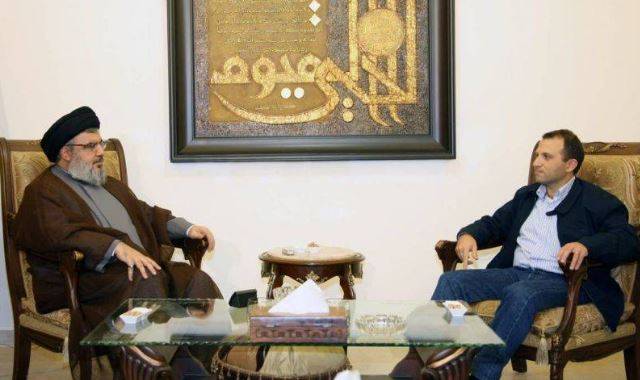
An archive photo of Hezbollah leader Hassan Nasrallah and FPM head Gebran Bassil during one of their meetings. (Credit: Al-Manar's website)






Facing multiple and pluralist opposition forces that arrived disunited at the first session of the new Parliament on Tuesday, there is a camp united behind Hezbollah.
It is thanks to this equation that the party and its allies managed to obtain a narrow majority of 65 votes (out of 128) to reelect Nabih Berri at the head of the legislature Elias Bou Saab, Free Patriotic Movement MP for Metn, as deputy speaker, as well as Alain Aoun as secretary of the new Parliament.
This hard-fought majority is the result of a meticulous calculation by Hezbollah to ensure the success of the candidates it supports, despite the strained relations between its traditional allies, notably the FPM, which has been at loggerheads with both Berri’s Amal Movement and Sleiman Frangieh’s Marada Movement.
This strategy may have given the impression that the pro-Iranian party still holds the majority, contrary to what the results of the legislative elections indicated.
But the reality is more nuanced, as what is true for key positions in Parliament is not necessarily true for other issues.
Are we heading for the same scenario that played out on Tuesday in the upcoming political junctures that await Parliament? The question is all the more burning since political players from all sides are preparing for these two battles.
The first milestone is the formation of a new government a few months before the expiration of President Michel Aoun’s mandate at the end of October.
Article 53 of the Constitution, which defines the president’s prerogatives, stipulates that the latter “shall appoint a prime minister after binding parliamentary consultations with the Parliament speaker.”
“For the selection of the head of government, there is no quorum or majority required. It is the candidate who obtains the largest number of votes that is designated to form the new ministerial team,” Ziyad Baroud, a legal expert and a former interior minister told L’Orient-Le Jour.
An explanation confirmed by several previous experiences.
In 2019, in the wake of the Oct. 17 popular uprising protest, Hassan Diab, a candidate for the premiership supported by Hezbollah and its allies, was nominated with only 69 votes while former Prime Minister Saad Hariri was elected before him with more than 100 votes.
However, today, the situation seems different.
“Hezbollah has no interest in imposing its will in the formation of the next government,” said Kassem Kassir, an analyst close to the party.
“What happened on Tuesday was the result of a one-time agreement specifically related to the election of the speaker and his deputy,” he added.
“When it comes to the cabinet formation, things are much more complicated. The country needs a prime minister who can manage to form a government and who is able to hold a dialogue with the international community, which appears to favor the reappointment of Najb Mikati in this position,” Kassir said.
According to him, “the logic of majority no longer holds, and the time has come for a broader compromise in which Hezbollah, a force to be reckoned with on the local scene, will certainly be part of it.”
This is a point of view that is not shared by Samir Geagea’s Lebanese Forces.
In the aftermath of the May 15 legislative elections, the party defined its priorities as the establishment of a majority government.
Today, it is increasingly determined to wage this battle against Hezbollah at all levels, starting with the appointment of the future prime minister.
“We know that the new majority is pluralistic and that it is difficult to agree on common points. But we must overcome the obstacles to be able to arrive in strength at the battle for the appointment of the head of government,” an LF official told L’Orient-Le Jour.
Explaining his point of view, the source warned against the choice of a personality supported by both Amal and Hezbollah as well as FPM head Gebran Bassil, as “this risks leading to the formation of governments similar to those that led the country to collapse.”
This is a thinly veiled criticism of Diab’s and Mikati’s cabinets, which the LF fiercely opposed.
A new Fouad Chehab
The first session of the new Parliament showed that Hezbollah and its allies have enough votes to have a say in the choice of a prime minister and ensure that he wins a vote of confidence.
But for the presidential elections, things appear to be more complicated. There are two main reasons for this, both of which favor an early compromise.
The first is the need to obtain two-thirds of the votes (86 out of 128) in the first round, according to Article 49 of the Constitution (an absolute majority is then required in the second round).
The second is the requirement of a two-thirds quorum to hold the session.
This would allow parties that oppose a potential candidate supported by Hezbollah and its allies to block the process.
Between 2014 and 2016, Hezbollah and its allies blocked the holding of 45 parliamentary sessions dedicated to the election of the president before Aoun, their ally, was elected.
The pertinent question is: Are the days of political blocking and bad habits over, knowing that the results of the parliamentary elections have reduced the chances of Bassil and Frangieh ascending to the presidency?
“Hezbollah can no longer block the presidential election,” said Kassir, stressing that this also applies to all other players.
“There is no longer an absolute political majority. This will be defined on a case-by-case basis. And I believe that we are heading toward the election of a new Fouad Chehab (head of state between 1958 and 1964), so a consensus figure,” Kassir said.
LF source appears to concur with him.
“No camp can elect a president alone in Lebanon,” the LF official said, indicating that his party is currently focusing on the future ministerial team.
“It is still early to talk about the next president,” said Simon Abiramia, FPM MP for Jbeil.
“There is no longer an absolute majority. This will be defined on a case-by-case basis,” he added.
This article was originally published in French in L’Orient-Le Jour. Translation by Sahar Ghoussoub.
It is thanks to this equation that the party and its allies managed to obtain a narrow majority of 65 votes (out of 128) to reelect Nabih Berri at the head of the legislature Elias Bou Saab, Free Patriotic Movement MP for Metn, as deputy speaker, as well as Alain Aoun as secretary of the new Parliament.This hard-fought majority is the result of a meticulous calculation by Hezbollah to ensure the success of the candidates it supports, despite the strained relations between its traditional allies, notably the FPM, which has been at loggerheads with both Berri’s Amal Movement and Sleiman Frangieh’s Marada Movement.This strategy may have given the impression that the...