






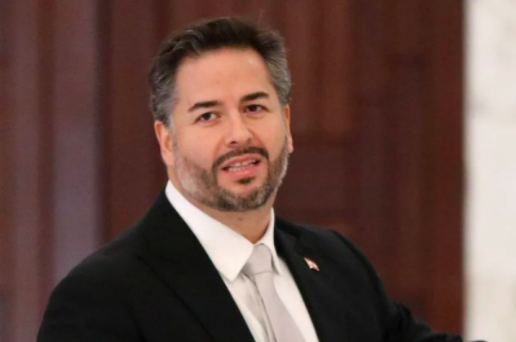
Economy Minister Amin Salam, at the Presidential Palace in Baabda, Sept. 13, 2021. (Credit: Anwar Amro/AFP)






Want to get the Morning Brief by email? Click here to sign up.
Economy Minister Amin Salam sought to reassure the country about its wheat supply yesterday, saying stocks are sufficient to last between a month and a month and a half. Salam made the remarks in a meeting on food security with Prime Minister Najib Mikati. Last week, the cabinet gave the General Directorate of Cereals and Sugar Beets approval to purchase 50,000 tons of wheat, roughly a month’s supply. The stability of Lebanon’s wheat supply has been a topic of speculation since the Russian invasion of Ukraine last week, which pitted Lebanon’s top two sources of foreign wheat against each other in military conflict, and threatened to disrupt supply chains. Lebanon is heavily dependent on imports to meet its wheat needs. Last week the president of the Association of Mills in Lebanon, Ahmad Hoteit, told L’Orient Today that if wheat exports from Black Sea countries were interrupted, Lebanon would have to resort to other trade partners that may be farther away, like the US and Argentina, which may cause a short-term delay in wheat arrivals.
An influential member of Parliament, Yassine Jaber (Nabatieh/Amal), will not stand for re-election. The 71-year-old politico has been a member of the legislature for 30 years. In a tweet, Jaber thanked “everyone that supported me all those years, particularly [Parliament Speaker] Nabih Berri.” A few hours later, Jaber posted another tweet saying “after my decision not to run in the next election, I repeat my thankfulness for all the citizens who stood by my side in all my political and national career.” He added that his decision not to run in the elections does not mean “stepping down from political life and social work.” Jaber presently stands as president of Parliament’s Foreign Affairs and Emigrants Committee and is a member of the Finance and Budget Committee.
Cabinet will convene today in Baabda for a regular session at 3 p.m. At the meeting, the Interior Ministry will present a study on the feasibility of using megacenters during the upcoming parliamentary elections. Megacenters are large, centrally located voting centers that would allow voters to cast ballots for their constituencies without having to physically go to their designated polling place, which may be far from where they live. The cabinet will also consider updated laws on distributed renewable energy, energy conservation and other matters.
The families of the victims of the Beirut port explosion will hold their monthly vigil at 5 p.m. today. As has become usual since differences of opinion developed over the leadership of the probe into the Aug. 4, 2020, tragedy, the families will gather in two separate groups. The Association of Families of Victims of the Beirut Port Explosion will gather at the statue of the expatriate while the Founding Committee for the Gathering of the families of the Martyrs, Wounded, and Victims of the Beirut Port Explosion will meet at Gate No. 3 of the port. The latter group made the news this week when it filed a lawsuit against Judge Tarek Bitar, lead investigator into the explosion. The group will deliver a statement explaining their reasons for filing the lawsuit at 5:45 p.m.
In case you missed it, here’s our must-read article from yesterday: “The ground is ripe for corruption and clientelism in the May parliamentary polls, election monitors say”