






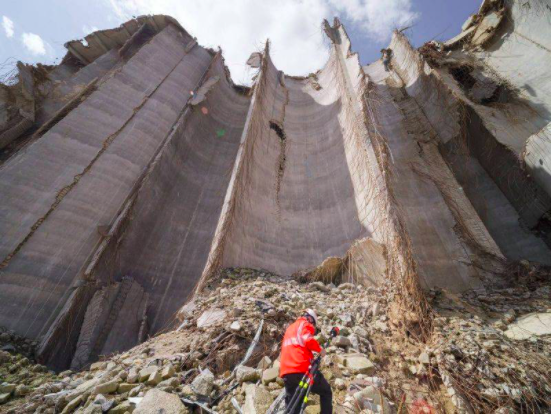
Engineer Emmanuel Durand laser scans grain silos damaged by the massive explosion at Beirut’s port. (Credit: Dia Mrad)






Want to get the Morning Brief by email? Click here to sign up.
State Security yesterday failed to find central bank governor, Riad Salameh, to bring him in for questioning. State Security personnel were unable to locate the governor at either of his two homes, or in his office at the central bank in the Hamra neighborhood of Beirut. The effort to apprehend Salameh follows a subpoena issued by Mount Lebanon Public Prosecutor Ghada Aoun against the Banque du Liban chief for failing to show up for questioning on multiple occasions. Last month, Aoun issued an asset freeze against Salameh, after a lawsuit was filed against him by the civil society group The People Want to Reform the System. Aoun has also issued a travel ban against him. So far the governor has failed to appear three times for questioning. Last week, Reuters reported that Germany had requested information from Lebanon about the governor’s financial dealings. Similar requests were made by Luxembourg and France just days earlier. Salameh’s personal wealth is the subject of investigations in several European jurisdictions. In Lebanon, Judge Aoun yesterday vowed to continue pursuing Salameh, and asked the Internal Security Forces if there was a secret agreement against arresting the governor. Later yesterday, the ISF issued a statement clarifying that the security detail assigned to Salameh did not prevent State Security from executing the subpoena against him, adding that it does not fall within its jurisdiction to do so. The Future Movement meanwhile condemned the attempt to arrest Salameh, claiming that the move was ordered by President Michel Aoun.
Najib Mikati’s cabinet yesterday set aside LL320 billion in funding for parliamentary elections scheduled for May. 15. Acting Information Minister Abbas Halabi announced the sum following a cabinet meeting held at the Presidential Palace in Baabda. However, the sum announced, worth around $16 million at the parallel market exchange rate, is significantly less than the $54 million the 2018 polls reportedly cost. Over the weekend, President Michel Aoun had told local pro-Hezbollah daily Al-Akhbar that he feared that a lack of funding could cause the postponement of the elections. Additionally, cabinet assigned the interior minister to study a request presented by President Aoun to build several electoral “megacenters” that would enable voters to cast ballots outside their home districts. As for funding for the struggling electricity sector, the cabinet tasked Energy Minister Walid Fayad with drawing up a plan to study increasing tariffs. Yesterday’s cabinet session went ahead without incident, assuaging fears expressed over the weekend that Hezbollah and Amal could boycott the meeting over fallout from the budget’s approval and controversy over a number of security appointments.
An activist group has started a petition to save the grain silos damaged in the port blast. The Beirut Urban Declaration initiative has said that the silos’ destruction would deprive the city of its memory. The initiative is being put forward by a collective comprising the Order of Engineers and Architects and educators in the field, and was launched last year “with a general vision on ways to reform the affected areas.” Last month, Economy Minister Amin Salam announced that there were plans to demolish the silos, which were badly damaged by the Aug. 4, 2020, Beirut port blast. The petition argues that “the fate of the silos lies within the public interest.” It also contends that repairing the silos is technically possible, citing a French study on the feasibility of the restoration. The silos were originally completed in 1970, built by the Czech company, Prumstav, with funding from Kuwait. Meanwhile, the Civil Court of Cassation has ruled against deposing a judge overseeing complaints filed against port blast investigator, Judge Tarek Bitar. Unsuccessful attempts to remove Bitar from the port blast case have led former ministers summoned by him to seek the removal of judges presiding over their dismissal requests.
Judicial assistants across Lebanon began a weeklong strike yesterday to protest worsening economic conditions. They have demanded pay rises as well as educational and medical benefits. Additionally, the protesting judicial assistants called for the renovation of courthouses across Lebanon. Last week, judges refused to enter the courthouse in the Baabda district, citing the lack of cleanliness, electricity and water.
In case you missed it, here’s our must-read story from yesterday: "Samir Geagea’s electoral chessboard"