


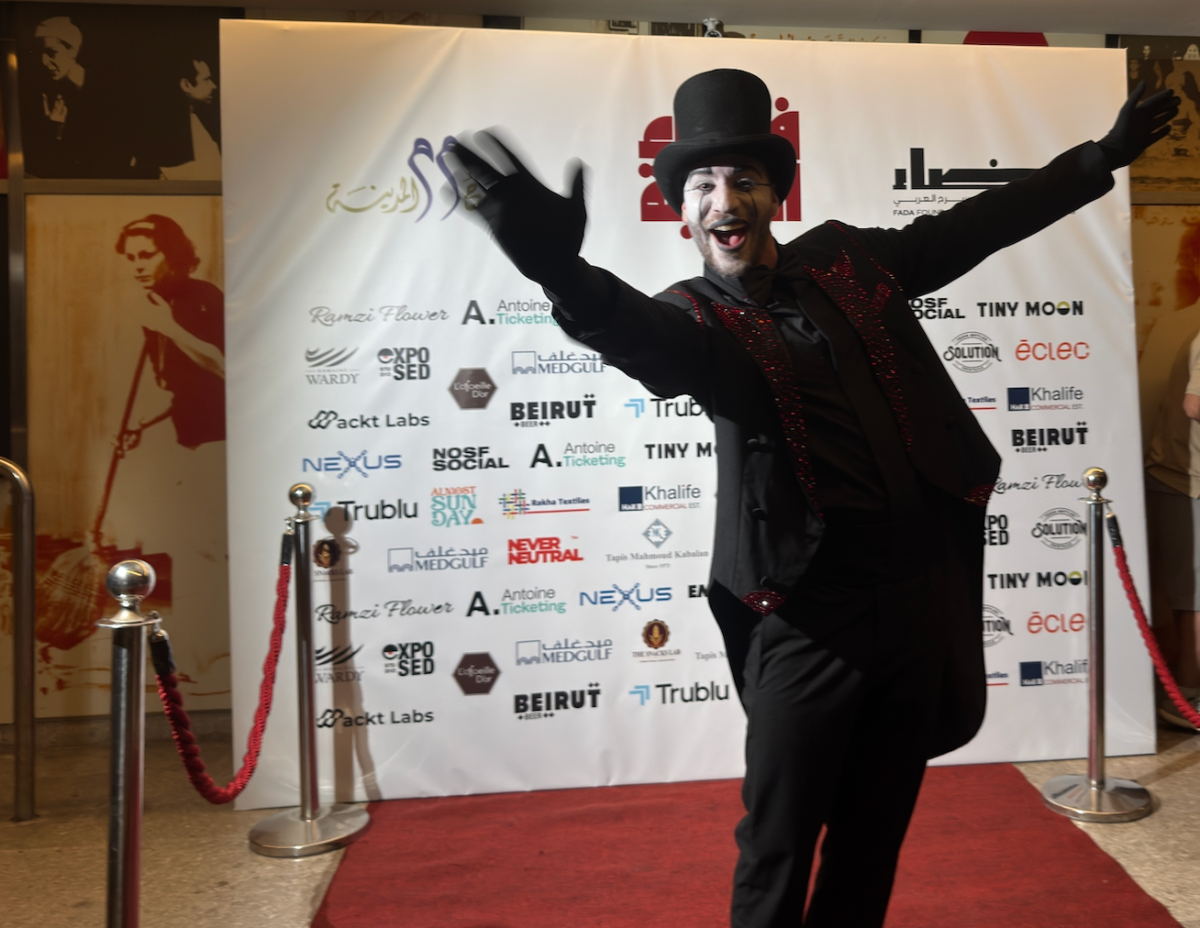
At the entrance of Fada al-Madina, a mime in a frock coat welcomes the guests at the inaugural evening. (Credit: Rayanne Tawil/L'Orient-Le Jour)






It seemed as if everyone had arranged to meet there. Comedians, musicians, humorists, influencers and theater lovers flocked to al-Madina Theater on the evening of Tuesday, Oct. 6, for the inauguration of Fada al-Madina, a new cultural space housed within its walls. Outside, a red carpet led guests to the entrance, where a mime posed with them for photos. Inside, the crowd grew, nearly blocking the view beyond the rows of spectators.
Titled Aal Marikh, ktashfna al-may (“On Mars, we discovered water”), the evening brought together a long list of artists who took the stage in turn to help finance the space.
Backed by the Foundation for Arab Dramatic Arts (FADA), Fada al-Madina will feature a 110-seat theater, a dedicated space for workshops and rehearsals, technical facilities, exhibition spaces, dressing rooms and a café. The goal is to offer artists, from recent graduates to established performers, a modestly sized venue at an affordable cost while embedding it in the cultural life of Hamra.
That night, the public was invited for the first time to be part of the adventure.
Fundraising takes the stage
The evening opened with a video by Bert Wakim, known as Bertillicious. With humor, she presented the project and underscored the need to support the new theater, encouraging donations without letting the laughter subside. The fundraising appeal was woven into the show, becoming a key part of the event. Actor Elie Mitri continued in the same vein, joking about the venue’s very practical needs, starting with air conditioning, a must on hot nights. The artists took the stage one after another, each finding their own way to ask the audience for a helping hand.
This gave the evening a unique rhythm: a joke, a performance, a reminder of how to contribute, then another joke. For $1,000, donors could sponsor one of the 110 seats and have their name inscribed on a plaque affixed to it. A $500 contribution option was also available, along with larger sponsorship packages. The crowd was invited to laugh, dance and, as the night went on, open their wallets.
'Culture is the Face ID of a country'
The curtains closed. A spotlight illuminated Tarek Tamim, who was immediately welcomed by applause and shouts of “Tarek! Tarek!” The actor began by pointing out the absence of a microphone. “Sorry if you can’t hear me: There’s no mic, but my voice carries well enough,” he said, before turning to a more personal subject: Hamra.
He recalled the neighborhood of his memories, its cafés, theaters and streets, everything that once made up a cultural life of rare density. The Horseshoe, the Piccadilly, the Hamra that shaped him. The names returned with the nostalgia of someone who has watched a familiar landscape change over decades. Gradually, these memories gave way to present-day challenges. Keeping a cultural space alive takes money, work and perseverance. Finding funds has become an essential part of this struggle.
Then this phrase echoed through the room: “Culture is the Face ID of a country.” On this inauguration night, Tamim was also talking about a city trying to remember what its cultural spaces had allowed it to experience.
The Fada al-Madina project is built on this same memory. Its presentation describes Hamra as Beirut’s former “intellectual and cultural heart,” making the new space an attempt to reconnect with that heritage.
A small stage for big ideas
Nidal al-Achkar, actress and founder of al-Madina Theater, which is currently celebrating its 33rd anniversary with a packed program, then took the stage to recall the institution’s history and place.
For Awad H. Awad, artistic director and general manager of Fada al-Madina, the new venue addresses a very concrete need.
“I mainly work with graduates and future students. We notice there’s always a need for small, affordable spaces where people can experiment and create without worrying about production constraints,” he told L’Orient-Le Jour.
Alongside the larger auditoriums of al-Madina Theater, the new space will offer artists the chance to work on a different scale. Aliya al-Khalidi, founder of FADA and adviser on university affairs and programming, also values its location in Hamra for personal reasons. She has seen the neighborhood change over decades. “I grew up in Hamra. I know its streets like my own home. And I’ve witnessed its decline over the years,” she said. To her, a theater can affect neighborhood life far beyond the shows it hosts.
“We think Hamra needs another theater to remain vibrant. Theater brings people together. It opens minds. It brings together musicians, artists, lighting designers and dancers. It creates a meeting place.”
Fada al-Madina aims to become a hub where theater, dance, music, workshops, exhibitions, film screenings, discussions and meetings with residents all have a place.
Welcome to Mars
Once the official speeches had finished, Aya Abi Haidar and Mariam Chouman appeared onstage in oversized, mismatched clothes, as if they had hurriedly grabbed whatever they could before leaving home. They had landed on Mars.
Playing Mirvat, Aya wore a loose floral outfit. Mariam, as Em Fadel, wore a hijab. Coming from different sectarian backgrounds, their characters were trying to find their footing in this new life on the red planet. The detour to Mars made it possible to talk about Lebanon, with references to the country’s political and economic situation woven into their exchanges. Forced displacement, confusion, survival and the absurdity of everyday life all featured in their dialogue.
Offstage, in the stairwell, an artist provided live sound effects. This do-it-yourself approach added to the charm of a show that made the most of its limited resources: Each sound effect offered a new excuse for laughter. The audience enjoyed watching the two women improvise their way through Mars, an improvisational art so familiar in Lebanon. Then the stars came down to the stage.
Dressed in white and gold, women crossed the darkness holding star-shaped objects before breaking into a dance to Ouli bhebbik. The dabke group Moulayiten joined them. The stage filled with movement, and Mars suddenly resembled a Lebanese spectacle.
The artists take turns
May Chehab then appeared in red, matching the evening’s theme, to take over as host. The actress improvised based on the audience’s reactions, the artists’ performances and the small happenings in front of her, setting the pace for transitions.
Manal Mallat followed with an emotional singing performance. Next, Noor Hajjar brought laughter back with his stand-up routine. Sandy Matar dedicated a song to Sabah. Mario Bassil’s familiar “Yallaaaa” was met with another round of laughter. Finally, George Tawil took the stage. Lebanese folk tunes filled the theater, and the audience began dancing in the aisles. Behind the singer, the musicians played with an energy that swept through the crowd, while traditional ululations rang out.
Soon, some audience members joined the artists onstage to dance with them. The crowd that had arrived on the red carpet was now mingling with those who had entertained them all night.
A second home
For Aliya al-Khalidi, this sense of belonging is at the heart of the project.
“Fada al-Madina is a dream come true. It’s our second home. This is what we wanted: a theater open to the community, a place where people feel safe, where you can have fun and experiment, and where the public can discover new ideas.”
Awad hopes everyone will feel that way as they walk through the door.
“I want them to feel at home. To feel like they’ve taken part in this adventure, this birth of a project.”
There is still much to be done. According to Awad, the initial fundraising drives will help pay for electrical work, bathrooms and painting. Al-Khalidi also lists bathrooms, ventilation, air conditioning and electrical installations among the most urgent needs.
The search for funds must continue as the team works toward a model that will eventually allow the space to support itself through productions, workshops, rentals, ticket sales and partnerships. On Tuesday night, though, the future theater had already seen its first full house. George Tawil was still singing. The audience joined him onstage, dancing alongside the musicians as the red lights of Mars bathed the crowd.
This article was originally published in French in L'Orient-Le Jour.

 7 p.m. recap: Houthis strike Riyadh airport again; Yemeni forces claim Bab al-Mandeb gains; Abbas postpones Palestinian polls