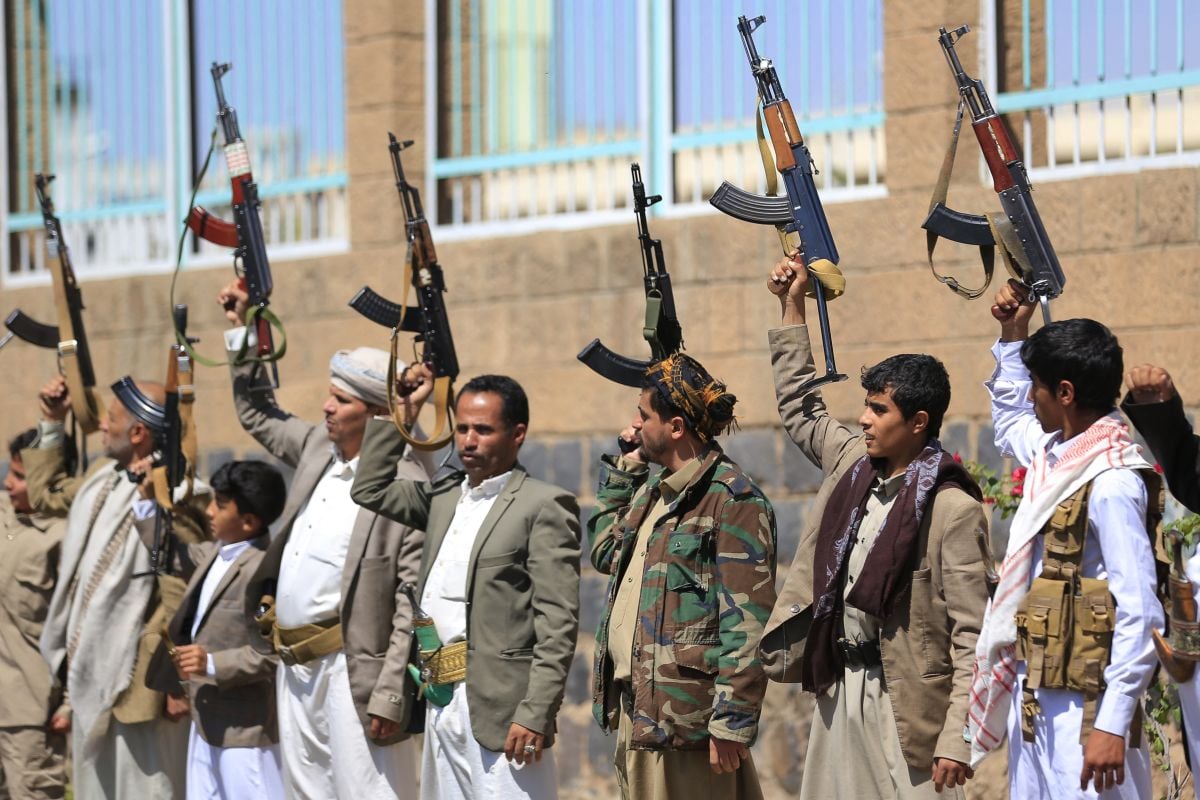
Fighters loyal to the Houthi authorities take part in a rally to recruit more fighters in Sanaa, on Oct. 7, 2026. (Credit: Mohammed Huwais/AFP)






The news of the day
Saudi aviation authorities reported on Friday that three people were killed by Houthi attacks on the capital’s airport a day earlier. The strikes hit airport facilities and a plane operated by national carrier Saudia. The airline said one of its pilots died in an "incident" at King Khalid International Airport.
Tensions continue to rise, and Riyadh does not appear ready to yield to the Houthis. A regional source told AFP that Saudi Arabia "excludes" any "cease-fire" as long as the Yemeni government forces it supports have not retaken territory recently seized by the Houthis, particularly around the Bab al-Mandeb Strait. According to the source, Saudi Arabia, which has sought assistance from several regional partners, also said it would not yield to their "military blackmail."
Why it matters
The renewed fighting between the Houthis and Saudi Arabia has become a major front in the regional war that began in late February, as tensions have escalated across the Middle East in recent weeks. Against this backdrop, the Iranian president reiterated that negotiations with Washington, which have stalled, can succeed only in the absence of "pressure and threats."
Riyadh’s refusal to agree to a truce with the Houthis raises the risk of a prolonged escalation in Yemen and Saudi Arabia. The situation could put pressure on the kingdom’s partners, particularly Syria and countries associated with the Mecca Alliance, Saudi Arabia, Pakistan and Turkey, to support Riyadh while weighing their own strategic interests.
Beyond the direct impact on Riyadh, which Iran has repeatedly targeted since late February, Houthi strikes and threats against Saudi oil facilities add further pressure to energy markets already strained by the closure of strategic shipping routes through the Strait of Hormuz and the Bab al-Mandeb Strait.
What to watch for
Will Lebanon find a solution to its electricity crisis? A meeting is scheduled for Friday to address the issue, which has fueled tensions within the government as increasingly severe power rationing disrupts daily life across Lebanon.
On Tuesday, Energy Minister Joe Saddi, who represents the Lebanese Forces in the Cabinet, announced that he would suspend his participation in Cabinet meetings to protest the lack of resources allocated to his ministry to address electricity shortages. On Wednesday, President Joseph Aoun and Prime Minister Nawaf Salam received Saddi to discuss the crisis, and the minister announced a special meeting for Friday.
On Thursday, Saddi skipped the Cabinet meeting at Baabda Presidential Palace and met with Nassib Nasr, the new chairman of the board of Electricite du Liban (EDL). They discussed the possible reactivation of the Zouk Mosbeh (Kesrouan) and Jiyyeh (South Lebanon) power plants. The two plants are currently offline but could provide 1.5 hours of electricity per day for six weeks.
According to press reports, Salam also responded favorably to Saddi’s request to settle part of government agencies’ outstanding payments to EDL. The payments would allow the utility to purchase fuel to operate its power plants.
Lebanon has long grappled with chronic power shortages, relying on costly, polluting private generators and successive temporary fixes, including years of renting power ships. The crisis has worsened recently as the war in the Middle East has driven up energy prices.
Elsewhere in the news
- Nobel Peace Prize awarded to South African jurist Navi Pillay. The Nobel Peace Prize has been awarded to Navi Pillay, 85, "for her efforts to promote peace and international law." Pillay chaired the U.N. Independent International Commission of Inquiry on the Occupied Palestinian Territory, including East Jerusalem, and Israel, which accused Israel of committing genocide in the Gaza Strip. "This year’s laureate played a crucial role in ensuring that war crimes, crimes against humanity and genocide were prosecuted," the Nobel Committee said, praising her "exceptional courage" and "integrity."
- Nearly all of Gaza’s population lacks adequate shelter ahead of winter. Almost 2 million people in Gaza still lack proper shelter, the U.N. warned, calling for greater access for humanitarian aid.
- Israeli general killed in accident in South Lebanon. The Israeli army announced Thursday evening that a general had died in an "operational accident" in Israeli-occupied south Lebanon. Media reports said he died when his Humvee overturned in a traffic accident. Three other soldiers were injured. Meanwhile, Israeli forces continued strikes and artillery shelling across several areas of the occupied zone, according to our correspondent in the South. An Israeli force also advanced toward the "pilot zone" in Zawtar Gharbieh.