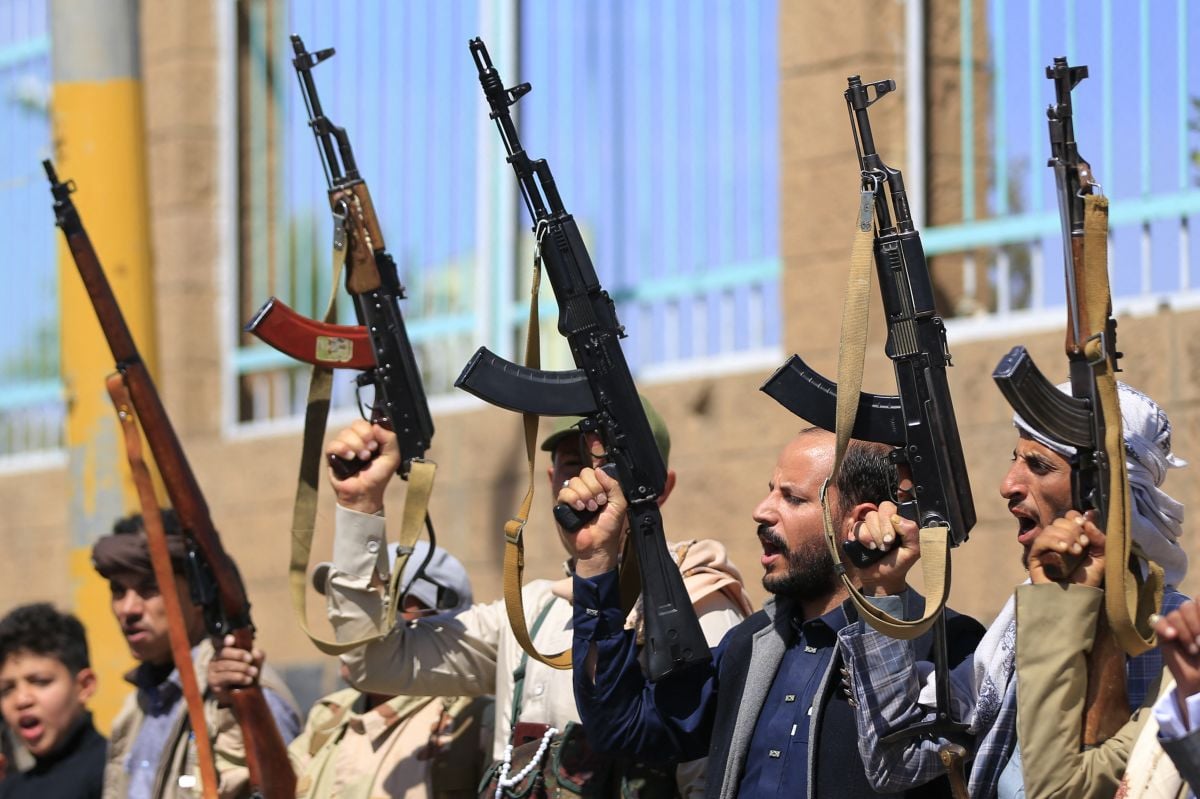
Fighters loyal to the Houthi authorities take part in a rally aimed at recruiting new fighters, in Sanaa, on Oct. 7, 2026. (Credit: Mohammed Huwais/AFP)






Top story
Saudi Arabia experienced one of its most violent episodes on Thursday since the start of the war in the Middle East: Houthi missiles repeatedly targeted Riyadh and its international airport, while debris from the interception of a ballistic missile caused damage to a kindergarten and a medical complex, with no casualties reported. Diplomats and students from international schools were sheltered, and several flights were postponed or canceled. The Yemeni rebels also called on staff at Saudi oil facilities to leave the premises, while fighting continued in Yemen, where more than 200,000 people have been displaced since hostilities resumed.
Why it matters
Yemen has become one of the main fronts of the regional war, while direct fighting between Washington and Tehran has largely subsided. Backed by Iran, the Houthis are now directly confronting Yemeni government forces supported by Riyadh and are seeking to put pressure on Saudi Arabia, especially on its energy and airport infrastructure. Their strengthened control of the Red Sea coast and the Bab al-Mandeb strait, a strategic passage between Asia and Europe via the Suez Canal, gives this confrontation a scope that goes far beyond Yemen. For Riyadh, the stakes are both security-related, energetic, and commercial, as Saudi Arabia tries to regain control over its southern neighbor while avoiding an expansion of the conflict onto its own territory.
What to watch
- "Look at what Hezbollah is doing to us": the anger of a resident of Haret Hreik after his kiosk was removed. A resident of Beirut's southern suburb accused Hezbollah of destroying his livelihood and home after his kiosk was removed by the Haret Hreik municipality. "We sacrificed for Hezbollah. I lost my livelihood and my home," he says in a video posted on social media. The municipality denied any political involvement, stating that the kiosk had been set up on public land and was removed after several complaints from local residents. They specified that no political party or figure was involved in the operation.
- Israel opens a defense pavilion in Morocco for the first time. The Israeli Defense Ministry announced the opening of a national pavilion at the Marrakech Airshow, a first in Morocco and another sign of warming ties between the two countries. Israel and Morocco, who normalized relations in December 2020 under the Abraham Accords, are also set to open their respective embassies soon. This cooperation, notably in military and security matters, comes as pro-Palestinian demonstrations were held again this week in Rabat to protest normalization with Israel.
In other news
- Framework agreement: Salam reiterates the need for a timeline and verification mechanism. Prime Minister Nawaf Salam welcomed U.S. Republican Senator James Lankford, along with the U.S. ambassador to Beirut, Michel Issa. Discussions focused in particular on the situation in the South and the implementation of the framework agreement between Israel and Lebanon. Salam stressed the need for a clear timetable for reciprocal commitments and for a mechanism to verify their implementation. He also called for continuing U.S. support for the Lebanese Army, as well as for support for the return of residents, the recovery, and reconstruction of areas affected by war.
- Zouk and Jiyeh could provide an additional 1.5 hours of electricity for a month and a half. Energy Minister Joe Saddi received the head of Électricité du Liban (EDL), Nassib Nasr, who informed him of ongoing efforts to restart the Zouk and Jiyeh power plants. Their restart would provide about an hour and a half of additional electricity for a month and a half, given the fuel supplies currently available.
- Lebanese University: government reappoints Bassam Badran despite objections. On Thursday, the Council of Ministers renewed Bassam Badran's term as president of the Lebanese University, despite objections from several members of parliament who denounced the possible renewal and cited a Constitutional Council decision invalidating any extension of his mandate. MPs Michel Douaihy, Waddah Sadek, and Mark Dao called for "an end to political compromises and clientelism," while Halima Kaakour said a new appointment would harm "the law, governance, and reforms."
- Hezbollah announces new aid to the displaced. A day after Reuters revealed a $200 million transfer from Iran to Hezbollah (an allegation denied by Washington), intended in part to support Lebanese displaced by the war, the Loyalty to the Resistance parliamentary bloc said the party-militia "is about to implement a new phase for providing housing aid to displaced persons." In a statement, they did not specify the amount of aid or its source of funding.
- In Syria, certain majors now banned for female students. A decision by Syria's Education Ministry to ban certain majors for female students has sparked fierce criticism in the country, with some denouncing further restrictions by Islamist authorities on women’s rights. At the National Defense Science University, legal and social sciences, management, and economics, among others, are now reserved for male students only. In Idlib, women are no longer admitted into TV and radio production programs.