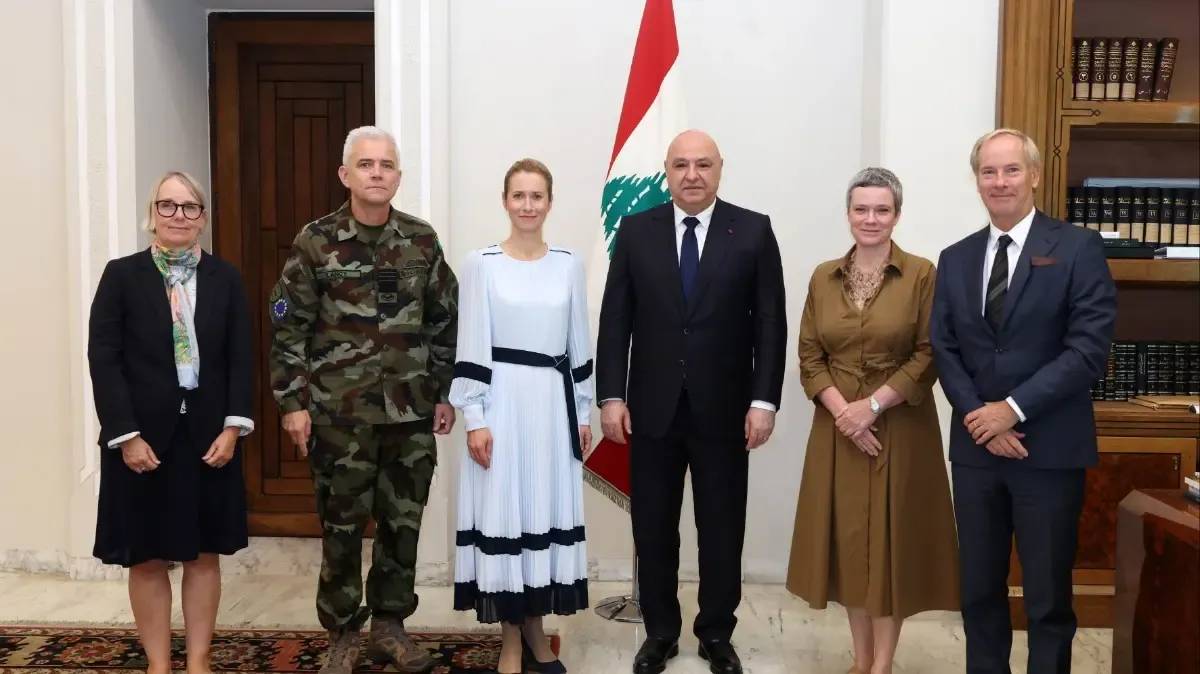
President Joseph Aoun poses alongside the EU's chief diplomat, Kaja Kallas, and the delegation accompanying her. (Credit: NNA)






While receiving European Union chief diplomat Kaja Kallas on Thursday, President Joseph Aoun and Parliament Speaker Nabih Berri stressed the need to find an alternative to the United Nations Interim Force in Lebanon (UNIFIL), whose mandate expires at the end of 2026, amid ongoing Israeli occupation and daily Israeli attacks on the South.
Kallas later Thursday called for extending the U.N. peacekeeping force’s mandate.
In recent weeks, Aoun and Prime Minister Nawaf Salam have warned of the risk of a "security vacuum" in south Lebanon after UNIFIL’s departure. Under U.S. pressure, the U.N. Security Council decided in August 2025 to end the force’s mandate on Dec. 31, 2026. In recent days, a majority of MPs have called for maintaining the U.N. force in the South, where Israel continues to carry out daily attacks and occupies an area estimated at more than 600 square kilometers.
Aoun on Thursday praised "the efforts made by the European Union (EU) to avoid a vacuum after UNIFIL," while specifying that Lebanon wants "any deployed force to operate under the banner of the United Nations." He thanked Kallas for the EU "moving toward approving the deployment of a civilian and military mission to Lebanon, tasked with providing advice, training, and equipment."
Kallas, in turn, expressed the EU’s "readiness to provide Lebanon with the necessary assistance," including support for the army and civil society organizations. In early September, she announced plans to launch a training mission for the Lebanese Army in the coming months, although the mission would not replace the current U.N. force.
Asked later Thursday by AFP, Kallas said the EU favors extending the peacekeepers’ mandate despite the Security Council’s decision. "There can be no security vacuum in southern Lebanon, and so everyone is worried about the end of UNIFIL’s mandate," she said, adding that an extension "would be extremely welcome."
Diplomacy as an 'alternative'
Discussing the "framework agreement" signed between Lebanon and Israel on June 26 in Washington, Aoun said the document "reflects Lebanon’s conviction that the diplomatic negotiating path is an alternative to war." The president called on the international community to "put pressure on Israel to respect this agreement," insisting that Israel "will not achieve its goals" through war.
"The Lebanese Army is fully carrying out its mission in the zones where it is deployed south of the Litani, in accordance with the framework agreement," Aoun added.
An Israeli military source, however, accused the army Wednesday of being "infiltrated" and failing to carry out its mission of disarming Hezbollah in the "pilot zones." The framework agreement provides for the Lebanese Army to deploy in these sectors and dismantle Hezbollah’s infrastructure, while Israeli forces must withdraw from them.
The first such zone was established in Zawtar Gharbieh (Nabatieh), a village that Israel had not occupied.
Kallas also met with Berri and was expected to meet Foreign Minister Joe Rajji. After their meeting, Berri reiterated his warning about "the consequences of ending UNIFIL’s mandate without finding an alternative under the auspices of the U.N."
He said such a "serious mistake would undermine international legitimacy and U.N. resolutions, including Resolution 1701, while negatively affecting the European Union and its role."
Later Thursday, Kallas visited the port of Beirut in the presence of EU Ambassador Sandra De Waele and the chairman of the EU Military Committee, Sean Clancy. She met with Beirut Port Chairman and General Manager Marwan Naffi, as "part of the EU’s support for the port’s role in Lebanon’s maritime security strategy," according to a statement released after the visit.
Naffi and Kallas toured the container terminal and reviewed operations and procedures related to security and safety.
Naffi said Kallas’ visit "is evidence of the pivotal position held by Beirut port," noting the EU’s support for the port, particularly on security and safety. He said the visit also underscored the port’s importance to Lebanon’s economy and the region, describing it as the "gateway to the East."
Naffi said the "progress made at the port in security and safety resulted from measures and procedures that had been adopted," adding that "work would continue to develop them and maintain the standards that have brought the port to its current level."