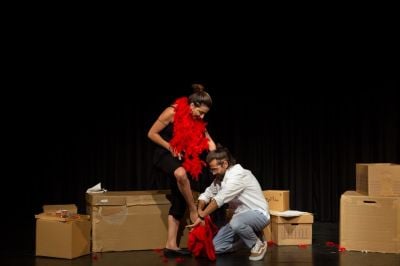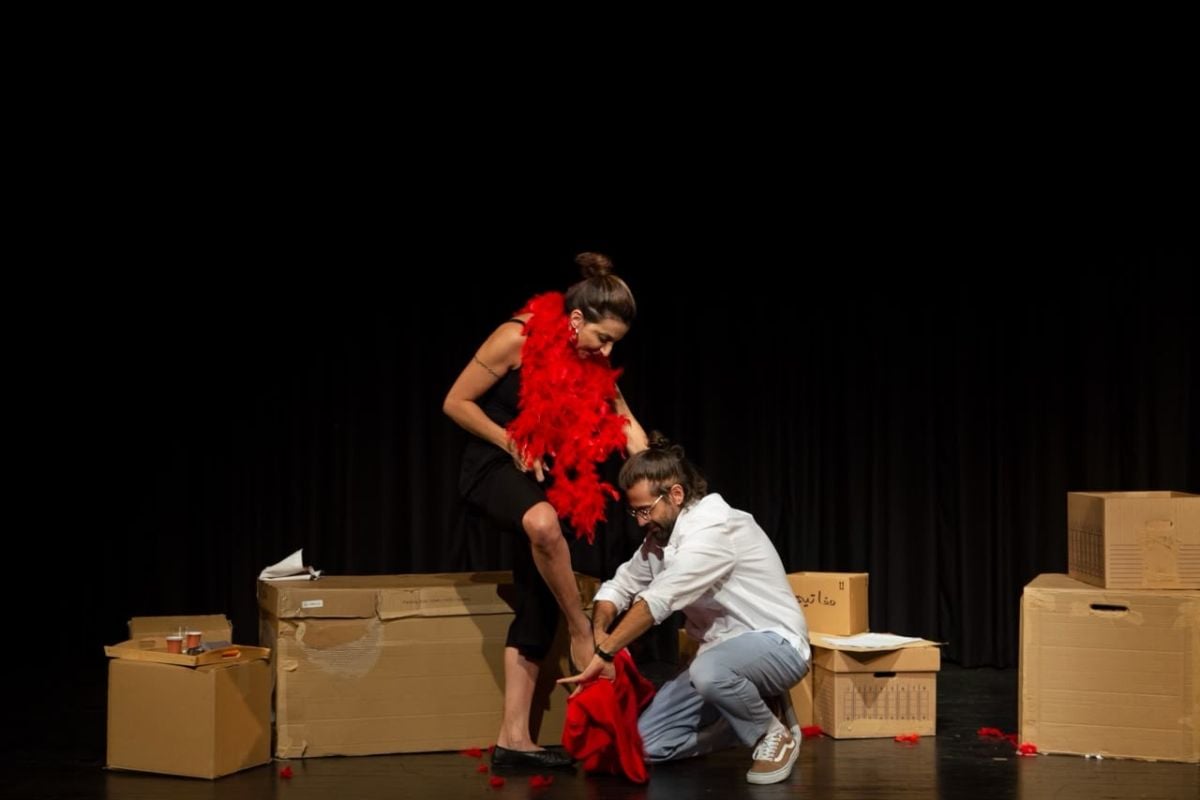
Zeina Daccache and Karim Chebli during their play "Zeina Put on Her Anklet" at the Monnot Theater. (Credit: Dalia Khamissy)






Certain losses outlive their burial. They settle in the body, tighten the throat, and weigh on the stomach. They nestle in old clothes, photographs, cherished documents, and words left unsaid. We think we have tamed them, until a smell, an object or a name brings back their sting.
It is in this in-between, where the absent continue to inhabit the living, that "Zeina lebset khelkhala" ("Zeina Put on Her Anklet"), by Zeina Daccache and Karim Chebli, unfolds. Rooted first in a deeply intimate family story, the show gradually widens its horizon: Mourning meets the weight of tradition, male authority, and the comedy of appearances that follows us even in death.
After putting onstage the stories of prisoners and marginalized people, notably in "Twelve Angry Lebanese" and "Scheherazade," Daccache this time turns her gaze inward. Her story, her body, and her memory become the material of the theater. With Chebli, she explores its wounds, but also its tender and absurd sides.
At first, however, the two artists want to create a musical and dance show, break free from family and community ties and find their own path between folklore and Broadway models. But preparations go off track. The trunks open, memories spill out, and the past demands a place onstage.

From the trunks emerge characters, songs, secrets, laughter and tears. A box opens: Here is the father. A paper appears: Here is the death notice, the funeral, the bankbook. The latter tells another story of dispossession: The savings of a well-off notary, swallowed up by the financial crisis. The father, who died after the crisis began in 2019, left behind a family that can no longer afford to care for their sick mother.
A few colorful clothes, feathers, and accessories complete this set of boxes. The objects carry the weight of the lives they have passed through. The house Zeina sells after her father’s death survives in its remnants of papers, clothes, debt, jokes, love, habits, and little lies. As these reappear, an entire family, a village and a society come back to life.
A father without a halo
The father’s mourning is at the center of the performance. Behind it looms the older loss of a brother, who died in childhood, at an age when initial attachments are formed, and pain leaves a lasting mark.
Daccache does not draw the edifying portrait of her father that death so often inspires in Lebanon. She restores his contradictions, moods, relationships, and overwhelming presence. Above all, she recalls his refusal to acknowledge her femininity. For him, she was "the sister of men," a nickname repeated by those around her, as if he could not bring himself to have a daughter.
This is where the show finds much of its authenticity. Saying goodbye becomes possible when you remember a person in all their complexity: tender and authoritarian, loved and disconcerting, funny and sometimes hurtful. Affection remains without erasing what he made his family endure.
The brother’s death opens a different wound. Added to his disappearance was the family’s silence by hiding him, keeping the child at a distance for protection, in the hope that the absence would hurt less if it was never named. But what is left unsaid continues to work through the body and memory.
The play gives the brother a place long denied in the family narrative. It reminds us that he lived and belongs to this story. Onstage, this intimate memory becomes shared, welcomed by the audience. Their tears reveal how much this story echoes their own.
Laughter, constantly elicited by the quick wit and agility of both actors, sometimes leaves the audience defenseless before emotion. Some leave the theater with misty eyes, touched in wounds they thought were buried. It recalls the therapeutic dimension of Daccache’s work. The performance creates a space where personal pain can be recognized by others.

Two actors, an entire family
"Zeina Put on Her Anklet" is autobiographical theater and a self-revelatory performance, making the performer’s experience the substance of the show. This kind of approach can risk collapsing into mere confession. Daccache avoids this pitfall by giving her story immediately familiar faces.
We know them: Those visitors who pay condolences with an inappropriate anecdote, those relatives more concerned with the death notice than the deceased, those curious about the inheritance, or who suddenly become masters of ceremony. We are also familiar with the scrutiny of women. How do they sit? What do they wear? Have they cried enough? Is it permissible for them to enjoy life again so soon?
With just two actors and a stripped-down set, the performance populates the stage with a crowd. The father, mother, secretary, mistress, the tenant linked to the prostitution scene, relatives, and villagers pass from one body to another with remarkable ease. A voice, a stance, or a glance is enough to bring someone to life.
The rapport between Daccache and Chebli gives these transformations their fluidity. In seconds, each changes gender, age, or place in the narrative, switching from witness to protagonist. This fluidity matches the shifting of memories. Faces overlap, one voice summons another, and a gesture brings back someone gone for decades.

The comedy of condolences
Black humor is one of the show’s strongest assets. Daccache and Chebli find abundant comedic material in Lebanese funeral rituals. Laughter arises in the midst of mourning, then almost unintentionally leads us to pain. This oscillation feels right because it mirrors the experience of loss. A joke by the departed may make us laugh between sobs; a scene that was once painful may turn into an anecdote we like to tell. The sorrow changes shape without completely disappearing.
Through these scenes, Daccache delivers a biting critique of Lebanese society, patriarchy, and the weight of its conventions. The banking crisis also cuts through the narrative. The show denounces the alliance between banks and the powerful that has stolen depositors’ savings, leaving once-comfortable citizens without even the means to seek health care.
Amid these constraints, a woman tries to untangle what she has chosen from what her family and society chose for her. The father becomes more than a beloved figure to mourn. He embodies authority, values, and conceptions of gender relations that continue to act after his death.
The maturity of the performance lies in its ability to face this legacy without giving up on love. The daughter can love her father and still recognize the limits he imposed. She can give him a place without letting him take up all the space.
The chime of freedom
The anklet symbolically captures this act of reclaiming. A small piece of jewelry linked to the body, femininity and dance, it accompanies the movement of the woman wearing it with its sound. When Zeina puts it on, she finds again a body long defined by duties as daughter, sister, keeper of family history, and artist devoted to others’ pain.
What does she desire for herself? After carrying her family’s dead and supporting so many prisoners and oppressed people, what space can she give to her own happiness?
Dance offers a fragile but vital answer. It allows her to move on with the departed once their memory has been restored to its rightful place. Mourning that consumes all existence eventually becomes a prison. Memory can also clear a path.
This final movement opens a new perspective for Daccache. The artist, who first gained recognition in comedy shows such as "Bas mat watan," has since devoted much of her work to prisons, trauma, and life on the margins. Can she now make joy and lightness a full-fledged theatrical subject? Will dance give her a new creative space?
The play leaves that question open. The anklet chimes; the body moves again. The past remains, but its weight shifts. The dead can finally walk alongside the living without blocking their way.
At Monnot Theater, Oct. 7, 8, 9, 10, 14, 15, 16, and 21, at 8:30 p.m.