


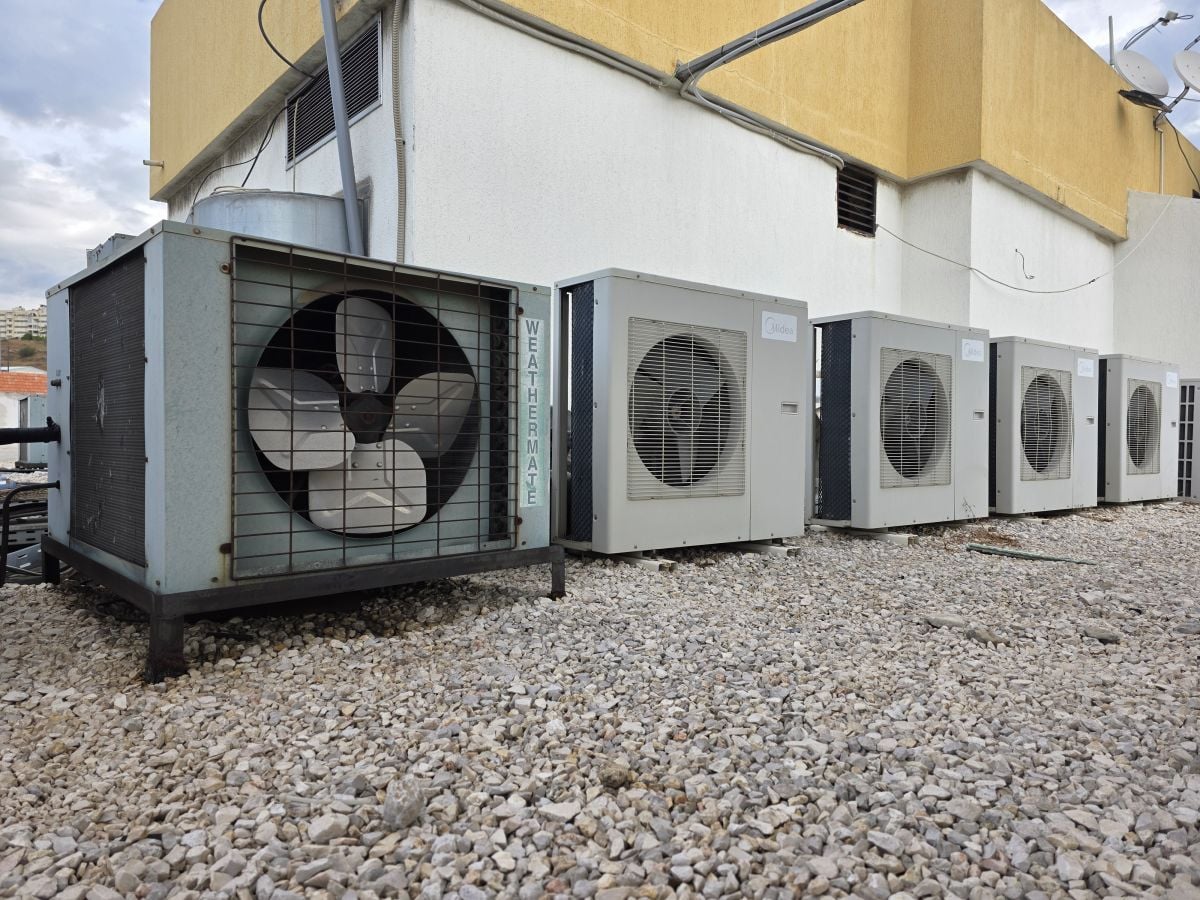
Air conditioners installed on the roof of a business in the suburbs of Beirut, Oct. 2, 2026. (Credit: L’Orient-Le Jour)






In Lebanon, air conditioning and refrigeration account for 26 percent of energy consumption. Environment Minister Tamara Elzein announced the figure Thursday during a ceremony awarding honorary certificates to technicians in the field. According to the minister, improving the efficiency of these systems should be a national priority because of their environmental impact, particularly in a country that struggles to produce enough electricity and has relied for decades on polluting private generators.
Elie Mansour, project manager of the National Ozone Unit (NOU), managed by the United Nations Development Programme (UNDP) at the Environment Ministry, commented on the figure for L’Orient-Le Jour.
According to Mansour, “This figure ... comes from modeling work carried out as part of Lebanon’s National Cooling Action Plan [NCAP 2026], led by the NOU,” based on methodologies that comply with international standards. The estimates presented are based on studies conducted between 2018 and 2024.
“For 2024, the NCAP estimates that the refrigeration and cooling sectors consumed about 6.0 to 6.2 TWh [terawatt-hours, with each equaling 1 billion kilowatt-hours, Ed.] of electricity, or about a quarter of national electricity consumption, which leads to the reference value of 26 percent,” he explained.
The study took into account numerous factors, including import and sales data for air conditioning and refrigeration equipment, the technical characteristics of devices, such as power, energy efficiency and lifespan, Lebanese climate conditions, and usage habits observed in households, businesses and industries.
Asked which activities are included in this sector, Mansour cited air conditioning in homes, offices, shops, hotels, hospitals and government offices; domestic refrigerators and commercial refrigeration; cold-storage warehouses and industrial facilities; and the cold chain for food and medical products.
Lebanon, not an isolated case
According to Mansour, “Lebanon is not an isolated case.” He explained that “in many hot or Mediterranean countries, cooling already represents a very significant share of electricity consumption. Analyses from the International Energy Agency show that the Middle East and North Africa region is among the areas where cooling demand is growing the fastest in the world.”
In Lebanon, several factors explain this high rate of energy consumption. The expert cited climate conditions, with increasingly hot and lengthy summers. High urbanization is also a significant factor: Major cities, especially Beirut, experience an urban heat island effect that raises perceived temperatures and increases the need for air conditioning.
Moreover, a significant portion of buildings was constructed before modern thermal insulation standards were introduced. Finally, equipment efficiency remains an issue.
“The NCAP still identifies a significant gap between the average efficiency of equipment currently used in Lebanon and the best technologies available internationally,” Mansour said.
This increased energy consumption has an environmental cost. The cooling sector produces indirect emissions linked to its energy consumption. It is also responsible for direct emissions related to refrigerants, chemical or natural compounds that circulate in closed circuits in air conditioning, refrigeration and heat pump systems.
When these fluids leak during the use or maintenance of equipment, they result in significant emissions because “they have a global warming potential several hundred or even thousands of times greater than that of CO2.”
According to Mansour, “the NCAP estimates that Lebanon’s cooling sector generates about 8.2 million tons of CO2 equivalent per year, with nearly 77 percent coming from energy consumption and around 23 pe from refrigerant emissions.”
Raising consumer awareness
This energy consumption from the cooling sector is not inevitable.
“Lebanon plans to gradually introduce minimum standards to remove the least energy-efficient air conditioners and refrigerators from the market,” Mansour said. It will also be necessary to promote cooling powered by solar energy, “since Lebanon has exceptional potential with nearly 300 days of sunshine per year.”
To achieve emissions-reduction goals, it will also be crucial to improve the thermal efficiency of buildings, particularly through roof insulation, high-performance glazing and natural ventilation. Consumers must also be educated about maintaining their equipment.
''According to NCAP projections, implementing these measures could save about 1,220 GWh of electricity annually by 2035, which represents a reduction of nearly 15 percent in sector consumption, while preventing about 0.85 million tons of CO2 equivalent per year,'' Mansour concluded.
This article first appeared in French in L'Orient-Le Jour.
 Israeli army carries out demolition at Jabal Amel School in Houla as strikes continue