





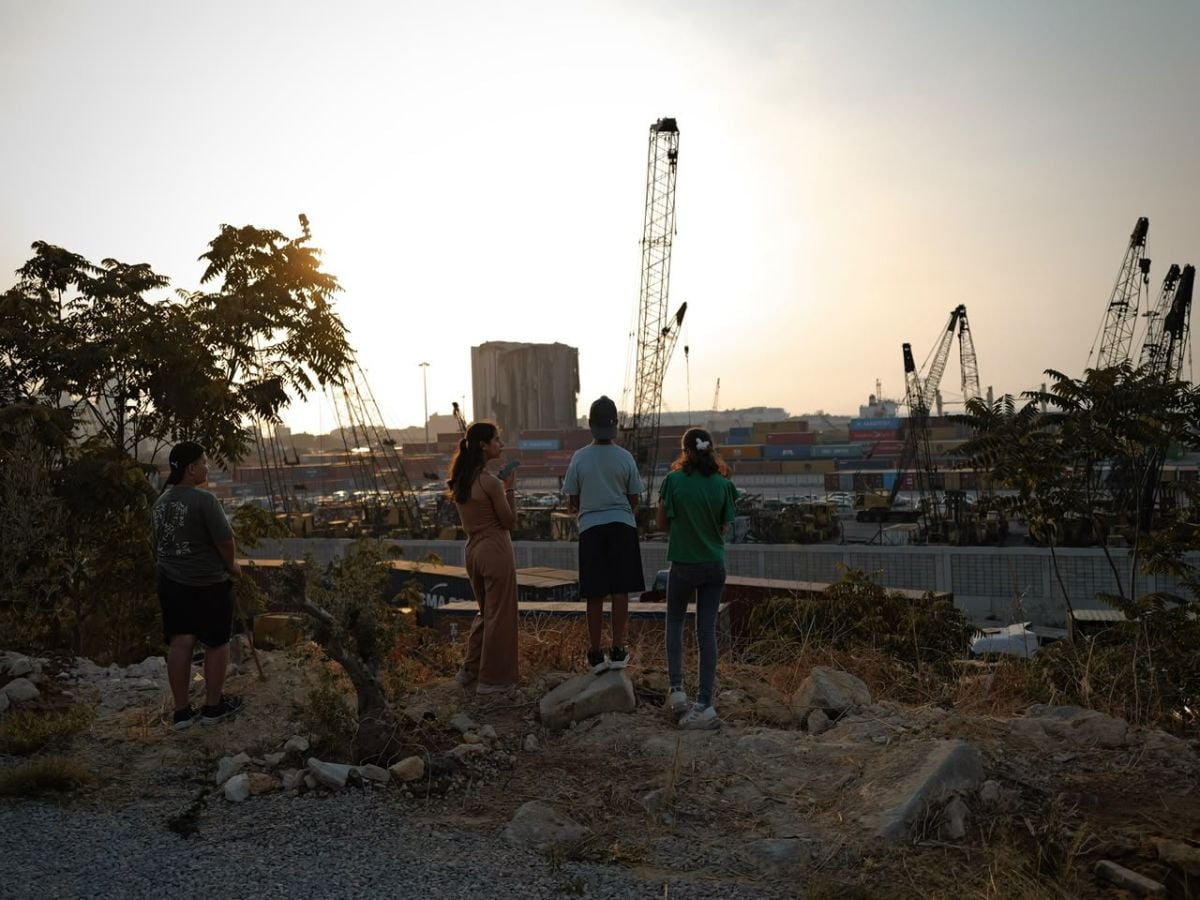
View of the Beirut Port and its shattered silos on Aug. 4, 2026. (Credit: Matthieu Karam/L'Orient-Le Jour)






BEIRUT — Justice Minister Adel Nassar stated on Wednesday that the investigation into the Aug. 4 Beirut Port explosion was "on track" and that an indictment was “expected before the end of the year,” during a press conference in which he also addressed the issue of Hezbollah’s disarmament.
The announcement came after Tarek Bitar, the investigating judge at the Court of Justice, had received the closing submission from the Public Prosecutor’s Office at the Court of Cassation two weeks ago, in a case in which the victims’ families and the Lebanese public have been waiting since 2020 for justice. This all against a backdrop of multiple appeals, twists and turns, and pressure from the officials implicated.
Investigating Judge Tarek Bitar concluded his investigation on March 30 and referred the file to the Court of Cassation’s public prosecution for its legal opinion. In September, Court of Cassation prosecutor Mohammad Saab completed the prosecution’s submission and handed it to Bitar on Sept. 15.
Nassar had previously said on Aug. 4 that the Court of Cassation prosecutor’s office was expected to complete its review within 60 to 90 days. The prosecutor’s submission is not binding on Bitar, who retains full discretion in assessing the case. The indictment he issues will then be referred to the Justice Council for trial proceedings to begin.
Additionally, Nassar thanked President Joseph Aoun and Prime Minister Nawaf Salam for not intervening in the judicial appointments. The Supreme Judicial Council unanimously approved judicial transfers on Sept. 22, filling around 60 vacant posts in courts and public prosecution offices across Lebanon. Nassar said at the time that the appointments had “never been this far removed from political interference.
He said the productivity of Lebanon’s judiciary had “increased by 200%,” adding that all commercial registry files in Baabda had been processed and archived. “Work is also underway to digitize commercial registries across Lebanon,” he said.
Nassar praised the judicial appointments, saying there had been no political interference and that the Higher Judicial Council had carried out its role. He added that there were no longer vacancies in any public prosecution offices in Beirut or Mount Lebanon.
Disarming Hezbollah ‘with as little damage as possible’
Furthermore, Nassar stated that the disarmament of Hezbollah “will take place.” “This matter has been settled," while warning that time was running out to carry out the process with as little damage as possible. Nassar represents the anti-Hezbollah Kataeb party’s quota in the government.
The government’s push to establish a state monopoly over weapons is part of a framework agreement reached between Lebanon and Israel in June, which calls for the gradual Israeli withdrawal from Lebanon in parallel with Hezbollah’s disarmament. Implementation of the agreement has stalled, with the next round of Lebanon-Israel negotiations expected to take place in October.
Nassar said generations of Lebanese from different regions and political affiliations had seen nothing from Hezbollah’s weapons over the past 27 years “but reckless adventures, blood, and destruction,” adding that there was “a long list of disasters” linked to the weapons.
“If the goal is to prevent the building of the state and obstruct negotiations, at a time when they are the means to recover the land and stop the attacks, then this is a disaster,” Nassar said. “And if the goal is to retain the means to support Tehran again at the expense of the country and the people, then this is an even greater disaster.”
“This weapon obstructs state-building, the recovery of the land and reconstruction,” he added. Nassar also rejected claims that handing over Hezbollah’s weapons would amount to a blow against Lebanon’s Shiite community.
“Turning to the state, building it, protecting society, liberating the land and ensuring the security of society is a project for all Lebanese, and above all to guarantee the protection of the people of the South, the Bekaa, and the southern suburbs, in all their components and affiliations,” he said.
He also said Lebanon could not remain under the threat of a potential new war between Iran and the United States.

 7 p.m. recap: Iran warns Egypt, Israeli soldiers vote in south Lebanon, Haret Hreik responds to Kataeb