





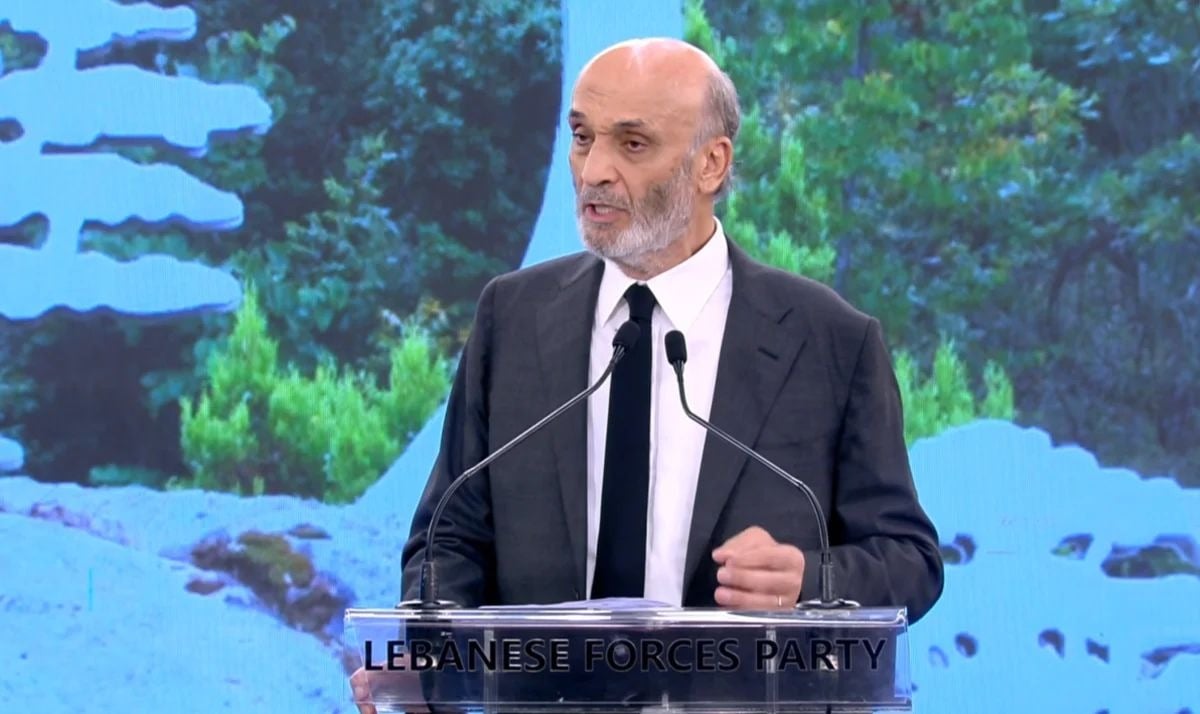
The leader of the LF, Samir Geagea, during his speech on Sept. 6, 2026. (Credit: Screenshot)






BEIRUT — Lebanese Forces (LF) leader Samir Geagea said Sunday that "it is impossible to imagine a dignified life as long as Hezbollah’s weapons remain," insisting that "it is the state’s responsibility to defend its people." "Without this, it would be the end of Lebanon," he warned.
"The struggle will continue by peaceful means in order to achieve the goals for which the martyrs sacrificed themselves and to have a country where we can fully live as citizens," he said. "We have started to take the right path, the one leading to the country of our dreams. Now it remains to speed up implementation, and we are constantly exerting pressure to achieve this," he added.
The comments come as the Lebanese state faces international pressure to extend its authority across the entire country and disarm militias, notably Hezbollah, which is allied with Iran
Returning to the issue of the Shiite group's weapons, Geagea stressed the state's responsibility for national defense. "It is the state's responsibility to defend its people," he said, adding that "without this, it would be the end of Lebanon." "It is impossible to imagine a dignified life as long as the weapons of Hezbollah are still there," he added.
Kabalan urges Aoun 'not to let Lebanon devour itself'
For Jaafari Mufti Ahmad Kabalan, a religious figure close to Hezbollah, "the debate is not about choosing between the state and the resistance, but about determining what is necessary for national defense in the face of the most dangerous Zionist war targeting the very existence of Lebanon."
According to Kabalan, "the resistance fulfills a defensive role born from the state's relinquishing the protection of the South." He argued that "resisting Israel and preventing civil war are two issues linked to the protection of Lebanon and its unity," and that "the security of Beirut should not be separated from that of the borders."
Kabalan also addressed President Joseph Aoun, calling on him "not to let Lebanon devour itself." "We must prevent external and internal crises from becoming a mechanism of self-destruction," he said, emphasizing that "the South is the concern of all Lebanon." "An abandoned South means an abandoned Lebanon, a threatened South means all of Lebanon is threatened, and a weakened South means the entire Lebanese state is weakened," he said.
Meanwhile, Geagea reiterated his support for the general amnesty law, saying that “there have been many injustices in Lebanon ... and that some people have been victims of injustice simply because they supported the Syrian revolution.”
Parliament passed the law on Aug. 12, and President Aoun enacted it on Sept. 4. It was suspended on Sept. 10 by the Constitutional Council after the Free Patriotic Movement (FPM), which opposes the release of Islamist detainees accused of killing Lebanese Army soldiers, filed a challenge seeking to have it declared invalid.
Proposed for several years, the legislation was adopted as part of a compromise among various sectarian and political groups. It has faced strong opposition from many criminal-law judges, who view it as a factor contributing to impunity.
According to a parliamentary source, the law was intended to pave the way for the release of around 2,000 detainees prosecuted for various offenses in the first phase of its implementation.

 7 p.m. recap: Iran warns Egypt, Israeli soldiers vote in south Lebanon, Haret Hreik responds to Kataeb