






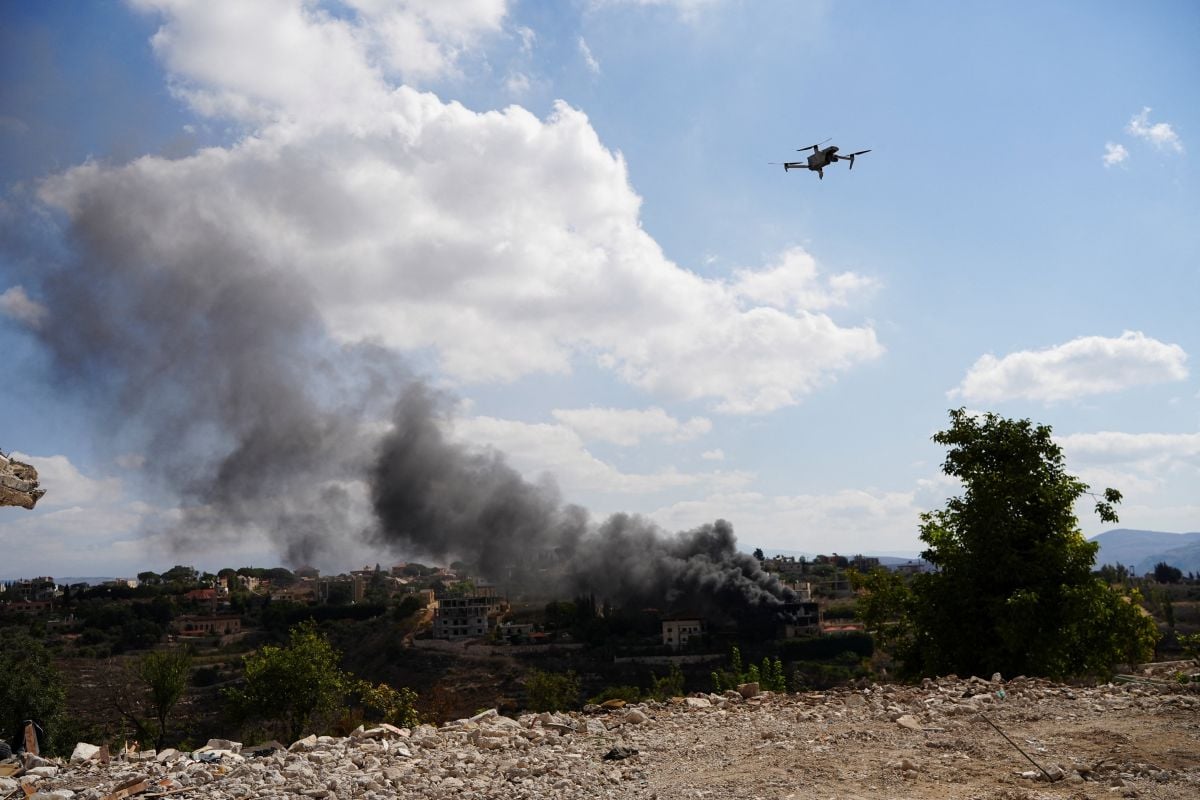
Smoke rises over Zawar Sharqieh whilst an Israeli drone flies over the neighboring town of Zawtar Gharbieh in southern Lebanon on Sept. 22, 2026. (Stringer/Reuters)






BEIRUT — Whilst Israeli attacks continued throughout Friday across occupied southern Lebanon, the U.S. Ambassador to Lebanon, Michel Issa, stated that “Hezbollah handing over its weapons would pave the way for peace,” adding that “opportunities are being lost as long as the party continues to hold onto them."
These statements come against a backdrop of persistent tensions surrounding the implementation of the framework agreement concluded on June 26 between Beirut and Israel under U.S. auspices. The agreement provides for a gradual withdrawal of Israeli forces from the territories they occupy in southern Lebanon, alongside the deployment of the Lebanese Army, which is tasked in particular with disarming Hezbollah.
In an interview with the local channel MTV, Issa also stated that “if the weapons are withdrawn and Israel withdraws, there will no longer be any need for the United Nations Interim Force in Lebanon [UNIFIL]." UNIFIL’s mandate is due to end at the end of the year, whilst the Lebanese authorities fear the emergence of a "security vacuum" in the South.
These statements come as Israeli bombings and air strikes continue against several villages, dozens of which have been razed to the ground, whilst Israeli troops still occupy an area of over 600 km² in southern Lebanon. The Israeli press has also reported a possible reduction in troop numbers in the "buffer zone" in southern Lebanon, with several special forces brigades being demobiliZed and replaced by regular units, and a reduction in the "zone" of occupation. Israel’s Channel 12, for its part, reported on Friday that a "reorganization" of the Israeli deployment in southern Lebanon is underway, involving, in particular, the construction of "new fortified positions in occupied territory," where troops already have several bases.
Strikes, artillery fire, military vehicles
On the ground, today's attacks followed an unusual night of relative calm, with no air strikes or bombing reported in southern Lebanon. Artillery and machine-gun fire, however, continued to target several areas. A resident of Qleileh noted the absence of overnight blasts "for the first time since June." The village lies a few kilometers north of Mansouri, which borders the occupied "buffer zone" and has been relentlessly pounded by Israeli forces in recent months.
Earlier Friday morning, however, Israel resumed its attacks. At around 10 a.m., an Israeli patrol infiltrated the Saddana sector, near the inhabited village of Kfar Shuba (Hasbaya) on the edge of the occupied "buffer zone," and surrounded a farm sheltering several shepherds, under cover of small-arms and artillery fire before later retreating.
Around midday, Israeli military vehicles were seen advancing towards Deir Mimas (Marjayoun), where soldiers entered and searched several homes before moving into the village. Other military vehicles drove through Mansouri under cover of heavy gunfire.
On Friday afternoon, Israeli artillery fire targeted the outskirts of Hadatha and Haris (Bint Jbeil), followed by artillery fire targeting the outskirts of Aita al-Jabal (Bint Jbeil). Meanwhile, a Merkava tank stationed in Mansouri (Sour) fired several rounds toward the village’s valley, according to sources cited by our correspondent in the South. The committee overseeing the "cease-fire" mechanism authorized Lebanese Civil Defense teams, with support from the Lebanese Army, to extinguish fires burning in the forests of Wadi al-Hujair, which were sparked by Israeli attacks and shelling, according to a source cited by our correspondent.
Troop movements were also reported near Hebbarieh and Shebaa, also in the Hasbaya district.
Artillery and machine-gun fire was also reported in several other areas, notably Byout al-Siyad and Mansouri in the Sour district, Houla in the Marjayoun district, and Beit Lif in the Bint Jbeil district. The Israeli army also set fire to houses on the outskirts of Khiam (Marjayoun).
In the early afternoon, the Israeli air force bombed Bani Hayan (Marjayoun), and then the outskirts of Zawtar Sharqieh (Nabatieh) on two occasions. Artillery fire also targeted the outskirts of the latter town, as well as Mayfadoun and Kfar Tibnit.
At 2.30 pm, the Israeli army announced that “an interceptor had been launched towards a suspicious aerial target detected in an area where its forces are operating” in southern Lebanon. It stated that no alerts had been triggered in the towns, in accordance with current protocol, adding that “the circumstances of the incident are currently under investigation.”
Shortly before 3 p.m., Israeli air strikes were carried out alongside demolition operations on the outskirts of Deir Siryan. In the afternoon, four artillery shells also struck Wadi al-Khanazir, on the outskirts of Qousseir (Marjayoun), causing fires that spread to several areas of the valley. Late in the evening, the occupying forces carried out a demolition operation in Mansouri, before setting fire to houses there.
Thursday-Friday night attacks
Overnight, artillery fire had also targeted these districts, specifically the Zibdin Valley in the Sour district, Wadi Slouqi in the Marjayoun district, and Zawtar Sharqieh in the Nabatieh district.
A nominal "cease-fire" took effect in Lebanon in June as part of a memorandum of understanding between Iran and the United States aimed at ending attacks against the country. Since then, Hezbollah has not claimed responsibility for any strikes against Israeli forces, while the Israeli army has continued its bombardment, primarily within occupied territory.
This apparent decrease in Israeli attacks coincides with Israeli press reports suggesting a possible reduction in troop levels within the "buffer zone" in southern Lebanon. This reportedly involves demobilizing several special forces brigades, replacing them with regular units and scaling back the occupied zone itself.
Meanwhile, Israel's Channel 12 reported Friday that a "reorganization" of the Israeli deployment in southern Lebanon is underway, including the construction of "new fortified positions in occupied territory," where troops already maintain several bases.
Reporting contributed by our correspondent in southern Lebanon, Muntasser Abdallah.