






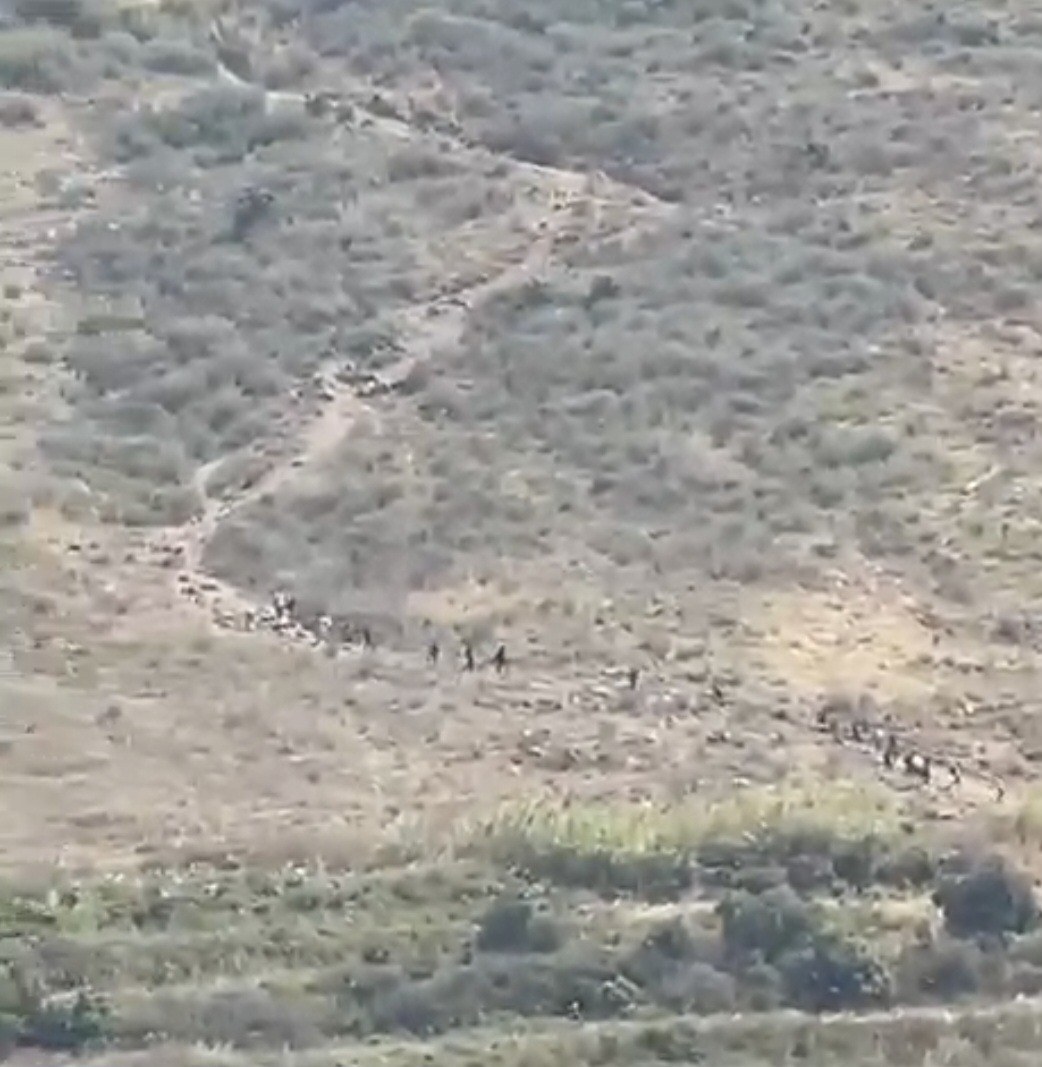
People from Syria coming in to northern Lebanon irregularly last week. (Credit: Screenshot from circulating video, sent by Michel Hallak)






NORTH LEBANON — A video showing a column of people, allegedly Syrians, crossing into Lebanon through an unofficial route in the Wadi Khaled area along the Syrian border circulated on social media Thursday, prompting renewed discussion over illegal crossings along the northern border. The Lebanese Amy, however, told L'Orient Today that there has been no new surge in crossings.
The video, filmed around four days ago and published Thursday, shows a group of people crossing through an unofficial route in the Wadi Khaled area, according to L'Orient Today's correspondent in the North, and a source within the army.
The source told L'Orient Today Thursday that “the measures currently in place along the border are not new and that there has been no sudden increase in crossings. We have procedures in place as they are. Almost weekly, we issue statements announcing that more than 100 people have been arrested for entering Lebanon illegally from Syria. There is no surge; we are continuing to implement our measures.”
The source said the army monitors entry and exit points along the border and regularly carries out operations against people entering Lebanon illegally, with patrols sometimes remaining in place for several days.
On Tuesday, the Internal Security Forces announced the arrest in Tannourine, in the Batroun area, of an alleged smuggler and 13 Syrians who had entered Lebanese territory illegally.
'I see Syrians crossing illegally almost daily'
Ahmad Sheikh, a resident of Wadi Khaled who frequently sees Syrians crossing into and out of Lebanon, told L'Orient Today Thursday that movement across the border varies depending on the deployment of Lebanese and Syrian security forces.
“Sometimes, at the entrances, a patrol comes and stays for hours, or from the evening until the following morning,” Sheikh said. “I see Syrians crossing illegally almost daily.”
Sheikh said some Syrians who left Lebanon after the fall of Bashar al-Assad in December 2024 had expected conditions in Syria to improve quickly and believed they would be able to find work there.
“But when that did not happen, many of those I spoke to left their families in Syria and came back to Lebanon to work,” he said.
“Many of them are the same people who cross back and forth,” Sheikh said. “Some wait for hours for the Lebanese Army patrol to leave and then start coming through the border in large numbers.”
Former minister and al-Tawhid party leader Wiam Wahab shared the video on X on Thursday and called on Lebanese authorities to intervene. “Are these pictures from today? Is this a Syrian invasion of Lebanon? Mr. President, Mr. Prime Minister, stop the invasion. Where are the security agencies?” Wahab wrote.
هذه الصور اليوم . هل هو غزو سوري للبنان؟ فخامة الرئيس دولة الرئيس اوقفوا الغزو . أين الأجهزة ؟ https://t.co/jfh1NNnBRF
— Wiam Wahhab (@wiamwahhab) September 24, 2026
The northern border's official crossings, including Abboudieh-Dabousieh and Arida, have been undergoing reconstruction and rehabilitation after bridges and other infrastructure were damaged during the Israeli war on Lebanon in 2024. No official date has been set for their reopening.
Syrian authorities have announced plans to reopen Dabousieh once rehabilitation works are completed, while reconstruction of the Arida bridge is ongoing.
The reopening of the official crossings is expected to facilitate movement between Lebanon and Syria and reduce pressure on other crossing points. Meanwhile, unofficial routes remain subject to Lebanese Army monitoring and patrols.
On Wednesday, Lebanon’s General Security Directorate announced new criteria for the entry of Syrian nationals through the country’s air, land and sea crossings, saying the measures were intended to facilitate entry. The criteria set different requirements and lengths of stay depending on the purpose of entry, including family ties, property ownership, education, medical treatment, tourism and work.
March 2025, mass killings in Syria’s coastal areas, which primarily targeted members of the Alawite community, prompted some 40,000 people to flee to Lebanon, according to UNHCR.
Reporting contributed by Michel Hallak, our correspondent in northern Lebanon

