


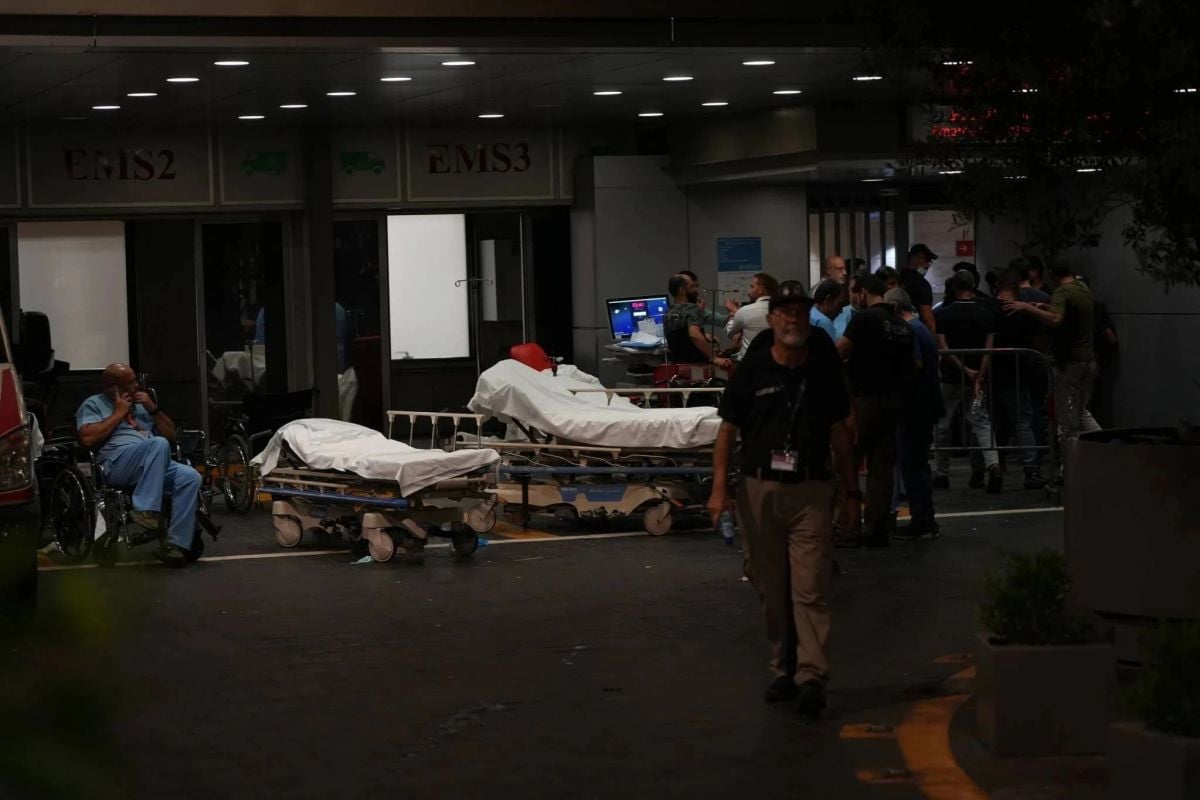
The emergency room of the American University of Beirut hospital, on the evening of Sept. 17, 2024. (Credit: Mohammad Yassine/L'Orient Today)






A little over two years after the Israeli pager operation against Hezbollah, Israeli outlet Walla reported new details about the preparations for the attack, claiming that 500 devices had been sent to Lebanon before Oct. 7, 2023, but that after the Gaza war began, the process of booby-trapping the devices was significantly accelerated.
On Sept. 17 and 18, 2024, thousands of communications devices belonging to Hezbollah exploded in homes, supermarkets, hospitals and other public places across Lebanon, killing a dozen people of people, and injuring more than 2,900.
According to Walla, by the start of the Gaza war on Oct. 7, 2023, the Mossad had already delivered 500 devices to Hezbollah. After Hamas' Oct. 7 attack, then-Mossad chief David Barnea instructed to speed up the production line, the outlet added.
To meet the "tight deadlines" without compromising production quality, it was decided to establish an assembly line inside the Mossad headquarters. However, shortly afterwards, a challenge emerged: There was no available building or facility at the Mossad headquarters large enough to accommodate all the assembly stations.
The only place available at the time was the Mossad gym, the newspaper continued. With Barnea’s approval, the "entire facility was cleared of exercise equipment and weights, and a sensitive defense factory was established in the heart of the headquarters." "Several prefabricated buildings were placed alongside it, and the mission began: working around the clock, in 24-hour shifts, Mossad personnel operated to embed the explosive material into the devices," the outlet added.
According to Walla, the Mossad knew that Hezbollah's former Secretary-General Hassan Nasrallah, assassinated around 10 days after the operation, did not carry a pager with him in the bunker. However, several of his closest aides and bodyguards used the devices to receive general operational messages.
"At the critical moment, the people closest to Nasrallah were hit by the explosions and collapsed right next to him ... he witnessed the scene with his own eyes — and these were not low-ranking operatives outside the bunker, but people he knew intimately," Walla noted.
Last but not least, the report added that Israeli "intelligence officials confirmed that the success of the pager operation served as a source of inspiration and led to the planning and development of additional groundbreaking weapons systems and technological innovations within the Mossad, the Defense Ministry and the Israeli army."
A little less than two months after the attack, Israeli prime minister, Benjamin Netanyahu, acknowledged that Israel was behind the coordinated explosions, specifying that this operation, like the assassination of former Hezbollah leader Hassan Nasrallah in late September, was carried out by Mossad with his green light, despite the opposition of senior security officials and some ministers.
In December 2024, two former Mossad agents revealed on CBS News' "60 Minutes" how Hezbollah had been duped into buying thousands of booby-trapped walkie-talkies and pagers, without realizing they had been made in Israel.

 7 p.m. recap: 1 person killed near border with Lebanon; 200 kilos of explosives carried by mules; Riyadh shuts its airspace