






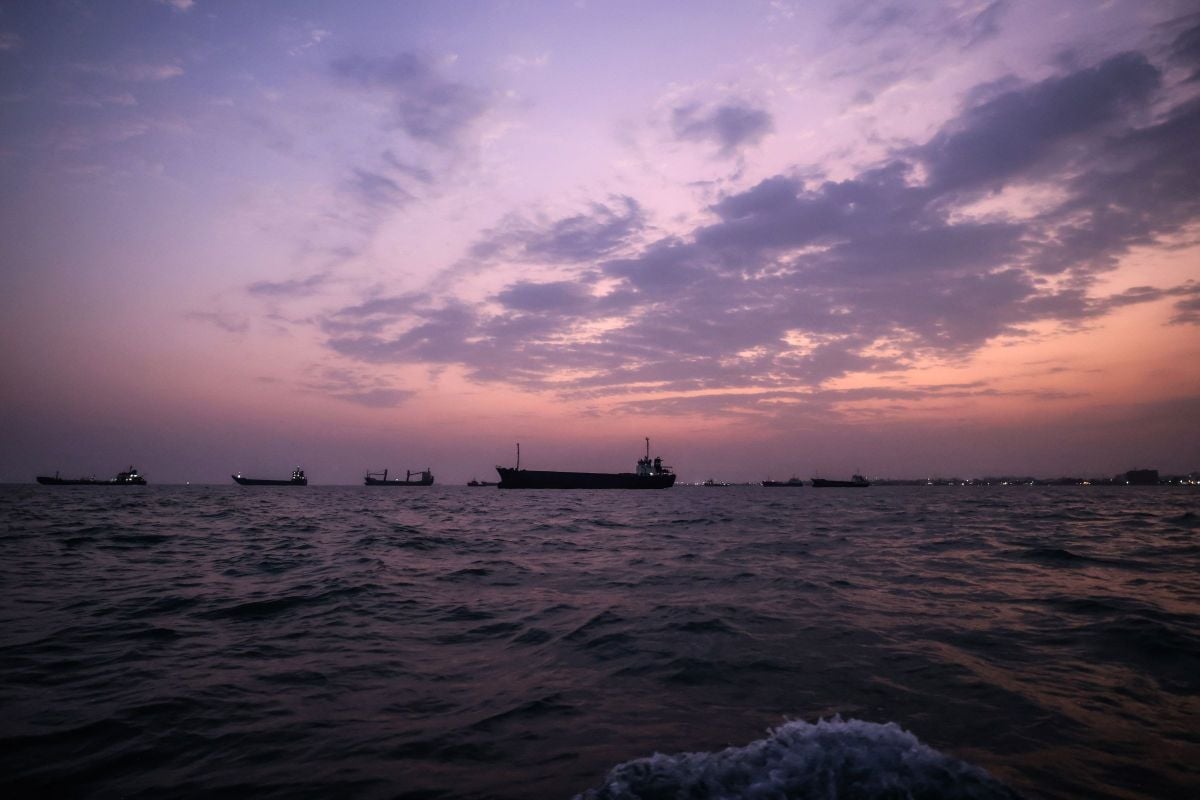
Ships passing through the Strait of Hormuz, off Bandar Abbas, on September 5, 2026. (Credit: Atta Kenare/AFP)






Oman has announced the postponement of a meeting scheduled for Monday between Iran and Gulf countries on the future of the Strait of Hormuz, at the heart of the war between Washington and Tehran which has been blocking this strategic maritime route for months.
"It has been decided to postpone to a later date the regional meeting which was to be held on Monday in Salalah, in order to create the conditions conducive to a constructive dialogue," announced the official Omani news agency ONA.
"We remain committed to promoting dialogue that contributes to stability and sustainable cooperation in our region," Omani Foreign Minister Badr al-Busaidi told X, stating that the meeting had been cancelled "in order to promote consensus."
Tehran had announced the meeting and said that Gulf countries, without specifying which ones, and Iraq would participate. However, no country in the region had confirmed its attendance, and Bahrain had said it would not send anyone.
Donald Trump stated on Sunday that he "didn't give a damn" about the meeting. "It's their business," the US president said.
Oman and Iran are the two countries bordering, to the south and north, the strait, through which approximately 20% of the world's hydrocarbons passed before the start of the conflict at the end of February, triggered by Israeli-American strikes on Tehran.
In the aftermath, Iran launched strikes against wealthy oil monarchies allied with Washington and claimed control of the strait, prompting the United States to retaliate by imposing a blockade of Iranian ports.
An agreement reached in June between Washington and Tehran has collapsed, with both sides stumbling over the Strait of Hormuz. And while airstrikes have recently resumed after a month-long lull, oil prices last week climbed back above the symbolic threshold of $100 a barrel.
Iran and the Sultanate of Oman, which maintain good relations, have been discussing for several weeks the future management of the strait, where navigation was free before the outbreak of the war.
Iran now requires ships to obtain permission from it to transit through its waters, citing security and sovereignty reasons, and is considering a mechanism to impose service fees.
Ships without authorization are regularly targeted by Iran, while the United States periodically bombs the Iranian coastline to challenge Tehran's control over the strait.
The Houthis, who announced a maritime blockade against Saudi Arabia in July and targeted its oil tankers, last week seized control of the strategic Bab el-Mandeb strait, through which maritime traffic passes to and from the Suez Canal.
With the blockade of Hormuz on the other side of the Arabian Peninsula, the kingdom, the world's leading exporter of crude oil, finds itself caught in a vice.
