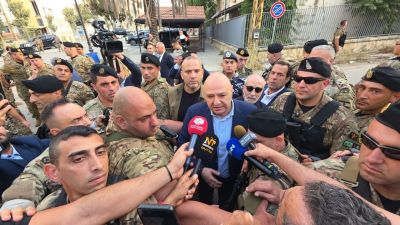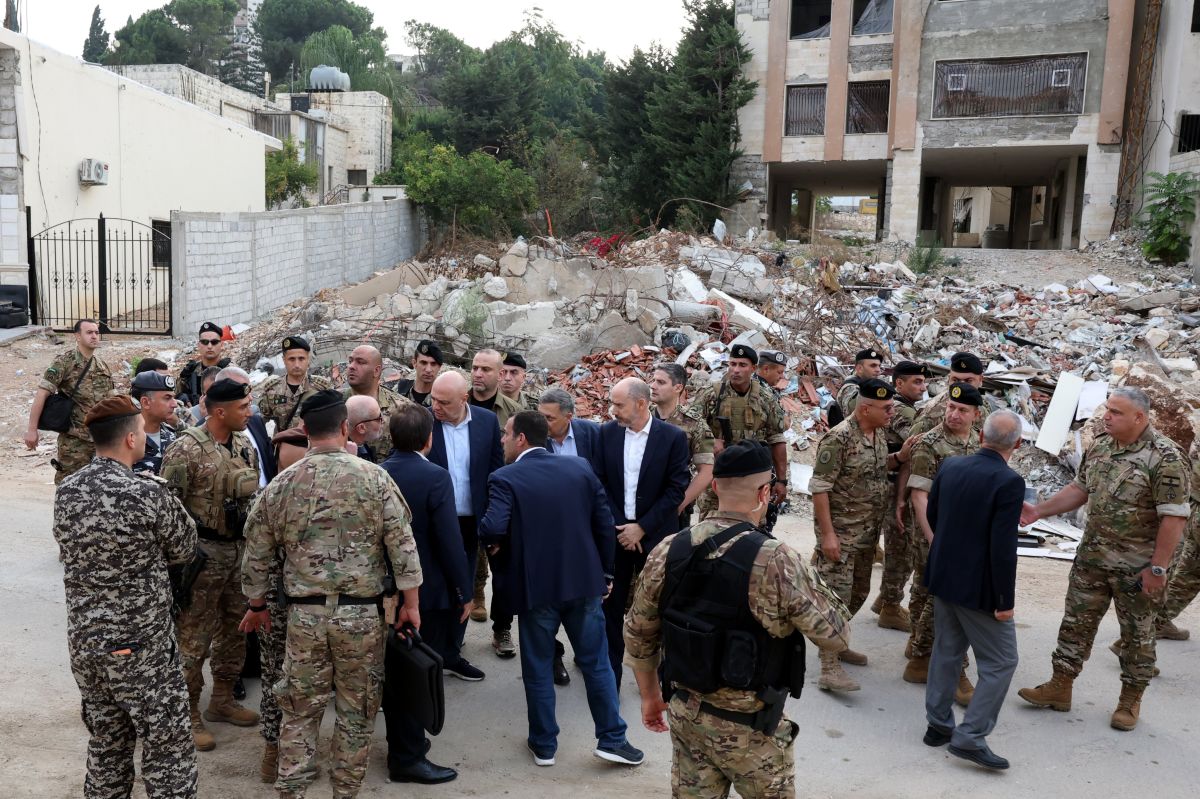
Lebanese President Joseph Aoun, surrounded by soldiers, speaks with residents of the city of Nabatieh in South Lebanon on Saturday, September 12, 2026. (Credit: @LBpresidency/X)






Lebanese President Joseph Aoun said Saturday that there were “no new negotiations with Israel at the moment,” in response to a journalist’s question during a visit to Nabatieh, L’Orient Today’s correspondent in the South reported.
Aoun visited the city early Saturday alongside Army Commander Gen. Rodolph Haykal in a show of “solidarity” with residents after Israeli attacks heavily damaged the city earlier this week.
A few hours earlier, a U.S. State Department official told AFP and Axios that diplomatic talks between Lebanon and Israel that had been scheduled to take place in Rome were postponed until October.
The Lebanese and Israeli ambassadors to the United States are still expected to meet in Washington next week to discuss “recent developments and the gradual implementation” of an agreement reached between the two countries in June, the official said on condition of anonymity, according to AFP.

The postponement was attributed to scheduling difficulties. A source familiar with the matter told Axios that Jewish holidays, a Paris conference in support of the Lebanese Armed Forces and preparations for the U.N. General Assembly prevented the main participants from meeting in Rome as planned.
Two days earlier, Israeli public broadcaster Kan reported that an eighth round of talks between Lebanon and Israel would take place Tuesday and Wednesday.
The report came shortly before Israeli forces carried out large explosions beneath Ali Taher hill in southern Lebanon, which Israel said destroyed Hezbollah tunnel networks. The blasts triggered a 4.1-magnitude earthquake at a depth of 10 kilometers, according to the National Center for Geophysics.
Following the Israeli attacks earlier this week, Aoun condemned “the attacks, the murders of innocent people, children and women.” “The question today is: Does Israel want peace or war? If it wants war, let it say so clearly,” he said. Aoun nevertheless said he remained committed to the diplomatic process, calling it “the best solution for both sides.”
Direct negotiations with Israel had 'reached a dead end', Hezbollah MP says
The comments came as political figures continued to debate the future of Lebanon’s negotiations with Israel. Hezbollah MP Hassan Ezzeddine said Saturday that direct negotiations with Israel had “reached a dead end,” arguing that they had failed to stop Israeli attacks or secure an Israeli withdrawal from Lebanese territory.
Speaking in Marwanieh (Nabatieh district), Ezzeddine accused the Lebanese authorities of enabling Israel through the framework agreement and said Hezbollah’s continued presence was necessary to protect Lebanon.
He also said Parliament would hold a session Tuesday and Wednesday to question the government about its commitments. Ezzeddine argued that future negotiations involving Iran could help establish “a new equation” to force Israel to withdraw from occupied Lebanese territory. Ezzeddine was speaking at a ceremony honoring two Hezbollah members, Ali Nizar Kawtharani and Saleh Hassan Jaber, who are listed as missing.
Ezzeddine also accused the Lebanese authorities of being “complicit in every drop of blood” shed by Israel, saying the government had “legitimized the occupation” by approving the framework agreement with Israel.
“The political authorities are complicit in every drop of blood shed by the enemy because they legitimized the occupation by approving the framework agreement and now simply watch without reacting,” he said.
Referring to the Israeli demolition of tunnels beneath the Ali Taher ridge near Nabatieh, Ezzeddine said the operation demonstrated “the extent of Israeli criminality and its detachment from any connection to humanity.”
A month earlier, Ezzeddine had said Hezbollah would not abandon Ali Taher, which he described as “one of the key positions of the Resistance,” and would confront any Israeli attack.
“For us, the solution to the crisis in the country is linked to the efforts being made by Iran within the framework of any future negotiations [with the United States], through which we are able to establish a new equation to protect our territory and force this enemy to withdraw” from southern Lebanon, Ezzeddine said Saturday.

Hezbollah MP Hussein Hajj Hassan also criticized the Lebanese government, saying the state and Foreign Minister Joe Raggi had “laid the groundwork” during the 15-month cease-fire between the 2024 and 2026 wars by arguing that Israel had the right to fight Hezbollah because the group had not surrendered its weapons.
“Let no one, whoever they are, think they can consider us weak,” Hajj Hassan said in a speech Saturday. “Beware of the one who is patient when he becomes angry.”
The comments came a day after Ebrahim Azizi, chairman of the Iranian Parliament’s National Security and Foreign Policy Committee, said Hezbollah, Hamas and Iraqi armed groups would “also reveal their decisive response at the appropriate time.”
Azizi also welcomed in a post on X the Houthis’ advances along Yemen’s Red Sea coast and toward the Bab al-Mandeb Strait.
‘I came here to tell you that I am with you’
Lebanese authorities have gradually increased the security presence in Nabatieh this week, where residents welcomed the deployment. During Saturday’s visit, Aoun said he had “not abandoned” the city.
“I came here to tell you that I am with you. I have not abandoned you at all. The purpose of my visit with the heads of the security services and the army commander is to tell you that we are by your side,” he said. “We are working to ensure you have all the necessary services so that you can remain here.”
Aoun inspected the government hospital in Nabatieh, praising medical staff for continuing to provide care despite difficult conditions.
Aoun also praised the resilience of residents who have remained in the South despite the fighting, saying their presence was “the greatest medal on our chest” and a message to the world that Lebanese society and the Lebanese people could recover and remain standing, the Lebanese Presidency said on X.
“The South is at the heart of the state and Lebanon,” Aoun said, adding that he hoped the region’s “wound” would finally heal. Southerners, he said, have the right to live safely and build homes without fearing that they will be destroyed.
Aoun also said Israel’s withdrawal from Lebanese territory, the return of detainees and displaced residents, and reconstruction were “national constants” that the state was committed to implementing.
“I commend them for their resilience in this hospital despite all the difficulties and trying conditions, and for continuing to provide a minimum level of healthcare coverage,” he said, according to our correspondent in southern Lebanon.
For his part, when asked about the army’s presence in Nabatieh, Haykal said, “The army is always deployed in the South.” He added briefly in comments to LBCI that, “We hope to liberate the remaining localities and deploy there,” referring to the area occupied by Israel in southern Lebanon, which spans more than 600 square kilometers.
The two officials also inspected military units deployed in the city. “The army is permanently deployed in the South,” Haykal said after leaving the hospital.
Aoun and Haykal also inspected army units deployed in the city. The president later visited the village of Zawtar Gharbieh, in the same region, where he visited a church and inspected army units. On Monday, residents and lawmakers called for Nabatieh to be declared “open to the army and free of Hezbollah weapons” to protect the city from Israeli strikes. Residents of Arab Salim in the Nabatieh district and the city of Sour made similar calls the following day.
Residents of Nabatieh and Sour had issued a similar appeal three months earlier, without success. The army deployed dozens of additional soldiers to Nabatieh on Tuesday to reinforce its presence in the city. The deployment, however, was not intended to begin a disarmament process.
Reporting contributed by our correspondent in the South, Muntasser Abdallah