





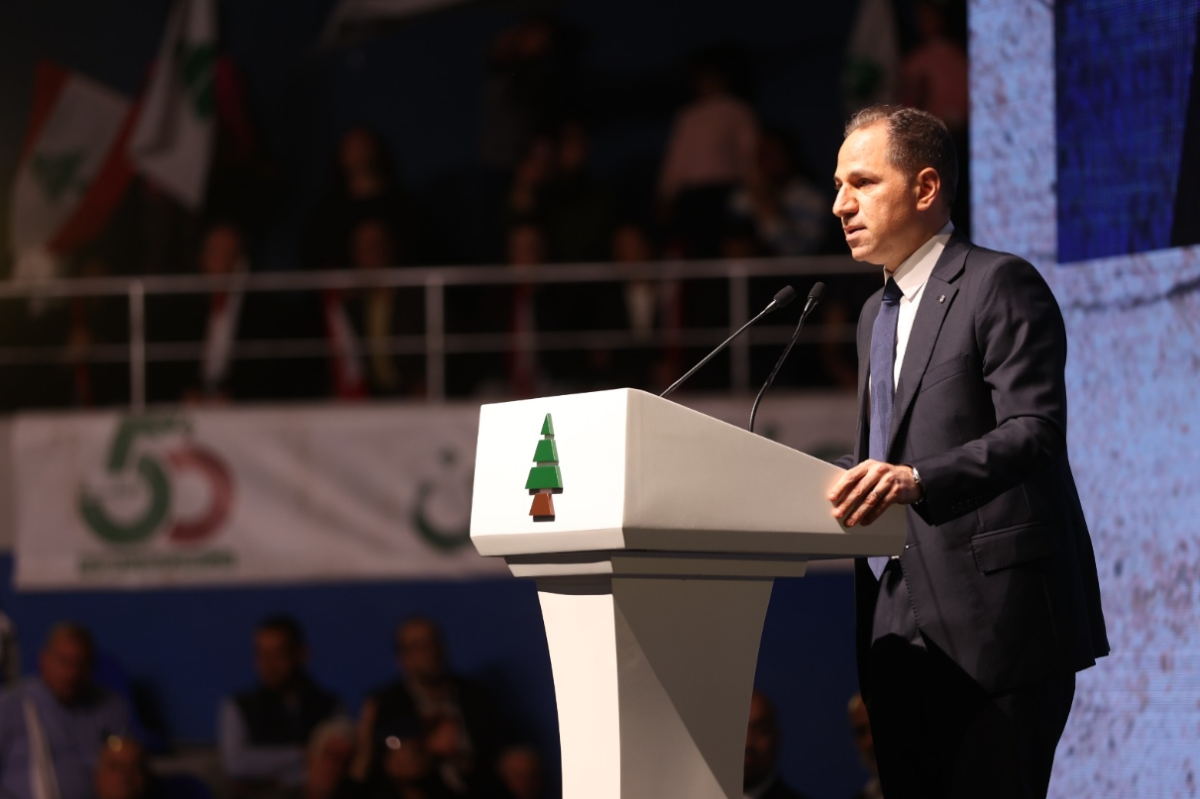
The leader of the Kataeb party, Samy Gemayel, during a speech on April 12, 2025. (Credit: @LebaneseKataeb/X)






Expressing fears that agreements are being made "at the expense" of the Lebanese state and over the "threats" posed by infrastructures that Hezbollah may have developed in various regions, Kataeb leader and MP Samy Gemayel called on the government to implement on the ground the successive decisions taken since its formation in February 2025 to restore the monopoly on arms and thus, disarm Hezbollah.
This is a call to "quell the rebellion" of the party, which refuses to disarm north of the Litani, while concerns are mounting over the fate of Nabatieh after the fall of the Ali Taher hill and deadly strikes on the region.
At a news conference a few days before a planned parliamentary session to debate with Nawaf Salam's government, Gemayel said a "crucial question" arises, namely the concrete application of the executive's decisions to restore the state's monopoly on arms.
This issue, considered central since President Joseph Aoun's election in January 2025 and the formation of Salam's cabinet, was mentioned in the president's inaugural address, the ministerial declaration, an August 2025 decision to disarm all militias, another to ban Hezbollah's military activities on March 2 — the day fighting resumed between the party and Israel — and another on April 9 to make Beirut a "weapons-free city."
Measures were taken to implement these successive decisions, notably to disarm groups affiliated with Fatah in the Palestinian refugee camps, as well as Hezbollah south of the Litani. However, the war that resumed in early March with rocket attacks on Israel — following the U.S.-Israeli offensive on Iran — wiped out the efforts of the Lebanese army, and the militia-party continued to launch attacks from southern Lebanon.
Risks posed by Hezbollah's tunnels
In this context, Gemayel challenged the executive: "What has been implemented from the Cabinet's decisions, the army's plan, and the monopoly on arms process? What is preventing action in regions not under Israeli occupation? Are there tunnels and weapons depots in these regions? What deadline has the government set for the monopoly on arms, and when will it become a reality?"
While assuring the cabinet of his support, he also warned against further delays in asserting the monopoly on arms. He specifically mentioned the risks of Israeli attacks spreading beyond the South. "The existence of another Ali Taher in the Bekaa, in Beirut, in Metn, or in Kesrouan means that everyone is at risk," he warned, referring to the underground military base beneath a hill near Nabatieh, which Israel said it had taken operational control of last Thursday after weeks of attacks — a claim not confirmed by Hezbollah.
This takeover was followed by deadly bombings in the region that killed several dozen people, including women and children. The Metn MP further voiced concerns about internal tensions. "Some are rebelling against the decisions of the State," he accused, alluding to Hezbollah’s refusal to hand over its arsenal. The state, he said, therefore "cannot be afraid" and must "quell this rebellion."
"If the state does not shoulder its responsibilities, it will collapse," the Kataeb leader added, first because an expansion of the war would mean "everyone loses." Secondly, "if the state appears unable to act, Israel and the United States will engage with illegitimate forces and reach deals with them at the expense of the state and the Lebanese people."
Following a meeting with Sheikh Ali al-Khatib, vice president of the Higher Islamic Shiite Council and a Hezbollah ally, U.S. Ambassador to Lebanon Michel Issa stated Tuesday that Washington was "ready to negotiate" with the pro-Iranian group "but through the Lebanese state."
In late August, Washington stated that only the Lebanese government is authorized to negotiate with Israel, which it has been doing for several months, especially regarding the Israeli withdrawal from southern Lebanon and putting an end to the ongoing attacks in the South, after several U.S. statements fueled speculation about possible direct talks with Hezbollah.

 7 p.m. recap: Iran warns Egypt, Israeli soldiers vote in south Lebanon, Haret Hreik responds to Kataeb