





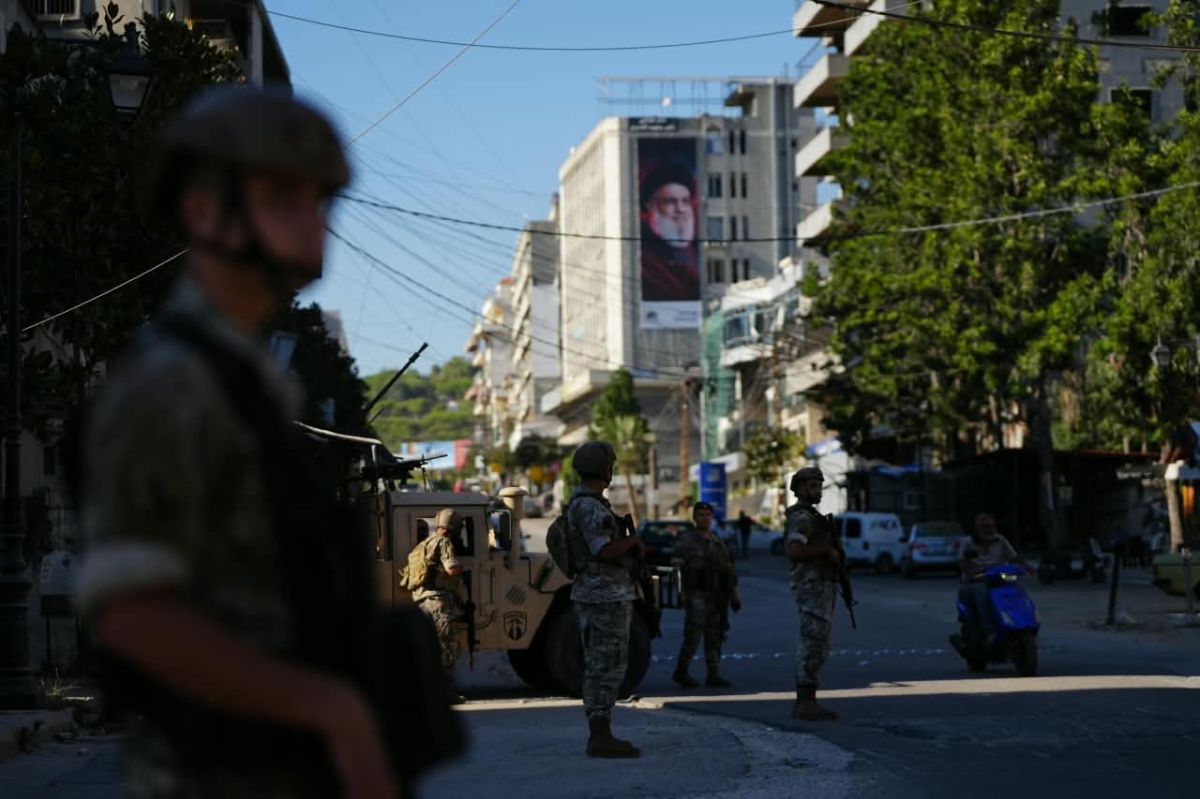
Lebanese Army patrol in Nabatieh on Sept. 8, 2026. In the background, a portrait of former Hezbollah leader Hassan Nasrallah hangs on the façade of a building. (Credit: Mohammad Yassine/L'Orient-Le Jour)






In Nabatieh, the Lebanese state aims to demonstrate its presence amid the Israeli escalation, but the extent of the army's deployment has already sparked debate.
While Prime Minister Nawaf Salam praises the army's measures to "strengthen its deployment" and "reassure residents," President Joseph Aoun warns that "any security vacuum in the south serves as a pretext for aggression and undermines national sovereignty." Meanwhile, the head of the Lebanese Forces (LF), Samir Geagea, believes the military presence "is simply insufficient at this time."
A heightened military presence was visible Tuesday on the main streets of Jabal Amel's principal city, where more than a dozen Lebanese Army vehicles were deployed along its main arteries. This deployment came after yet another deadly night of Israeli strikes in the region and amid increasing calls to step up the army's role.
During a security meeting at Baabda Presidential Palace, notably attended by the army commander, Aoun stated that "any security vacuum in the south constitutes a pretext for aggression and an assault on national sovereignty," according to a statement from the presidency posted on its X account.
He also stressed that "the security deployment in Nabatiyeh was tied to the commitments of the Lebanese state and its position in negotiations with Israel," noting that "maintaining internal security strengthens Lebanon's official position." The president called on the security services to assume their responsibilities and ensure "permanent" coordination among themselves, stating that "the security of Nabatieh and of the areas not under Israeli occupation is an integral part of the security of a unified Lebanon."
Salam on Wednesday praised the army's work and the measures taken to bolster its deployment in villages and towns not under occupation. "We salute the efforts of the Lebanese Army and the measures it is taking to strengthen its deployment in unoccupied villages and towns, which helps reassure citizens, consolidate stability, facilitate the return of residents, and ensure the proper functioning of government institutions and services," he said in a statement.
The head of government also said he is closely following the situation in Nabatieh and its surroundings, and is in regular contact with the city's imam, Sheikh Abdel Hussein Sadek, and the head of the municipality, Hajj Abbas Fakhreddine.
Salam also denied reports that a visit to Nabatieh scheduled for Saturday had been canceled. He explained that no such trip had been scheduled this week, while expressing hope that he would be able to go "as soon as possible" to the major city north of the Litani River. The prime minister also conferred with Aoun about "the measures taken by the army to reinforce its deployment in the unoccupied villages to reassure residents and allow the resumption of work in public administrations."
Geagea concerned about Nabatieh
For his part, the head of the LF, Samir Geagea, expressed concerns about Nabatieh's fate, hoping it would not end up like other cities in the south that were destroyed by the Israelis.
Geagea said he feared the city could "suffer the same fate as Ali Taher, the Shqif region (around the Beaufort fortress, in the same district), and other border villages." "Nabatieh holds major historical, economic, and cultural importance and remains densely populated. A significant number of its residents have issued a clear appeal to the Lebanese state to assume its responsibilities in these difficult circumstances," Geagea said.
Geagea also asked the authorities "to implement the decisions of the Cabinet, especially the March 2, 2026 decision, which considers the military and security branches of Hezbollah illegal." "The authorities are called upon to immediately implement this decision, at least in the city of Nabatieh and its surroundings, by dismantling all illegal armed groups present there, neutralizing their infrastructure, and informing the American authorities of the actions of the Lebanese Army so they may help end the fighting ravaging Nabatieh and its surroundings," said the Christian leader.
"As for the claim that the Lebanese Army is already deployed in Nabatieh, it is insufficient at present," Geagea said. In his view, "it is not enough to deploy the Lebanese Army; all illegal military and security structures in areas where the army is stationed must be dismantled, and the army should exercise its full authority, in line with the Lebanese government's decisions."
Aoun: 'Our loyalty must go to our country'
The president also spoke during another meeting about national loyalty and the negotiation process with Israel, affirming that everyone’s loyalty must be "to our own country ... Whoever seeks foreign support against their domestic rivals will lose, as foreigners will eventually abandon them," in a veiled reference to Hezbollah.
The framework agreement between Beirut and Tel Aviv notably provides for the Lebanese Army to disarm the pro-Iranian group, a prospect to which the party is categorically opposed.
He also stated that "no war in Lebanon has ever ended with a victor: everyone lost, and so did the country." The head of state once again defended the choice of a negotiation process with Israel, stressing that this decision had been made "in Lebanon's interest" and not to meet the expectations of foreign powers.
"We chose negotiation because we are a sovereign state. This decision was taken in Lebanon's interest and not to satisfy anyone abroad," he declared.

 Evening recap: Netanyahu announces West Bank offensive; 7 killed in Jordan church shooting; tents burned in south Lebanon
 US strike on Iran this weekend? ‘Absolutely,’ says Barrack; ‘I have no idea,’ says Trump