


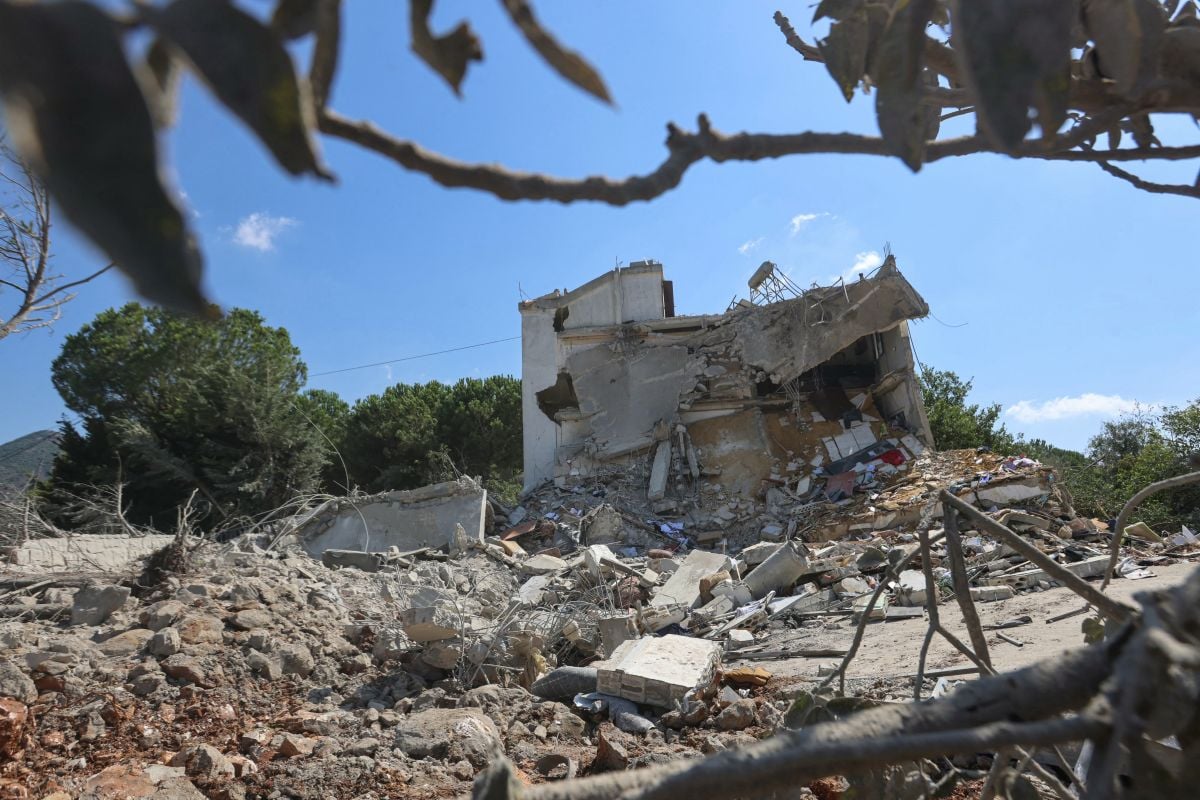
Building destroyed by an Israeli airstrike in the village of Arab Salim, in southern Lebanon, on Sept. 6, 2026. (Credit: Mahmoud Zayyat / AFP)






BEIRUT — President Joseph Aoun, Parliament Speaker Nabih Berri and Prime Minister Nawaf Salam on Sunday condemned the Israeli attacks on the Nabatieh region, which killed at least seven people, completely destroyed a hospital and caused significant damage to the local Ministry of Finance building.
Condemning "the resumption of Israeli attacks," Aoun denounced a "dangerous escalation" and said he held Israel fully responsible for the violence. He called on the United States and the international community to intervene urgently to put an end to Israeli violations and to hold the perpetrators accountable.
For Aoun, these attacks go beyond the repeated violations of the cease-fire agreement, theoretically in force since mid-June, and the framework agreement of June 26 between Lebanon and Israel. The agreement provides for the gradual withdrawal of the Israeli army from the occupied area, in parallel with the deployment of the Lebanese Army, tasked with disarming Hezbollah. According to Aoun, these attacks this time target "Lebanese state institutions and service infrastructure in charge of citizens’ affairs and their daily needs, as well as a hospital and health centers."
'State terrorism'
The president recalled the Israeli strike carried out on April 19, which targeted the Nabatieh Government Palace, killing 19, including 13 State Security agents. He stressed that the targeting of the local Ministry of Finance building, after that of a State Security center, revealed "a persistent pattern of attacks" going beyond "alleged military objectives to hit purely civil administrations and health centers." According to him, this reflects "a clear intent to undermine the continuity of Lebanese institutions' operations and to impede the daily lives of the populace."
Parliament Speaker Nabih Berri went even further by accusing the Israeli state of wanting "to turn south Lebanon, its inhabitants, and their property into a bloodstained ballot box." He said that, ahead of upcoming elections, Israeli political and military leaders were competing to determine "who will kill and destroy the most." These attacks, "by their nature and scale, constitute crimes akin to state terrorism," Berri said.
According to him, Israel’s continuation of this "war of destruction" conducted with "unprecedented violence" provides "irrefutable proof" that the country "has respected none of the cease-fire options" and disregards all "rules, agreements, and understandings." Berri also considered that the situation in south Lebanon falls both under an "international responsibility" requiring urgent intervention to end the war against Lebanon and its southern region, and a "national responsibility." He called on all Lebanese parties to stand with this territory, to see its cause as "that of all Lebanese," and its defense as that of Lebanon itself.
Prime Minister Nawaf Salam, for his part, said Sunday that "Israeli aggressions will not prevent the government from maintaining its support for the return of the displaced from south Lebanon, nor from ensuring everything necessary for the continuation of public services and the satisfaction of citizens’ needs.'" Salam made these remarks after a phone call with the head of Nabatieh’s municipal council, Abbas Fakhreddine, during which he inquired about the condition of the population and the extent of the damage following the strikes that targeted the city at dawn. Salam also discussed the Israeli attacks with Nabatieh’s imam, Sheikh Abdel Hussein Sadek, expressing his solidarity with the people, the families of those killed and the wounded. Salam also spoke with Finance Minister Yassine Jaber to learn about the damage to the ministry building in Nabatieh.
Municipal officials protest
Meanwhile, heads and members of municipal and mokhtar councils from southern Lebanon held a protest outside the Sour Serail on Sunday, condemning what they described as Israel’s systematic destruction of southern villages and calling on the Lebanese state to support displaced residents and reconstruction efforts, our correspondent in the south reported.
Ibrahim Hamzeh, head of the Naqoura municipality, called on the authorities "to provide housing allowances, monthly support for people who had lost their livelihoods, school fee exemptions for students from border villages and assistance for displaced residents." He said Naqoura had been "almost completely destroyed, including its homes, infrastructure, businesses and fishing port."
For his part, Abbas al-Sayyed Ali, head of the Khiam municipality, criticized the Lebanese authorities for "failing to adequately support southern communities, saying municipalities had been left to deal with the crisis on their own." He also said municipalities had not received their allocations from the Independent Municipal Fund since 2023.
Mohammad Bazzi, head of the Bint Jbeil municipality, said "85% of the city had been completely destroyed and the remainder was severely damaged." Qassem al-Abd Hamdan, head of the Jabal Amel Municipal Union, called on the state to assume responsibility for displaced residents, provide housing allowances and compensation for war damage, and begin reconstruction, particularly of public institutions and infrastructure. He stressed that southern residents would remain on their land and “will not give up a single grain of its soil.”
Reporting contributed by our correspondent in the south, Muntasser Abdallah
 2 p.m. recap: Flydubai investigation points to 'terrorist act'; calls grow for Hassan Diab’s extradition to France