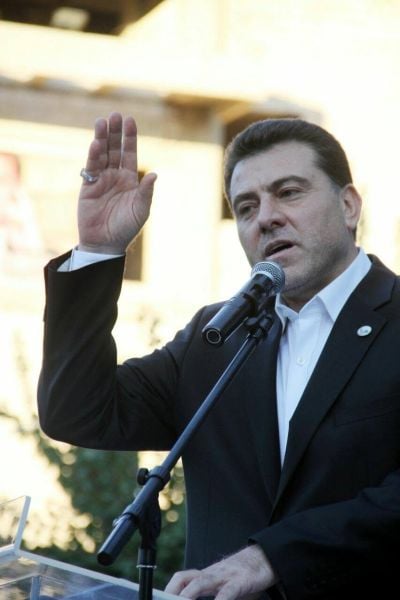
Hassan Yaacoub, son of Sheikh Mohammad Yaacoub, the missing companion of Imam Moussa Sadr. (Photo taken from Hassan Yaacoub's Facebook account)






On the occasion of the 48th anniversary of the disappearance of Imam Moussa Sadr, former MP Hassan Yaacoub, son of Sheikh Mohammad Yaacoub — one of Sadr's two companions who disappeared in Libya on Aug. 31, 1978 — on Monday called on the state to "move from managing the case to resolving it," stating that nearly half a century of mystery could no longer be justified.
The president of the El-Nahj movement in particular called on the authorities to shed full light on "the investigations, information, names, and the various versions" gathered over the years.
"There is a difference between a case that is hard to solve and a case where not enough is being done to reach a solution," he said in a statement relayed by the state-run National News Agency (NNA). "We don't want any more statements... We want the truth, evidence, and concrete results," he insisted.
He also addressed the recent release in October 2025 (on $900,000 bail) of Hannibal Gaddafi, son of former Libyan dictator Muammar Gaddafi, who had been imprisoned for nearly ten years in Lebanon on suspicion of possessing information about the disappearance of Moussa Sadr, Mohammad Yaacoub, and journalist Abbas Badreddine. "What information did he provide? What does he still hold? What has the judiciary done with this information? And how will the investigation proceed after his release?" he asked, while insisting that he did not want "to substitute for the judiciary" and that the release of a detainee "does not absolve the state of its responsibility in the case."
'48 years of mystery is not inevitable'
The former MP also urged the government to obtain from Tripoli "the opening of Libyan archives, the handing over of documents, access to records," and cooperation with the Lebanese judiciary, arguing that the authorities must use the diplomatic and judicial means at their disposal to obtain "effective Libyan cooperation." After years of frosty relations, Beirut recently resumed diplomatic ties with the Libyan government based in Tripoli, which sent, for the first time in decades, an official delegation to Beirut at the end of 2025.
"The solution begins when the state moves from merely receiving information to seeking it out, from being a mere observer to taking action, from waiting to taking initiative, and from managing the case to resolving it," Hassan Yaacoub concluded, adding that "48 years of mystery is not inevitable, but rather it is a national issue that must be resolved."
Originally from the village of Bednayel in the Bekaa, the former MP had been arrested for his alleged involvement in the abduction of Hannibal Gaddafi, then a refugee in Syria, in December 2015. Hannibal Gaddafi was then beaten and questioned about the disappearance of Imam Moussa Sadr and his two companions by an armed group in the Bekaa. Released, he was handed over to Lebanese intelligence services before being imprisoned until last October. Hassan Yaacoub was then accused of taking part in, or even leading, the abduction, but has always denied any involvement.