


Search
Search

PERFORMANCE

In Ajaltoun, 'Wayna Nay?!' lights the 70 candles of the Baalbeck International Festival

Between a tribute to Jean Cocteau, grand lyrical arias, and Lebanese musical heritage, the evening led by the ensemble Les Cordes résonnantes was marked by memory, joy, and solidarity.

In Ajaltoun, 'Wayna Nay?!' lights the 70 candles of the Baalbeck International Festival

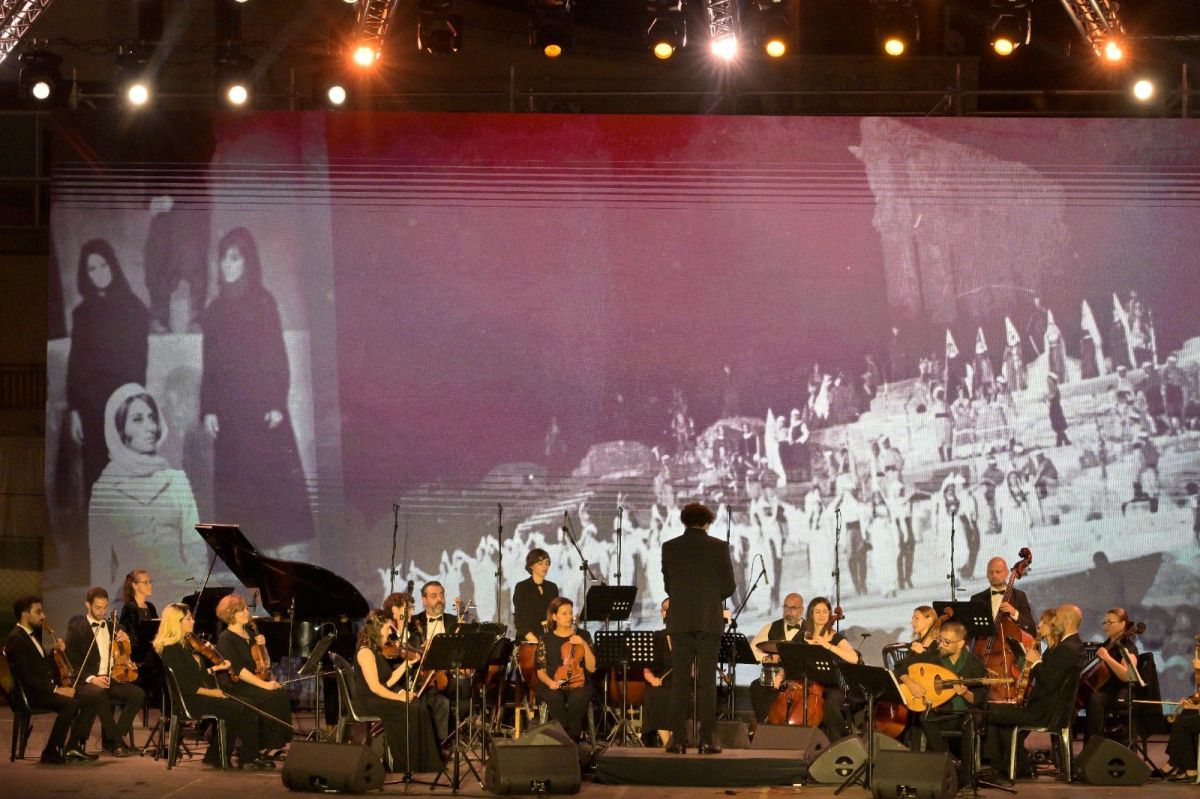
The ensemble Les Cordes Résonnantes on the stage of the Ajaltoun Festival in "Wayna Nay?!" the tribute show to the Baalbeck Festival. (Credit: Nabil Ismail)


While television screens and social media were occupied on Monday night with debating the truth of reports about Hezbollah military tunnels beneath the ancient temples of Baalbeck, the ensemble Les Cordes résonnantes opened the Ajaltoun Festival evenings with Wayna Nay?!, a show paying tribute to the City of the Sun and the Baalbeck International Festival on the 70th anniversary of its founding.

Created by the ensemble's founders, artists Elie Sfeir and Joe Daou — who also conducted the orchestra — the show, combining music, theater, and song, begins with the appearance of actor Noah Mokaddem in the role of Jean Cocteau, searching for Nay, his imaginary beloved who no longer comes to visit or leave flowers on his grave. He returns to Lebanon to find out what has become of her.

The idea of reviving poet, writer, and director Jean Cocteau — one of the first major artists to perform on the stage of the Baalbeck Festival in 1956, when he presented "La Machine Infernale" at the invitation of festival founder Camille Chamoun — and pairing him with a surreal love story involving a young woman from Baalbeck named Nay, with whom he falls in love, makes for a beautiful way to invite the audience to reflect on the Lebanon of dreams, imagination, glory, and stability. The text is written by author and playwright Hassan Makhzoum. An imaginary character, Nay embodies both history, geography, and the tale of the gods' departure, who left Baalbeck when the war machine got underway, when creativity and art faded, taking with them the music and festival nights, until the city became a land of desolation.

Actor Nouh Mokaddem, known for his social media videos where he declaims poetry with a warm voice and strong presence, however, did not quite manage to convey the soul of the written text to the audience. The comic and satirical dimensions, as well as the poetry and imagination that mark his character, were in part lost and the monologue was scattered, dragging the audience's attention with it. Certainly, Mokaddem generally delivers good performances in his videos, but there is a big difference between acting on stage — which requires intensive rehearsal, the ability to read beyond the words and a director to guide the actor — and a video performance, which can require merely a fine voice and a mic to accompany it.

The musical ensemble's performance and the careful choice of both Eastern and Western pieces, however, saved the evening and kept the audience's attention. From the overture of the opera "Carmen" to "Va, pensiero" from Giuseppe Verdi's "Nabucco," as well as works by the Rahbanis, Fairuz, and Zaki Nassif, the public responded to the melodies — which were interpreted with mastery and passion — with nods and approving applause, especially for Fairuz songs performed by singer Fadia Tomb al-Hajj, such as "al-Mahabba" and "Aatini al-Nay wa Ghanni" ("Give me the flute and sing").

The ensemble also paid tribute to the Franco-Lebanese set designer and architect Jean-Louis Mainguy, creator of iconic stages at Baalbeck, who passed away a year ago, with a text by Wajdi Mouawad entitled "Do You Hear My Voice?", performed by Fadia Tomb al-Hajj. The orchestra also played the first movement of Mozart's "Symphony No. 40" and "Nimrod," from the Enigma Variations by British composer Edward Elgar.

Fadia Tomb al-Hajj performing songs from Fairuz's repertoire as part of "Wayna Nay?!", the opening show of the Ajaltoun Festival 2026. (Credit: Nabil Ismail)

The surprise, however, came with the performance of an original piece, composed especially for "Wayna Nay?!" by composer Ramzi Kandalaft. Inspired by the "Lebanese Nights" that made Baalbeck Festival famous and in which the greatest Lebanese figures in music, theater, dance, and song participated, this creation refers to a strong, sustainable annual Lebanese production, for which the ensemble, together with Kandalaft, selected five themes from the "Lebanese Nights," which he rearranged in his own style to adapt them to the tastes and sensitivities of the current generation.

"The show is neither a story nor an account of everything that has been presented at Baalbeck, nor is it a catalog of all the artists who have appeared there, because we do not have the artistic or financial means, nor the necessary time," conductor Joe Daou told L’Orient-Le Jour. "The idea was to choose pieces able to highlight the spirit, image and brilliance of this prestigious festival, which is celebrating its 70th candle this year, far from the temples, ruins and archaeological site."

He added: "We also wanted to highlight the very spirit of the Baalbeck Festival, which we consider to be deeply linked to that of Lebanon. A spirit based on diversity, openness to the world and international artistic exchange, embodied here by Jean Cocteau and the international works we performed — between opera, classical, and eastern music, all previously presented in Baalbeck — but also by local creativity, conveyed by the 'Lebanese Nights' and their annual, powerful, and thriving productions."

For Daou, "these productions are important because they shaped Lebanon's artistic glory during that era. Artists like Fairuz, Philemon Wehbeh, the Rahbanis, Zaki Nassif, Sabah, Nasri Chamseddine, Najib Hankache, Caracalla, and many others did not need a foreign seal to give their art international value." He noted that "it was the large-scale production the Baalbeck Festival offered Lebanese creators that allowed them to reach that dimension. That is exactly what we focused on in our choice of pieces."

It is worth noting that this was the first show of this magnitude for the ensemble, founded in 2018, and that the production, achieved in collaboration with the municipality of Ajaltoun, came together in just a month and a half.

The president of the Baalbeck International Festival, Nayla de Freige, delivers her speech at the start of the opening show of the Ajaltoun festival, held in tribute to the starry nights of Baalbeck. (Credit: Nabil Ismail)

While works that carry the identity of Lebanon and of such a prestigious festival as Baalbeck certainly require more rehearsals and financial resources, the ensemble nonetheless seems destined for a bright future, considering what it managed to accomplish in such a short time; and also for the boldness with which it chose to address the region's first artistic and cultural festival and to pay tribute to it during one of the darkest periods Lebanon has ever gone through.

In this spirit of national solidarity, the people of Baalbeck, who traveled by bus to Ajaltoun, also prepared a surprise for the Les Cordes résonnantes ensemble and the Ajaltoun festival audience: a dabke dance from Baalbeck performed by the Shams Baalbek troupe, to the rhythms of the hawara, dalouna, and mijana. Their enthusiasm quickly spread to the audience, who began to dance, sing, and clap along from their seats.

This free village festival, organized in the courtyard of the municipality and Saint-Zakhia church in Ajaltoun, brought together residents of all ages in a festive atmosphere. Children played in areas set aside for them, surrounded by stands offering food and drinks at prices affordable for all.

A warm festival which, through its atmosphere, takes us back to the spontaneous gatherings of the past, to the songs of Fairuz and the Rahbanis — "Kan 'anna tahoun," "Sahar al-Layali" — and the play "Bayaa al-Khawatem," and to that image of a Lebanon of culture, stability, and solidarity that we wish for: a Lebanon without war or weapons, but rich in culture, creativity, and encounters. This was also emphasized in the opening remarks by Dr. Ali al-Samad, representing Culture Minister Ghassan Salameh, Ajaltoun municipality president Elias Sfeir, and Baalbeck Festival president Nayla de Freige.

This article originally appeared in French on L'Orient-Le Jour.

While television screens and social media were occupied on Monday night with debating the truth of reports about Hezbollah military tunnels beneath the ancient temples of Baalbeck, the ensemble Les Cordes résonnantes opened the Ajaltoun Festival evenings with Wayna Nay?!, a show paying tribute to the City of the Sun and the Baalbeck International Festival on the 70th anniversary of its founding.Created by the ensemble's founders, artists Elie Sfeir and Joe Daou — who also conducted the orchestra — the show, combining music, theater, and song, begins with the appearance of actor Noah Mokaddem in the role of Jean Cocteau, searching for Nay, his imaginary beloved who no longer comes to visit or leave flowers on his grave. He returns to Lebanon to find out what has become of her.The idea of reviving poet, writer, and director Jean...

Comments (0) Comment

Comments (0)

Back to top




