


Syrian Foreign Minister Asaad al-Shaibani, speaks during an interview with Reuters in Damascus, Syria, Aug. 22, 2026. (Credit: Khalil Ashawi/ Reuters)






Syria and Israel held high-level, U.S.-mediated talks in Jordan on Sunday to ease tensions following recent Israeli strikes on Syrian territory, Syria's state news agency SANA reported, citing a diplomatic source at the foreign ministry.
The talks focused on practical mechanisms to halt Israeli strikes, arrests and targeted operations, and on reviving negotiations towards a security agreement that could lay the groundwork for a broader future accord, SANA said. The two sides also discussed efforts to ease tensions between Israel and Turkey and to prevent their rivalry from spilling onto Syrian territory.
Syria's Foreign Minister Asaad al-Shaibani told Reuters on Saturday that Damascus expected security negotiations with Israel to resume soon, although he added that there was a lack of trust between them. Talks had been suspended since the start of the Iran war, while Syria cut off contact entirely after Israeli strikes on Syria’s Abu al-Duhur airbase last week, according to Shaibani.
A diplomatic source and a Syrian government source told AFP that Foreign Minister Assad al-Shaibani met the head of Israel's Mossad intelligence agency, Roman Gofman.
They discussed issues such as establishing "a special operations room" in Jordan under U.S. supervision to prevent any confrontation in Syria, including involving Turkey, the sources added.
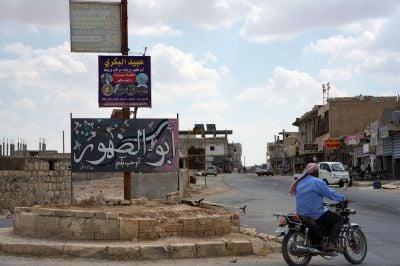
Negotiations
U.S. envoy for Syria Tom Barrack had slammed Israel's attack on the airbase on Tuesday as an "unnecessary escalation that does not advance regional stability." Israel said the strike on the northern Syrian airbase was intended to prevent the deployment of Turkish troops there. Turkey denied having any military presence at the site.
Israeli Prime Minister Benjamin Netanyahu and Turkish President Recep Tayyip Erdogan have traded barbs since the incident, with the former calling the latter an “antisemitic dictator” on Friday.
The Syrian government source told AFP that Sunday's talks were the first between Israel and Syria in some time, while the diplomatic source said they were the first in several months.
SANA said the discussions addressed "establishing practical mechanisms to stop Israeli attacks ... and reviving the negotiations process with the aim of reaching a security agreement that could form the basis of a more comprehensive future agreement."
Israel and Syria's new authorities have held several rounds of direct talks. After negotiations in Paris in January, they agreed to establish a dedicated communication cell under U.S. supervision to lower bilateral tensions.
An Arab diplomat in Damascus told AFP at the time that a joint operations room based in Jordan would follow issues including security coordination and border control.
At Sunday’s meeting, SANA said, Syria indicated that its immediate priorities remained an Israeli withdrawal to positions held before Assad's overthrow, and the full restoration of a 1974 disengagement agreement.
Damascus also told the Israeli delegation it would not accept arrangements restricting its right to rebuild and develop its armed forces or determine its alliances and partnerships, SANA said. Syria reiterated that the Israeli-occupied Golan Heights were Syrian territory but said discussions over the region's final status were premature, according to the SANA report.
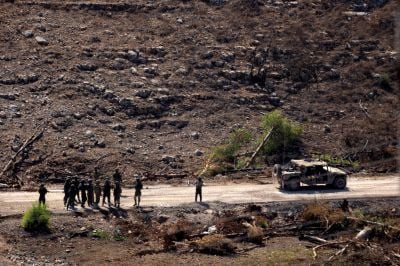
Southern Syria
Israel has launched hundreds of strikes on Syria since the December 2024 toppling of longtime ruler Bashar al-Assad by Islamist forces led by President Ahmad al-Sharaa.
It sent troops into a U.N.-patrolled buffer zone that had long separated Israeli and Syrian forces on the Israeli-annexed Golan Heights.
Israel has also carried out repeated incursions deeper into Syrian territory and vowed to keep troops in a so-called "security zone" in southern Syria, where it seeks a broader demilitarized area.
The talks also came a day after Israel struck what it claimed was a militant in southern Syria. Damascus said one person was wounded in the strike, which it called a "flagrant violation" of its sovereignty.
Washington has for more than a year sought to broker a security agreement between Israel and Syria. Shaibani said the two sides had agreed on paper to “almost everything” around the beginning of the year, including arrangements for security zones in southern Syria and a buffer zone where only United Nations forces would be present, but Damascus doubted Israel's willingness to implement the agreement.
The Israeli prime minister's office did not reply to a request for comment on Shaibani's remarks.

 7 p.m. recap: Houthis strike Riyadh airport again; Yemeni forces claim Bab al-Mandeb gains; Abbas postpones Palestinian polls