





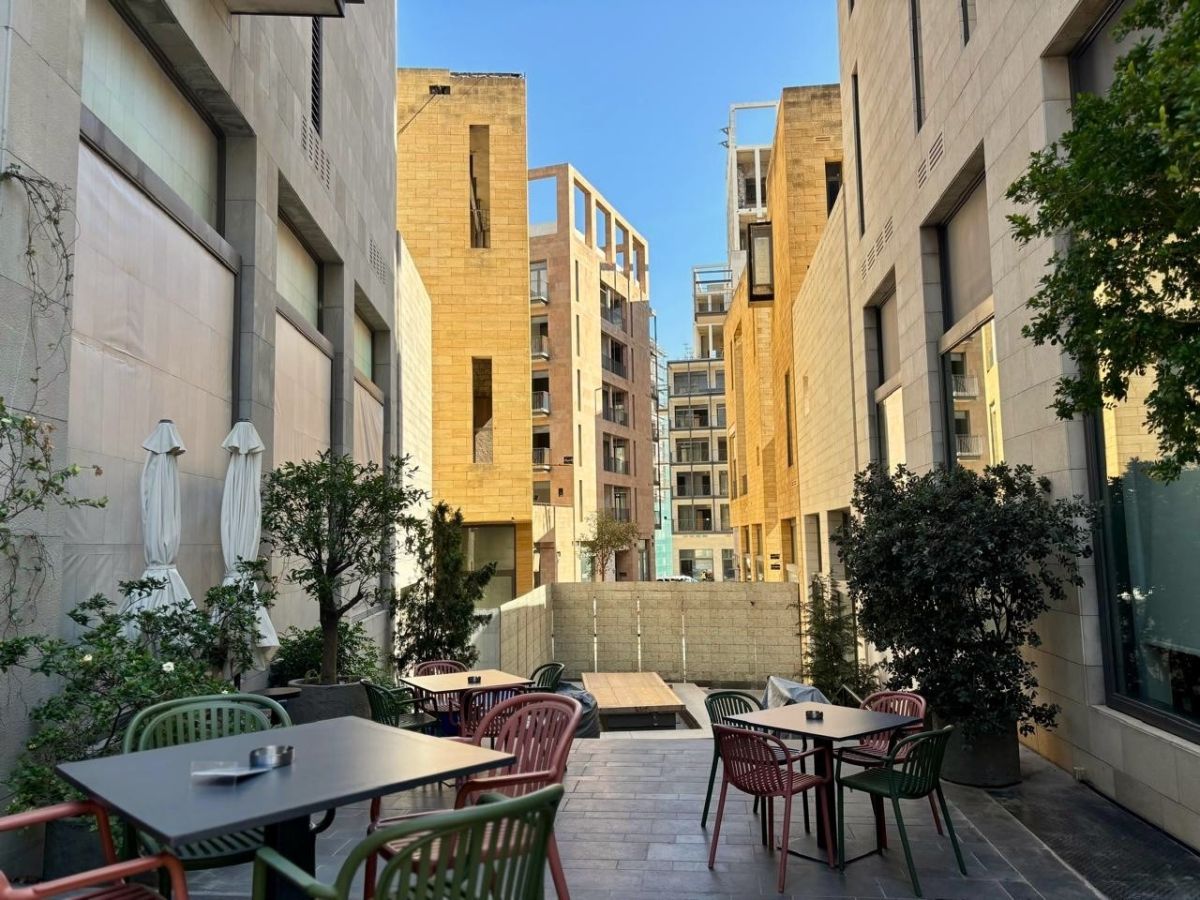
A small terrace in Beirut city center on June 24, 2026. (Credit: Philippe Hage/L'Orient-Le Jour)






The World Bank expects Lebanon's GDP to contract by 6.4% in 2026, according to the latest edition of the Lebanon Economic Monitor (LEM), the organization's semiannual report on the country, this time entitled "A Conflict-Torn Economy."
"Lebanon's economy is projected to shrink by 6.4% in 2026, as the resumption of conflict has reversed the fragile stabilization and recovery momentum recorded in 2025... While Lebanon continues to face urgent humanitarian and reconstruction needs, progress on reforms remains essential to restore confidence, relaunch growth, and support a sustainable recovery," the World Bank writes in its statement announcing the release of the report.
"Lebanon's fragile recovery was abruptly interrupted by the resumption of conflict, worsening an already severe social and economic crisis," said Dahlia Khalifa, World Bank Middle East country director, quoted in the same statement. "Advancing reforms — notably the restructuring of the banking sector and the management of public finances — will be essential to restore confidence, preserve stability, and mobilize the financing needed for reconstruction and recovery," she added, as the Lebanese Parliament amended its banking resolution law a week earlier, a step welcomed Thursday by the International Monetary Fund (IMF) and the United States, despite some weaknesses in the adopted mechanism.
The special section of the report assesses the macroeconomic impact of the 2026 conflict on Lebanon through two main channels: tourism revenue and private consumption, the World Bank notes in its statement. It estimates that GDP growth will be 10.4 percentage points lower than it would have been in a no-conflict scenario.
This edition is generally scheduled at the beginning of summer, but the uncertainty surrounding the Lebanese context makes the exercise difficult. Indeed, the country remains trapped by the war between Hezbollah and Israel, the pressure from the regional conflict between Iran and the United States on oil and supply chains, and the paralysis of the financial system, still unreformed nearly seven years into the crisis.
The organization had refrained from publishing a growth projection for Lebanon since early January, when the last LEM was published, at which point the situation led it to hope for a 4% rebound in real GDP in 2026, after a 2025 that ultimately saw growth estimated at 4.2% in this new report (compared with 3.5% for the same period in the previous LEM).


 7 p.m. recap: Iran warns Egypt, Israeli soldiers vote in south Lebanon, Haret Hreik responds to Kataeb