






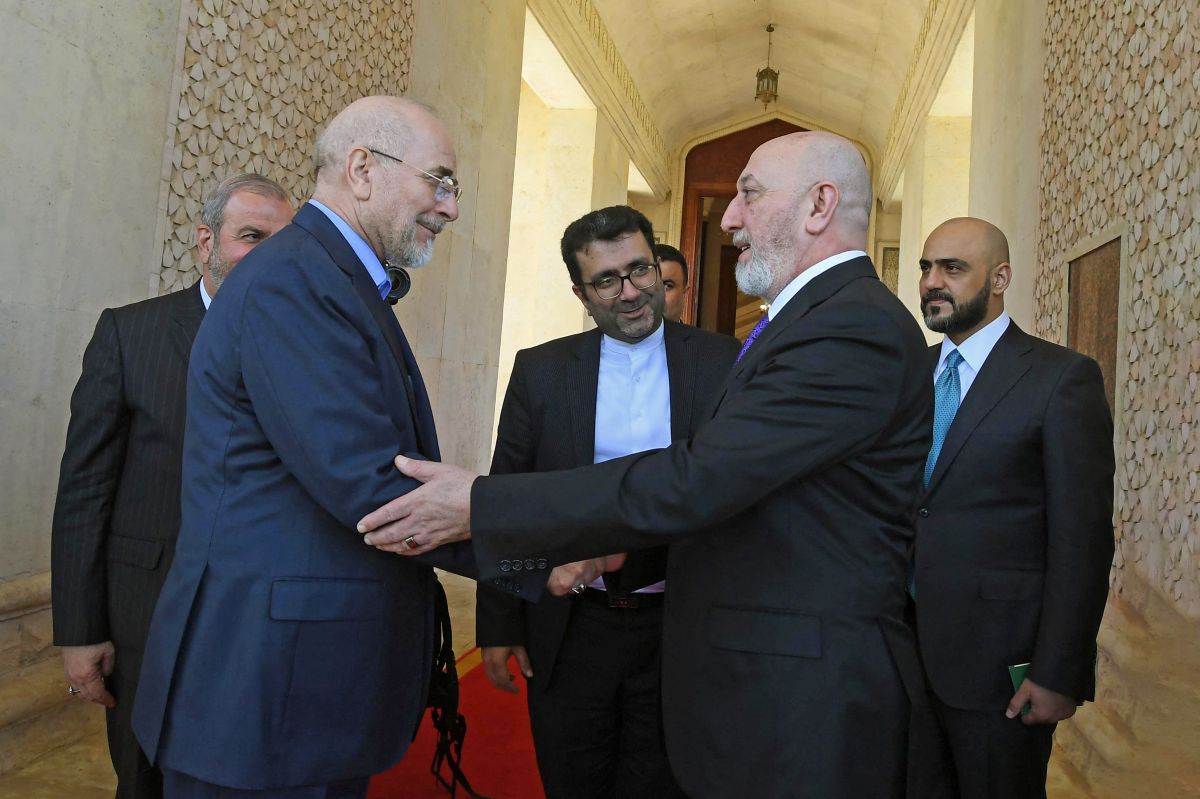
The president of the Iranian Parliament, Mohammad Bagher Ghalibaf, received by Iraqi President Nizar Amidi before a meeting in Baghdad, Aug. 19, 2026. (Credit: Iraq's Presidency/AFP)






BEIRUT — Iranian Parliament Speaker and chief negotiator Mohammad Bagher Ghalibaf stressed the need to strengthen a “new regional order” during a visit to Baghdad on Wednesday. He also denounced “foreign interference.”
His visit comes as Iraq faces U.S. pressure to disarm powerful armed groups backed by Tehran.
Ghalibaf said his three-day visit aims “to reinforce the new order in the region and to accelerate the strengthening of cooperation among all the countries in the region, without foreign interference.”
“The resistance in Iraq is one of the pillars of this country’s strength,” he said near Baghdad airport, at the site of the 2020 U.S. strike that killed Iranian General Qassem Soleimani and his Iraqi lieutenant, Abu Mahdi al-Muhandis.
Ghalibaf was due to meet Iraqi Prime Minister Ali al-Zaidi on Wednesday. He was also scheduled to meet the Coordination Framework, the ruling coalition of Shiite parties with varying ties to Tehran.
The fallout from the U.S.-Israeli war on Iran, which began in late February, has also reached Iraq. Armed factions have attacked U.S. interests, prompting deadly American strikes. Iran has also targeted positions held by Iranian Kurdish opposition groups.
Since the 2003 U.S. invasion, Iraq has been caught between Washington and Tehran. Under U.S. pressure, Zaidi has given pro-Iranian armed groups until Sept. 30 to disarm. The deadline coincides with the end of the U.S.-led coalition’s anti-jihadist mission. But some of the most powerful groups, and those closest to Tehran, reject discussing disarmament under American pressure.
Ghalibaf blames US for regional instability
Ghalibaf also blamed Washington for the region’s instability, calling the United States the “biggest problem and the main cause of all the region’s difficulties.”
He said U.S. policies and Israeli actions had fueled recent wars and disrupted energy markets. He also blamed Washington for problems in the Persian Gulf and disruptions to oil exports.
Ghalibaf argued that regional countries should not rely on the United States for security.
“The United States has moved closer to the countries of the Persian Gulf and the region in order to plunder and loot their resources,” he said.
He said regional countries could achieve greater stability through unity and without foreign interference, with Iran and Iraq playing a key role.
Ghalibaf also met his Iraqi counterpart, Haibat al-Halboussi, who called for special treatment for Iraq’s oil exports through the Strait of Hormuz, according to Iraq’s national news agency INA.
Halboussi said Iraq is “among the countries most affected by the situation and developments in the region.” Disruptions in the Strait of Hormuz have severely affected Iraq’s oil exports, forcing Baghdad to open a land route to the Mediterranean through Syria.
Iraq calls for end to ‘neither war nor peace’ situation
Iraqi President Nizar Amidi welcomed Ghalibaf and the Iranian delegation, calling the recent war unjust and saying its consequences for Iraq and the region were extensive.
Amidi called Iran and Iraq “one nation living in two lands” and said Iraq would continue to support Iran.
He also called for an end to the “neither war nor peace” situation between Iran and the United States.
“We also want the war to end,” he said. “Integrated regional security can only be achieved through the security of the countries of the region.”
Ghalibaf also called for stronger economic ties between Iran and Iraq, highlighting the Shalamcheh-Basra railway, dredging of the Arvand River and the expansion of border markets.
Iraq and Iran, both Shiite-majority countries, share a roughly 1,500-kilometer border and maintain close political, religious and commercial ties.
On Thursday, Ghalibaf will travel to Karbala for ceremonies marking the 40th day since the death of Supreme Leader Ali Khamenei, who was killed in the first U.S.-Israeli strikes on Iran on Feb. 28. He will end his visit Friday in Najaf.
