






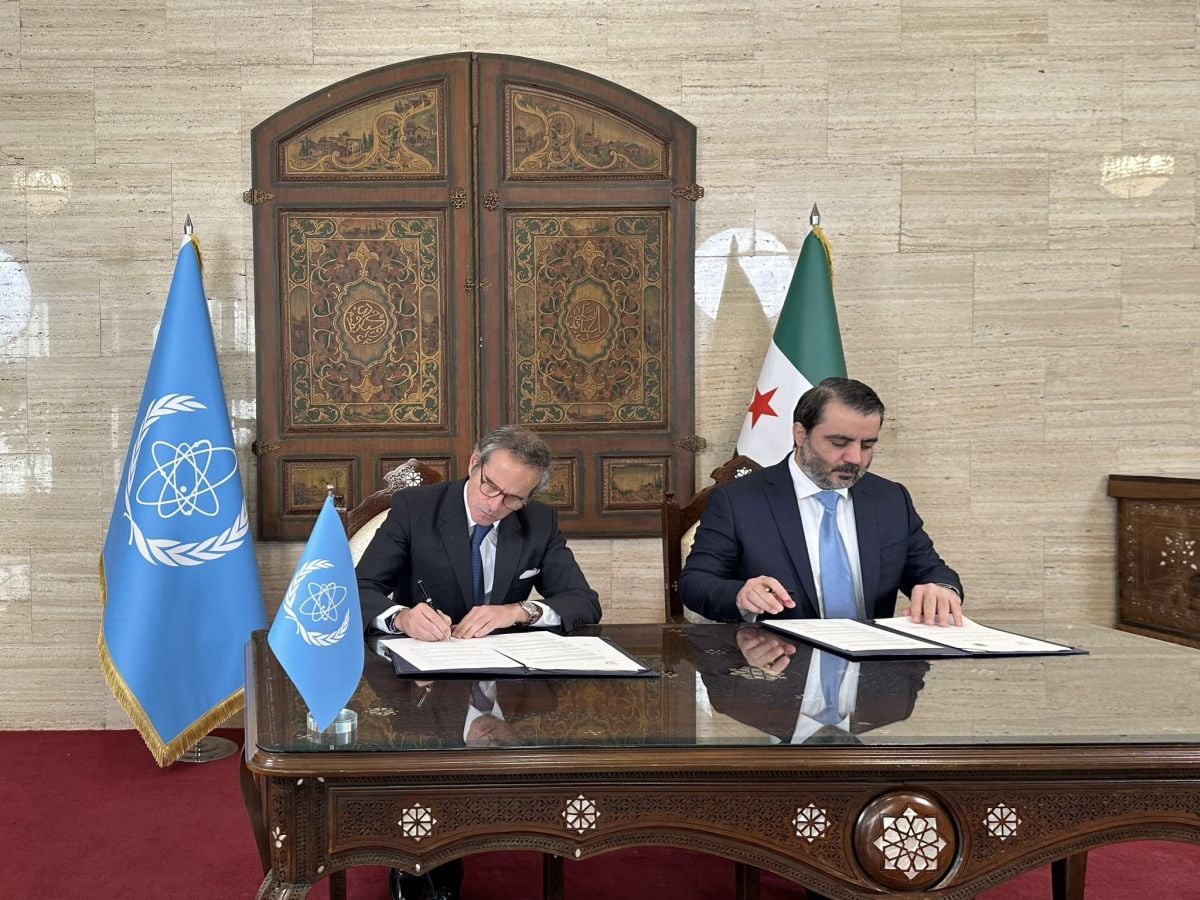
The Director General of the IAEA, Rafael Grossi, signs an agreement with Syrian Foreign Minister Assaad Chaïbani in Damascus on June 4, 2025. (Credit: Photo taken from Grossi's X account)






BEIRUT — The International Atomic Energy Agency (IAEA) will soon remove nuclear material stored at a clandestine site in Syria after the Trump administration reached understandings with Syria and Israel, according to Israeli and U.S. officials cited by Axios.
The site, known as “Site 99,” contains material linked to the Assad regime’s secret nuclear program, which centered on the clandestine Al-Kibar reactor. Israel bombed the reactor in 2007, largely destroying Syria’s nuclear program, although several research, development and storage sites remained.
The material at Site 99 cannot be used to make a nuclear weapon, according to a U.S. official cited by Axios, but it could be used in a “dirty bomb” — a conventional explosive that disperses radioactive material to contaminate an area rather than produce a nuclear explosion.
A U.S. official also said the material included yellowcake, a powder produced from uranium ore that can later be processed and enriched as part of the nuclear fuel cycle.
Israeli officials said the Israeli military bombed the entrances to the site shortly after the fall of the Assad regime to prevent access.
Secret negotiations
For more than a year, Israel and the United States had been discussing how to deal with Site 99, according to a U.S. official.
Israeli officials told Washington that they would not tolerate nuclear material remaining at the site. Israel also threatened to bomb the site again if the material was not removed or if there were signs that Syria was attempting to access it.
A U.S. official said Israeli officials were concerned but were never on the verge of bombing the site.
The United States and Israel eventually agreed that the best approach was to obtain the Syrian government’s “buy in” to remove the material.
When Washington raised the issue with Damascus, Syrian officials said they did not know that nuclear material was stored at the site, according to sources cited by Axios.
“Very few people in the U.S., Israel and Syria were aware of this,” a U.S. official said.
The official also described the relationship with Syria’s post-Assad government as productive, saying: “When we work with the Syrians on things — they are good partners.”
Suspected Syrian access
Several weeks ago, Israelis monitoring Site 99 detected movements in the area that led them to suspect that the new Syrian government was trying to access the nuclear material, according to Israeli and U.S. officials.
Israeli officials were also concerned that Turkey might help the Syrian government gain access to the material.
“The Israelis are always kicking the tires on different things to make sure it looks right and it's good they do that,” a U.S. official said.
The Trump administration asked Israel not to take action and brought the IAEA into the negotiations.
The result was an agreement signed three weeks ago between the IAEA and the Syrian government to remove the nuclear material from the site. The White House, the IAEA and the Israeli prime minister’s office declined to comment.
On Tuesday, Syria’s Atomic Energy Commission said an IAEA delegation would visit the country to announce “significant progress,” according to the Syrian state news agency SANA.
The commission reaffirmed its “transparent cooperation with the IAEA to manage the legacy of the defunct regime, strengthen Syria's adherence to the Agency, and support it in peaceful nuclear energy applications.”
A week after the fall of the Assad regime, the IAEA had already signed an agreement with Damascus allowing it to visit the Al-Kibar reactor and other sites linked to Syria’s past nuclear activity.
A wider regional rivalry
The cooperation comes as Israel views Syria’s new Islamist-led government as a security threat.
Following the fall of Assad, Israel destroyed large parts of the former regime’s military infrastructure and has since occupied part of the formerly demilitarized Golan Heights while carrying out regular incursions into Syrian territory.
Israel is also concerned about growing Turkish influence in Syria. Ankara has strongly criticized Israeli expansion in the region since Oct. 7.
The tensions contrast with the rapprochement between Syria and the United States since Assad’s fall. Washington recently removed Syria from its list of state sponsors of terrorism, a designation dating to 1979.
The announcement followed a meeting between U.S. President Donald Trump and Syrian leader Ahmad al-Sharaa on the sidelines of the NATO summit in Turkey. Washington has also moved to lift most sanctions on Syria.
What happens next?
The nuclear material has not yet been removed from Site 99.
U.S. officials said the operation remains ongoing and that the removal process is expected to begin soon.
“We think everybody is happy with the result. Hopefully we will be able to kick off the removal process soon and end it before the end of the year,” a U.S. official said.

