






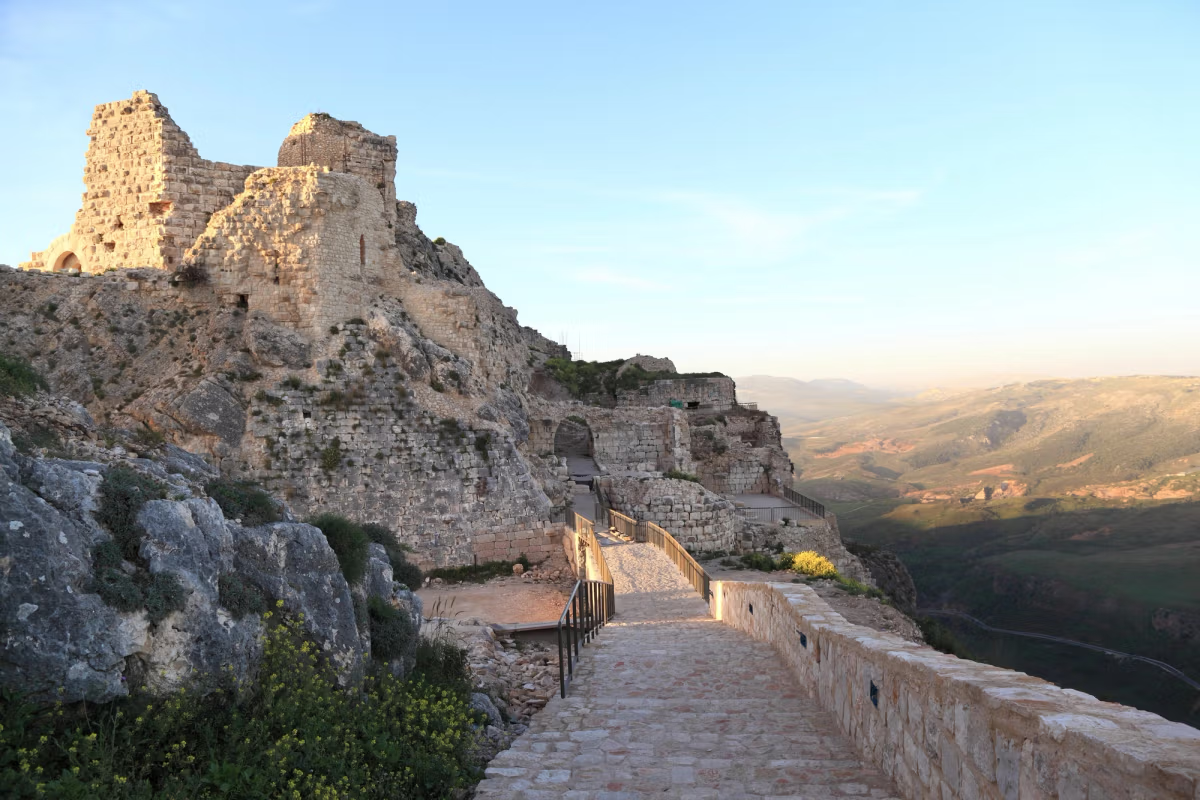
The Beaufort Castle in Nabatieh. (Credit: NNA)






Five medieval castles in south Lebanon's Jabal Amel region were inscribed Friday on UNESCO's World Heritage List and the List of World Heritage in Danger during the World Heritage Committee's meeting in Busan, South Korea, UNESCO said in a statement.
The emergency inscription recognizes the castles' outstanding historical and architectural value while acknowledging the threats and damage they have faced during the recent war in Lebanon.
The decision came despite objections from Israel, which had urged UNESCO to reject the nomination. Meeting in Busan, committee members approved the emergency inscription of both Sebastia, in Palestine, and the five Jabal Amel castles on the World Heritage List and the List of World Heritage in Danger.
According to UNESCO, the five castles are recognized for their layered architectural heritage, combining Crusader, Ayyubid, Mamluk and local influences, reflecting nearly nine centuries of fortified architecture in the region.
Israel also objected to the inclusion of Beaufort Castle (Shaqif), arguing that Hezbollah had transformed the site into a military stronghold by constructing tunnels beneath it and launching rockets from the surrounding area. In June, the Israeli military claimed to have uncovered Hezbollah infrastructure and tunnel networks beneath the historic grounds, drawing strong pushback and fears of a total demolition from local leaders.
For its part, Hezbollah reported engaging in a war of attrition against Israeli troops stationed around the foothills of the fortress.
Raising of Israeli flags over historic castles, damage and occupation
Welcoming the decision, Culture Minister Ghassan Salameh said the inscription reflects "the outstanding universal value" of five castles that collectively shaped the history of south Lebanon over centuries.
The serial nomination includes Beaufort Castle (Shaqif), Toron Castle (Tibnin), Shaqra Castle (Doubeih), Deir Kifa Castle (Maroun) and Shamaa Castle.
Addressing the World Heritage Committee, Salameh thanked member states for approving the inscription and recognizing the challenges facing the sites.
"Today marks a milestone of great importance for Lebanon and for the protection of our shared cultural heritage," he said. "On behalf of the Lebanese government and the Lebanese people, I extend my sincere thanks to the World Heritage Committee for its decision to inscribe the Jabal Amel castles on UNESCO's World Heritage List, while at the same time recognizing the exceptional challenges facing this property through its inscription on the List of World Heritage in Danger."
According to the minister, the castles formed "an integrated defensive and administrative network" controlling strategic routes between the Mediterranean coast and inland regions while bearing witness to nearly 1,000 years of political, military and cultural history.
Salameh said their inclusion on the List of World Heritage in Danger also reflects "the scale of the challenges and damage these monuments suffered as a result of the recent conflict," while demonstrating the international community's commitment to supporting their protection and recovery.
"Lebanon does not view this inscription as a judgment or condemnation," he said. "Rather, it sees it as a call for collective action and an acknowledgment of the profound impact of the recent conflict, as well as the international community's determination not only to safeguard the site's outstanding universal value, but also to support efforts to protect, restore and preserve it for future generations."
He reaffirmed Lebanon's commitment to working with UNESCO and its advisory bodies to preserve the sites.
"What was built over thousands of years must not be lost in a matter of hours," Salameh said.
Repeated Israeli violations on cultural sites
On Thursday, and Israeli flag was raised over Doubieh fortress in south Lebanon, and Salameh had condemned the act "carried out by Israeli soldiers."
Between April and May 2026, the medieval 11th-century citadel in Shamaa (Sour) and its enclosed village suffered extensive damage from airstrikes, precision explosives, and military bulldozing. The site lost at least three of its four distinctive domes.
Separately, Tibnin Castle (Bint Jbeil) has sustained structural damage during the late 2024 war including heavy impacts and the collapse of an outer medieval wall from nearby Israeli strikes.
Beaufort Castle, one of the five inscribed sites, has long held strategic military significance. Following Israel's invasion of Lebanon in 1982, the hilltop fortress overlooking the Litani River was occupied by Israeli forces and later transformed into a military position. Additional buildings and fortifications were constructed before being destroyed when Israel withdrew from south Lebanon in May 2000.
Additionally, Sour, an ancient Phoenician city along the southern coast of Lebanon was the target of incessant and severe Israeli airstrikes throughout the latest Israeli war on Lebanon. After calls from the Lebanese state, it was added on Tuesday to the list of World Heritage in Danger by the United Nations Educational, Scientific, and Cultural Organization (UNESCO), as announced by the U.N. agency on X.
