






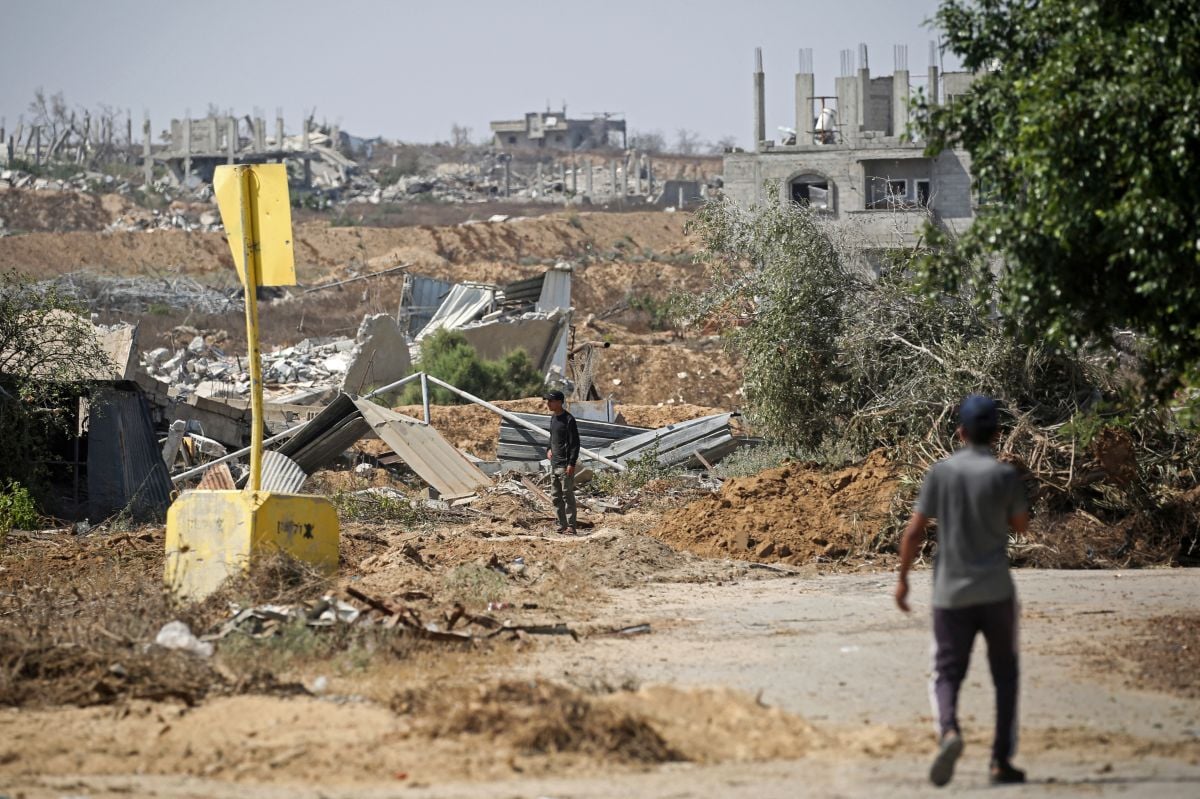
Palestinians walk past a concrete block marking the 'Yellow Line' drawn by the Israeli military in the east of Deir al-Balah, central Gaza Strip on July 22, 2026, as violence has continued in Gaza despite the theoretical "cease-fire." (Credit: Eyad Baba/AFP)






BEIRUT — Israel has expanded a land barrier in Gaza beyond the official cease-fire ''Yellow Line" and into territory designated to remain under Hamas control, Haaretz reported, citing satellite imagery.
The report says the barrier, largely made up of earthen embankments and trenches, had previously followed the "Yellow Line," with only limited deviations. However, satellite images from July show it now extends about 400 meters beyond the line near Khan Younis and up to 1,300 meters in the Rafah area.
According to Haaretz, the expanded barrier approaches the Israeli military's self-declared "Orange Line," an area deeper inside Gaza where humanitarian organizations are obliged to coordinate movements with the Israeli army.
The Israeli daily reported that Israel has also moved "Yellow Line" marker blocks westward in several locations, increasing the territory under its control. While the theoretical "cease-fire" framework placed around 53% of Gaza under Israeli control, Haaretz said current restrictions now affect about 65% of the enclave, after Prime Minister Benjamin Netanyahu directed the military to expand Israeli-controlled territory to 70%.
The U.N. Office for the Coordination of Humanitarian Affairs has also reported that Israeli forces have shifted marker blocks beyond the original "Yellow Line" in several parts of Gaza, including the north, Gaza City and the Deir al-Balah governorate, according to the report.
Gaza remains gripped by daily violence, with both the Israeli military and Hamas accusing one another of violating the truce. Israel has killed at least 1,185 Palestinians and injured over 3,800 others since the Oct. 10 truce went into effect, according to Gaza health officials.
Israel's genocidal war on Gaza killed over 70,000 Palestinians, flattened swathes of the territory, displaced most of the population at least once, and left hundreds of thousands of people living in tents and temporary shelters.
