






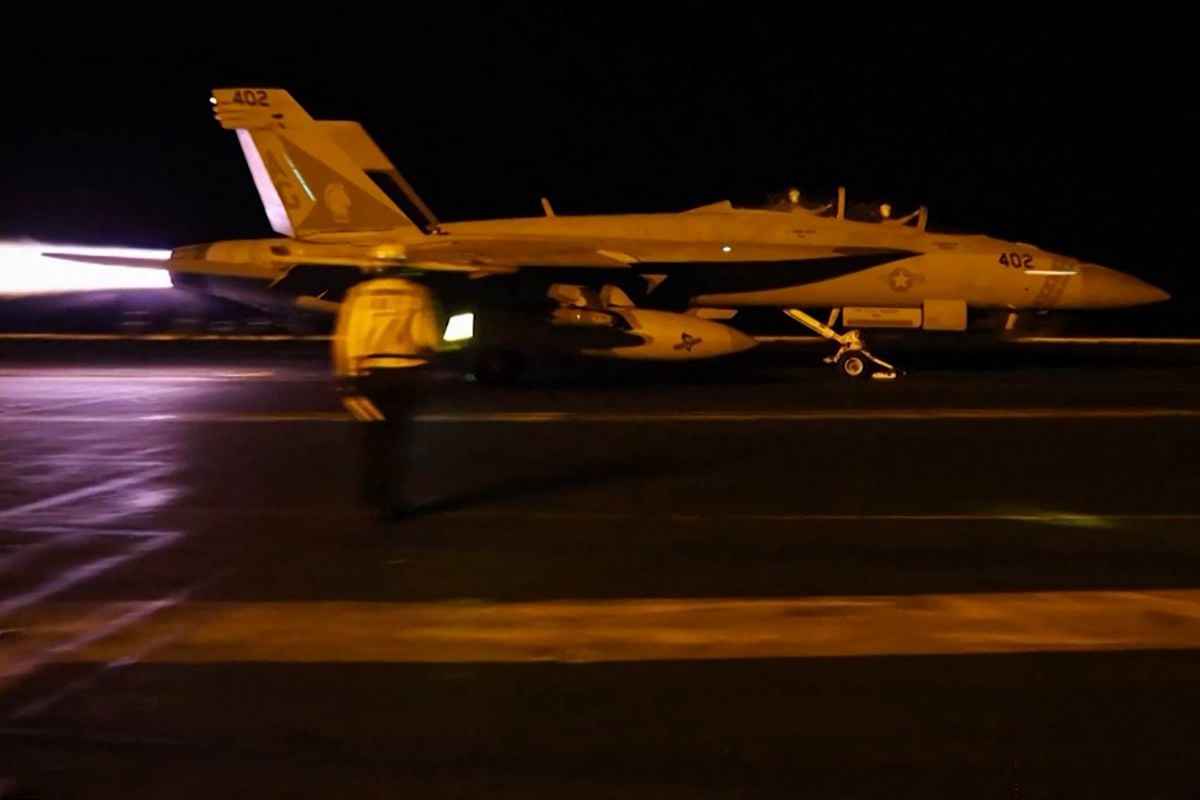
This screenshot, taken on July 19, 2026 from a video provided by US Centcom and released on July 18, shows U.S. forces carrying out what the military describes as precision strikes targeting Iranian military capabilities, for the eighth consecutive night. (Credit: Centcom]/AFP)






BEIRUT — A possible involvement of Israel in the renewed war between the U.S and Iran would "clearly thwart the plans" for Israel's withdrawal from the south, according to Haaretz.
The Israeli newspaper is a known critic of Prime Minister Benjamin Netanyahu’s government.
A cease-fire in Lebanon, which has been caught up in the regional war following Hezbollah’s intervention alongside Iran, is mentioned in the first point of the agreement between Washington and Tehran signed in mid-June, which has been challenged this week by both sides amid escalating tensions.
All indications, however, suggest that the Israeli occupation of the south will be long-lasting, according to observers.
President Joseph Aoun is currently in Washington attempting to persuade the Trump administration to put pressure on Israel for a withdrawal, while destruction continues in the occupied areas. In early July, Israeli army Chief of Staff General Eyal Zamir promised "decisive" action against Hezbollah during a tour of his troops near Beaufort Castle in Southern Lebanon.
Israeli silence
However, as hostilities resume between the United States and Iran, neither side currently wishes to involve Israel, Washington’s ally, in the escalation in the Middle East, according to Haaretz.
The newspaper, which describes Israel as an "unpredictable actor," nevertheless believes that "the inability to contain hostilities" or Netanyahu’s "political considerations" could change the situation.
According to Haaretz, the United States does "not need for now" Israeli assistance, and Iran "hesitates to involve the Jewish state at this stage, because Tehran is clearly not interested in a broader confrontation." The paper notes the Israeli government’s silence on a possible involvement in the conflict.
Israeli officials quoted by Axios earlier this week said the decision to postpone Netanyahu’s visit to Washington planned for Saturday was linked to the anticipation of a military escalation in the region, and that the prime minister would rather be on site in case of an Iranian attack.
His popularity has declined following criticism over his handling of the war against Iran. An overwhelming majority of Israelis believe Iran emerged victorious from the conflict after the framework agreement with the United States, and that their country’s long-term security has been weakened as a result.
The newspaper also recalls the ongoing tensions between the Israeli government and Eyal Zamir, the latter regularly pointing to a "shortage" of soldiers in the Israeli army, amid controversy over exemptions from military service for ultra-Orthodox Jewish students.
Under an agreement dating back to Israel’s founding in 1948, those studying religious texts full-time avoid conscription. However, calls for their enlistment have intensified in recent years, as the Jewish state is engaged in several conflicts.

