







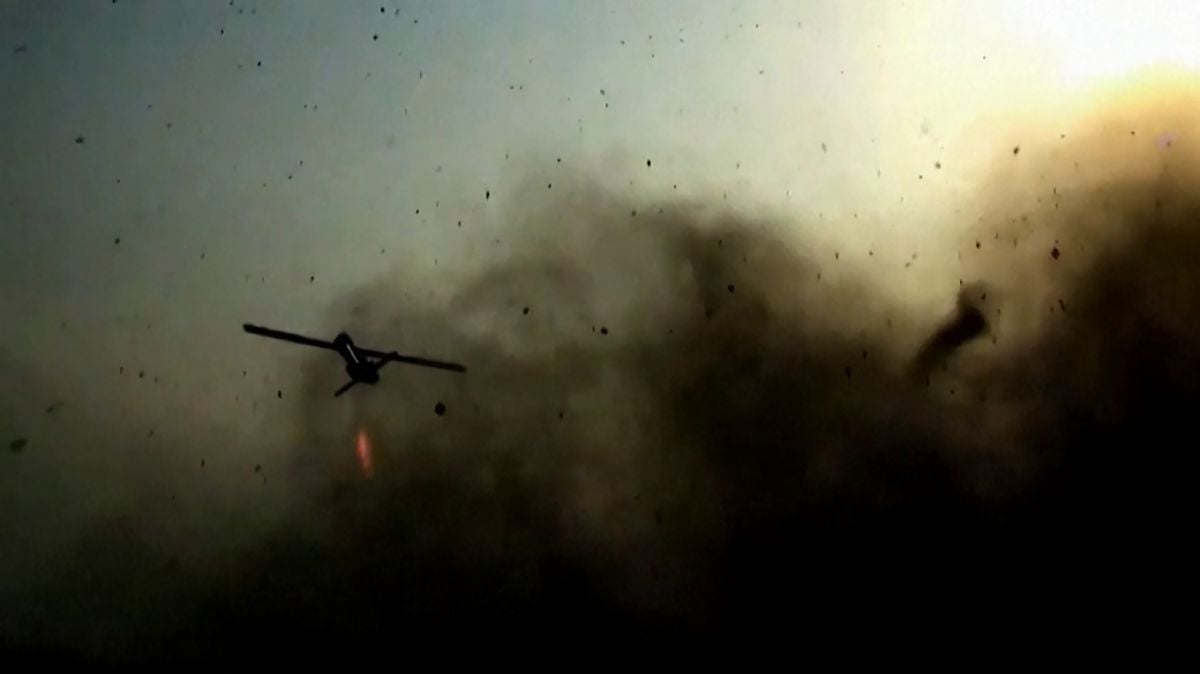
This screen grab taken on July 15, 2026, from video footage released by the IRGC Sepah News website on July 14, 2026, allegedly shows a drone being launched from an undisclosed location towards U.S. targets in Bahrain and Kuwait. (Credit: Sepahnews.com/AFP)






The United States struck bridges and an airport in Iran on Friday and Tehran responded by hitting a power and desalination plant in Kuwait, as the warring foes risked further escalation by expanding their targets to include infrastructure.
In the contested Strait of Hormuz, where the renewed conflict has again cut off global energy supplies from the Middle East, U.S. Marines boarded a tanker and another ship was reported to have been hit by a projectile. Another vessel was boarded by armed men off Yemen, though one maritime security source said the incident appeared to be an act of Somali piracy rather than linked to the Iran conflict.
Washington and Tehran have been testing the limits of escalation since their ceasefire agreement collapsed last week, raising the prospect of a return to all-out war. U.S. President Donald Trump has threatened to launch broad-based air strikes on Iran's infrastructure and has also declined to rule out a ground assault on Iran's coast or islands. U.S. officials have said attacks on southern Iran are designed in part to give Trump options. Such moves risk provoking Iran to escalate in turn by hitting the vital infrastructure of vulnerable neighbouring Arab states, or having its allies in Yemen further disrupt global energy supplies by attacking shipping from the Red Sea.
Bridges hit in Iran, plant hit in Kuwait
In the latest strikes, the U.S. military's Central Command included "military logistics infrastructure" in the list of targets it said it had hit, the first time it has mentioned infrastructure in more than a week.
Iranian state media said at least five bridges had been struck in the south. Seven people were reported killed in attacks on bridges in the southern port of Bandar Khamir, where the train station was also hit. An airport was reported hit further east and away from the coast in Iranshahr, in a province bordering Pakistan.
Reuters could not verify the reports, which also described other deadly attacks including one which killed a woman and wounded her child in the port of Bandar Abbas.
In response, Iran announced attacks on Gulf countries that host U.S. airbases, including Bahrain, Qatar and Kuwait. Authorities in Kuwait said one of the country's power generation and water desalination stations had been hit in an Iranian attack, causing damage to facilities, a fire and the disruption of a large number of electricity generation units.
Firefighters brought the blaze under control, while technical teams began assessing the damage, securing the station and working to restore power generation as soon as possible, the electricity water and renewable ministry, said. The rich Arab Gulf states depend on plants that produce electricity and remove salt from seawater to make their desert cities habitable. When Iran hit a Kuwaiti desalination plant on March 30 it was seen as a major escalation that helped push the United States to declare the war's first cease-fire a week later.
Feud over strait
Iran said it had struck U.S. bases in Kuwait, Qatar and Bahrain, and a U.S. radar station in Oman. Explosions were heard in the Qatari capital Doha, where the interior ministry said a child was wounded by shrapnel.
Iran also said it fired at Syria, apparently for the first time in the war, targeting what it described as a U.S. special forces base in Tanf. Syria says U.S. forces pulled out of the base there earlier this year. A Syrian military source said the strike hit near the base and caused no damage or casualties.
An interim agreement to end the war has collapsed since July 7, when Iran struck ships in the Strait of Hormuz and the United States responded with air strikes.
The escalation pushed the benchmark price of Brent crude up by another 2% to around $86, its highest level since an interim agreement was reached a month ago to end the war.
Iran has announced the closure of the strait, and Washington has reimposed its own blockade of Iranian ports.
In the latest action at sea, the U.S. military said it had boarded a tanker to enforce the blockade, releasing photos of Marines rappelling down from a helicopter onto the deck where one posed in front of an Iranian flag. Beyond the Gulf, armed men seized a small chemical tanker off Yemen in the Gulf of Aden, close to the mouth of the Red Sea. One maritime security source said the incident appeared to be related to Somali piracy rather than Iran's Yemeni allies, the Houthis.
While Iran and the United States have exchanged strikes daily since last week, they have so far stopped short of escalating beyond parameters set earlier in the war, when civilian infrastructure and major economic targets were mostly deemed out of bounds because of the threat of retaliation.
Iran has said that it would attack civilian infrastructure across the Middle East if Trump follows through on threats to attack Iran's infrastructure. It has also signalled that it could prod its Houthi allies in Yemen to close another key strait: the Bab al-Mandeb at the mouth of the Red Sea, potentially cutting off the main alternative route for Middle East oil bypassing the Gulf. Sources have told Reuters Iran has already instructed the Houthis to act if Washington attacks Iran's infrastructure.
The surge in energy prices generated by the conflict has created pressure on Trump to end the war quickly. In a televised speech on Thursday night mainly about election security, Trump said the United States was "winning big in Iran, and you will see the fruits of that labour very, very shortly."