



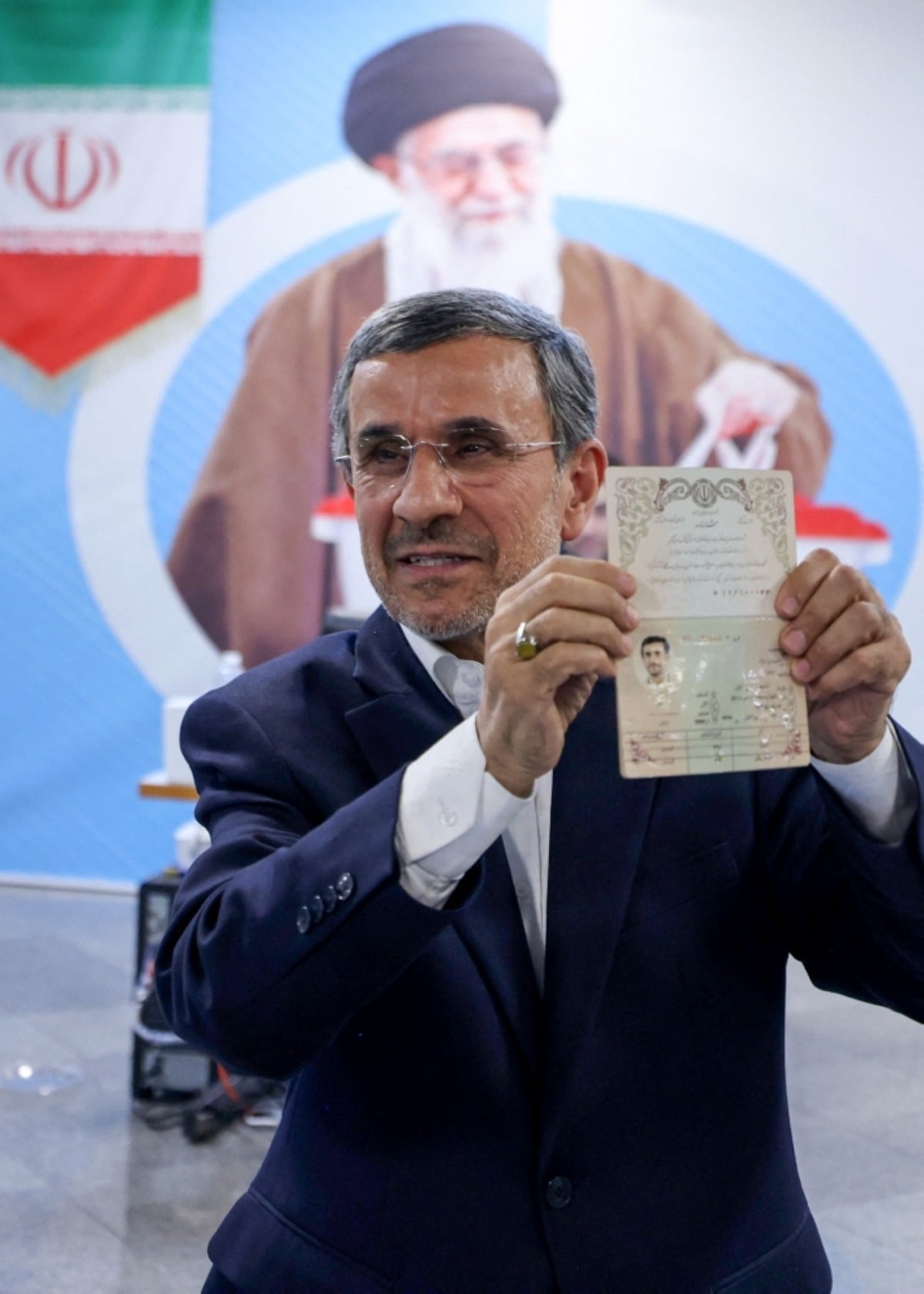
Former Iranian president Mahmoud Ahmadinejad posing while submitting his candidacy for the presidential election in Iran on June 2, 2024. (Credit: AFP)






A yearslong Israeli intelligence operation aimed to return former Iranian President Mahmoud Ahmadinejad to power, despite his hardline rhetoric against Israel, according to a report by The New York Times published on Monday. Ahmadinejad's office denied the allegations.
Alleged plan tied to the Abraham Accords
According to the NYT, Israeli intelligence sought to recruit Ahmadinejad as a Mossad asset before installing him as the leader of a restructured Iranian government.
Ahmadinejad served as president from 2005 to 2013. Under his rule, Iran restarted a program to enrich uranium, raising suspicions that it was pursuing a secret nuclear weapons program. He ordered violent crackdowns on a nationwide uprising contesting his re-election in 2009, and the judiciary carried out mass executions of dissidents and jailed opponents and rivals.
He was later sidelined and placed under close surveillance by Iranian authorities. As time went on, he reportedly trimmed his beard, began wearing suits instead of his usual oversized khaki jacket, and learned English, raising suspicions that he was planning for a return to power. According to an anonymous associate cited by the newspaper, he had said that if foreign powers were to place a new Iranian leader, he would be considered a better option than someone unknown, and that he would have Iran join the Abraham Accords.
The report does not specify when Israeli intelligence allegedly began trying to recruit Ahmadinejad. Iranian officials said there was at least some contact during a 2023 trip to Guatemala for an environment conference. Authorities initially refused to allow him to leave Iran, denying him a boarding pass, before relenting after he launched a social media campaign.
Alleged meetings with Mossad
According to the report, the operation intensified in 2024 when Ahmadinejad traveled to Budapest, where he allegedly met then-Mossad chief David Barnea.
Israeli officials reportedly arranged for "a top Hungarian government official" to order a local university to invite Ahmadinejad for a climate conference as cover for the meeting.
It also cited U.S. security officials who said Israeli intelligence later financed Ahmadinejad's international travel to facilitate additional meetings with Mossad agents, namely to Hungary, then led by Prime Minister Viktor Orbán, a close ally of Israel.
The report further alleged that after Ahmadinejad — who had been barred from running for president three times — was placed under house arrest, Israeli operatives extracted him during the first day of the Israeli-U.S. war on Iran.
On Feb. 28, an Israeli airstrike hit his compound, targeting the building of his bodyguards and his armored vehicle. After the strike, according to four senior Iranian officials, a black Peugeot car picked him up. American and Iranian officials said the car had been driven by Mossad operatives, who took Ahmadinejad to a secret safe house in Iran.
The newspaper also reported that Israel and the United States planned to arm and train Iranian Kurdish groups and other ethnic minority factions, enabling them to enter Iran from the west and advance toward Tehran in an effort to overthrow the country's clerical leadership. The plan was never carried out.
Public reappearance
Ahmadinejad, described as "upset" by the scale of the Mossad operation and "disillusioned" with the broader Israeli plan, left the secure location under unclear circumstances.
He did not reappear publicly until the funeral of former Supreme Leader Ali Khamenei in Tehran. Ahmadinejad remained under the custody of the Revolutionary Guards' intelligence branch despite his public appearance.
In a statement issued Tuesday, Ahmadinejad's office categorically denied the allegations. It called them "scandalous" and accused The New York Times of attempting to undermine his popularity. The statement also said the report sought to "exploit the political tensions generated by military threats" and described it as another example of "psychological warfare" targeting the Iranian public.

 7 p.m. recap: 1 person killed near border with Lebanon; 200 kilos of explosives carried by mules; Riyadh shuts its airspace