






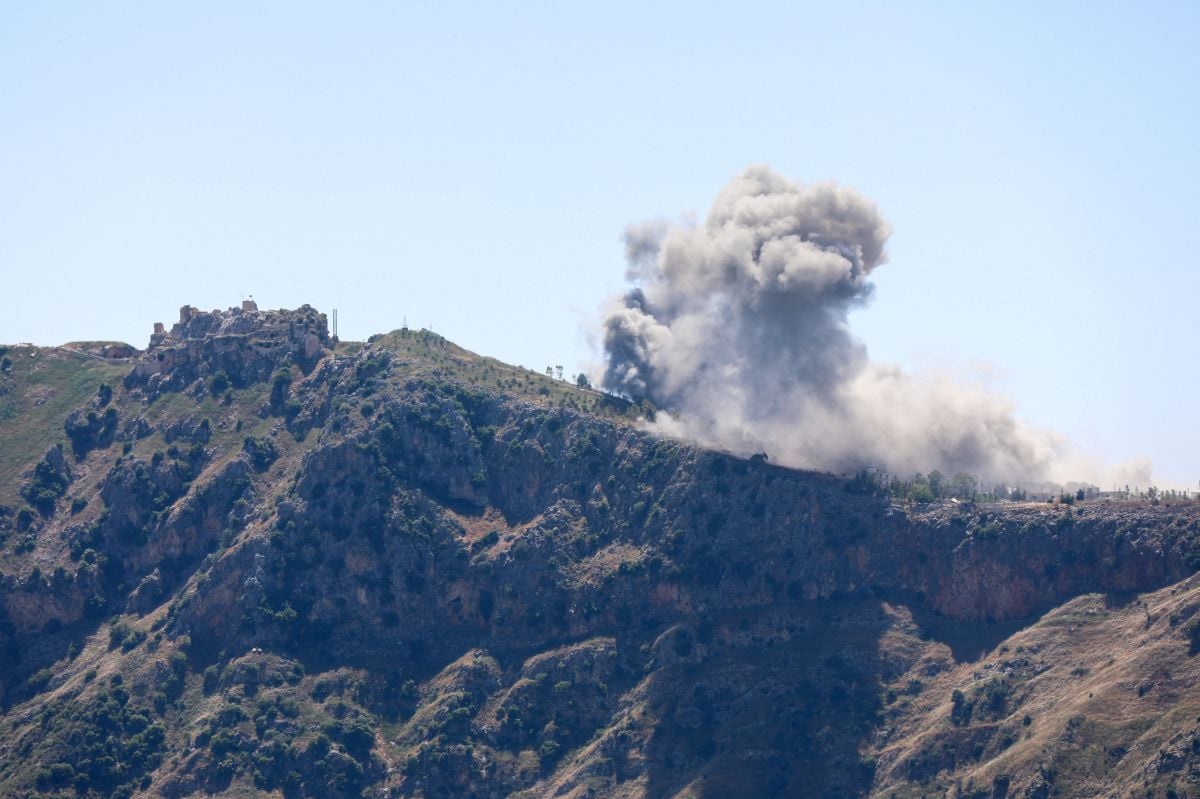
Smoke rises near Beaufort Castle, which was captured by Israeli forces, as seen from Marjayoun in southern Lebanon, on June 4, 2026. (Credit: Stringer/Reuters)






Lebanese Culture Minister Ghassan Salameh said Saturday that his ministry’s efforts to protect the country’s archaeological heritage have ‘’borne fruit,’’ announcing that 79 Lebanese sites, up from 39, now benefit from UNESCO’s ‘’enhanced protection’’ mechanism.
The announcement comes as Israeli attacks continue in southern Lebanon despite a cease-fire, although at a lower intensity.
Salamé said that had archaeological sites been directly targeted during the two wars between Israel and Hezbollah since Oct. 8, 2023, ‘’the damage would have been more significant,’’ according to the state-run National News Agency (NNA).
Several sites nevertheless sustained direct or indirect damage, he said. ‘’The Shamaa sanctuary, in particular, was directly hit: Three of its domes collapsed, and the fourth is now threatened.’’
Salameh also voiced concern over Israeli claims that tunnels are located near the Beaufort Castle, saying he launched ‘’a diplomatic and media campaign to demonstrate that these tunnels are more than 700 meters from the castle.’’
The archaeological sites of Sour and Baalbeck were also affected by vibrations caused by nearby strikes, resulting in fragments falling from several columns, he added.
’Specialized technical studies’
Assessing the full extent of the damage will require ‘’specialized technical studies,’’ Salameh said. He added that the Culture Ministry and the Directorate General of Antiquities, with the help of about 30 site guards in Sour, have spent recent months documenting the damage through field inspections, satellite imagery and residents’ testimonies in preparation for reconstruction.
Salameh made the remarks during a meeting of the parliamentary committee overseeing implementation of the Sustainable Development Plan for the protection of Lebanon’s cultural heritage following Israeli attacks. The meeting, held in Parliament’s library and chaired by MP Inaya Ezzeddine, included representatives from UNESCO, the U.N. cultural agency.
’’One of the priorities of the Ministry of Culture is to safeguard memory, alongside its mission to promote national unity, strengthen a shared sense of identity and contribute to economic recovery,’’ Salameh said.
He added that the ministry had mobilized ‘’all available legal and diplomatic means’’ to protect archaeological sites in south Lebanon.
Salameh said he had relied on UNESCO’s ‘’enhanced protection’’ mechanism to expand the number of protected sites, explaining that the designation is intended to prevent attackers from claiming ignorance when archaeological sites are struck because they are clearly identified.
At the end of an extraordinary session, a UNESCO committee unanimously approved expanding the number of Lebanese sites benefiting from enhanced protection from 39 to 79, he said.
Salameh also said he had asked UNESCO to place the archaeological site of Sour on the List of World Heritage in Danger, citing ‘’serious concerns’’ over the damage caused by intense Israeli bombardment. Sour is already inscribed on UNESCO’s World Heritage List.
He added that he had also submitted an urgent request to the World Heritage Committee, which is scheduled to meet July 17 in South Korea, to inscribe the five fortresses of Jabal Amel: Shamaa, Beaufort, Chaqra, Tebnine and Deir Kifa, on the World Heritage List.
Salameh said he also submitted a detailed report on the damage to Deputy Prime Minister Tarek Mitri, who included a chapter on archaeological heritage in his report to the U.N. Human Rights Council in Geneva, arguing that damage to cultural heritage also constitutes a human rights violation.
’’In good conscience, I am convinced that we have succeeded in making our voices heard through legal and diplomatic channels,’’ Salameh said. He added that he had contacted more than 25 culture ministers around the world, particularly in major powers, to inform them of Lebanon’s efforts and the damage sustained, and that he remains in regular contact with UNESCO Director-General Khaled El-Enany.

 8 p.m. recap: Israel again threatens Beirut’s south suburbs; 2 ships hit near Hormuz; Riyadh football matches canceled