






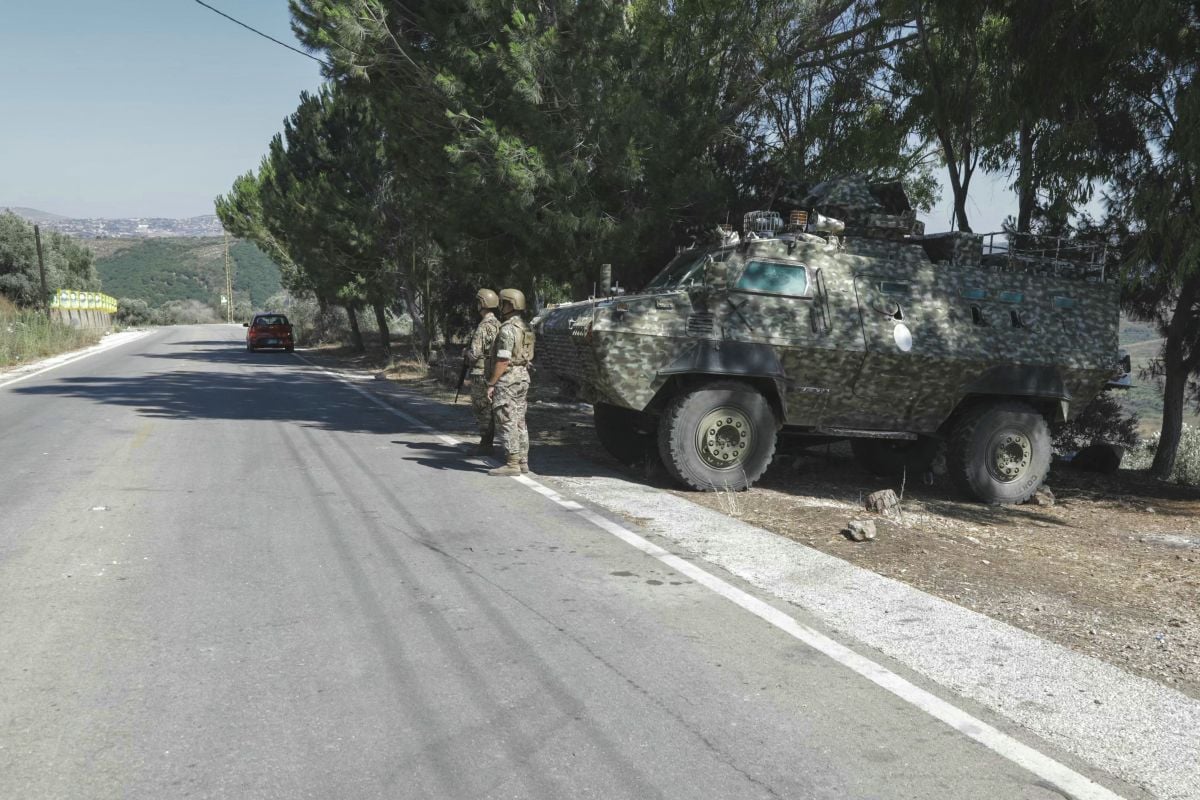
Lebanese soldiers in Froun, southern Lebanon, on June 30, 2026. (Credit: Kawnat Haju/AFP)






SOUTH LEBANON — Israel has delayed its withdrawal from the so-called "pilot zones" in southern Lebanon until a new monitoring mechanism is put in place, according to Kan11.
The withdrawal of Israeli troops from two "pilot zones’ in southern Lebanon, as provided for in the framework agreement signed last Friday between Lebanon and Israel, is reportedly to be postponed until an agreement is reached on a "joint monitoring mechanism" for the Lebanese and Israeli armies, according to Israeli Channel 11.
In addition to the framework agreement, the two countries signed a “security annex” on Friday, which provides for Lebanon and Israel to establish a “Military Coordination Group for Lebanon (MCG4L),” tasked with operating 24 hours a day, 7 days a week to manage deconfliction, verification, and overall implementation” of the framework.
No timeline established
This new "Mechanism," which is set to replace the supervisory committee established following the ceasefire agreement of Nov. 27, 2024, is expected, according to the Israeli broadcaster, to "strengthen cooperation" between the two countries, "which will operate jointly, presumably within a virtual joint command center, under U.S. coordination."
Security sources close to the matter emphasized to the media that no timetable has been set for a withdrawal from the "pilot zones," but that when it does take place, it must “be carried out properly.”
Unlike the 2024 "Mechanism," this supervisory commission will also be tasked with coordinating the dismantling of Hezbollah’s infrastructure, rather than merely reporting "cease-fire" violations. With this in mind, the United States seeks to "approve" the participants in order to ensure that Hezbollah does not have access to the information transmitted via this mechanism.
Ongoing Israeli violations
On the ground, Israel continues to occupy an area of over 600 square kilometers along the southern Lebanese border, extending up to ten kilometers deep into Lebanese territory.
Although the situation has been relatively calmer since June 20, when a precarious cease-fire went into effect following the Iran-U.S. MoU, Israeli nevertheless continues to carry out regular attacks across southern Lebanon, demolishing what little is left of homes in the border villages and carrying out other explosive detonations and military earthworks.
This morning, Israeli soldiers opened fire on a vehicle near the Ibl al-Saqi spring (Marjyoun), hitting the car several times, without causing any injuries, according to our correspondent in southern Lebanon.
Located in the south-eastern corner of Lebanon, a few kilometers from the border, the village was home to around 450 Lebanese families — Christians and Druze — prior to the war.
Meanwhile, Israeli troops carried out earthworks using military bulldozers on what was once a farm on the outskirts of Shanouh and Halta (Hasbaya), within the so-called "yellow line." The farm has been emptied of both people and farm animals due to Israel's ongoing occupation of the area.
Overnight between Tuesday and Wednesday, an Israeli drone fired a stun grenade on Haddatha. Israel proceeded to destroy houses in both Haddatha and Tiri, both located in the Bint Jbeil district.

 8 p.m. recap: Israel again threatens Beirut’s south suburbs; 2 ships hit near Hormuz; Riyadh football matches canceled