







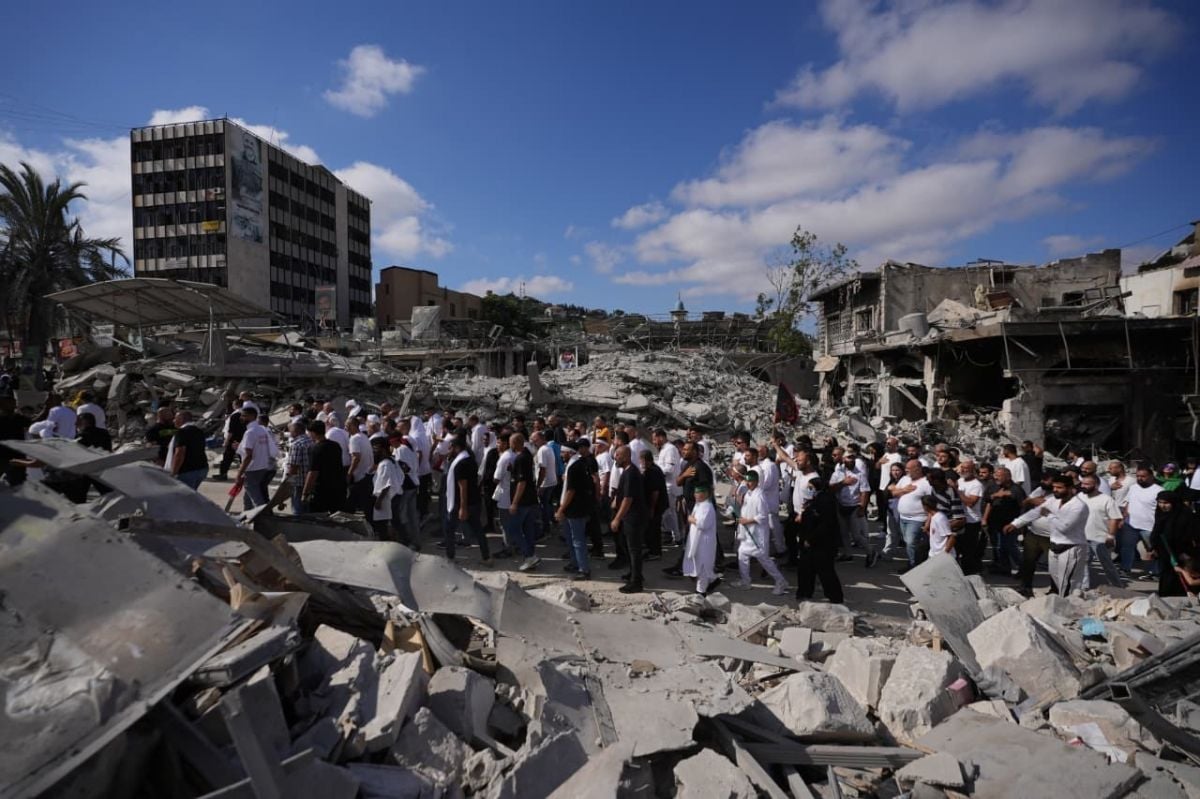
Residents commemorate Ashura amid the ruins in Nabatieh, southern Lebanon, on June 26, 2026. (Credit: Mohammad Yassine/L'Orient-Le Jour)






BEIRUT — Israeli occupation jets carried out strikes Friday in the Nabatieh and Bint Jbeil districts for the first time since the cease-fire took effect last Saturday, our correspondent in southern Lebanon reports.
Two strikes targeted Nabatieh Fawqa (Nabatieh) at 7:30 a.m. Friday, as processions were being held in the city to commemorate Ashura, a Shiite religious observance. Shortly after midnight, Israeli fighter jets also carried out two strikes on Beit Yahoun (Bint Jbeil).
Tensions had gradually risen overnight after about a week of relative calm, our correspondent reports, with artillery fire reported after 10:30 p.m. on the outskirts of Braasheet and Beit Yahoun, which was hit by more than 15 shells. Machine gun fire also targeted Beit Yahoun and its surroundings. Shortly after 11:30 p.m., artillery struck Kounin and Beit Yahoun, also in the Bint Jbeil district.
In addition, one person was killed and another seriously wounded when unexploded Israeli ordnance from the war detonated in the town of Mansouri (Sour).
Hezbollah denounces 'flagrant violation'
After three people were killed Thursday afternoon by an Israeli drone strike on a car on the road between Zawtar Sharqieh and Mayfadoun, Hezbollah denounced what it called another "flagrant violation" of the cease-fire by Israel.
"The Israeli army once again deliberately targeted Lebanese civilians as they were returning home on the Zawtar Sharqieh-Mayfadoun road, on the pretext that they posed a threat to its occupation forces," Hezbollah said Thursday evening.
The Iran-backed party denounced the strike as a third "flagrant violation" of the cease-fire, which it said it had "respected until now."
In addition, the fifth round of U.S.-mediated talks between Israel and Lebanon, which was scheduled to conclude Thursday, will continue Friday in Washington, the U.S. State Department announced.
South Lebanon: Israel abducts 8 farmers in Ain Arab
Israeli occupation forces abducted eight farmers in the town of Ain Arab, in the Marjayoun district of southern Lebanon.
The abductees include four Lebanese men — Ali Ibrahim and his two sons, Ahmad and Mohammad, as well as Ali al-Raja — and four Syrian farmers, according to our correspondent, citing sources on the ground. The abduction took place about an hour ago on the outskirts of the town.
A loud explosion was also heard in Ain Arab, but its nature and cause remain unknown. It is currently unclear whether it resulted from the demolition of houses or another military operation.
The incident comes amid persistent tensions in the border town in recent days, following Israeli threats against residents and repeated military incursions and movements in the area, our correspondent reports.
Several Hezbollah fighters reportedly trapped in tunnel beneath Ali al-Taher Hill
Several Hezbollah fighters, including members of the elite Radwan force, are reportedly trapped in underground tunnels at the strategic Ali al-Taher Hill near Nabatieh, according to reports by The New York Times and Israeli media.
Cited by the Times, the Israeli occupation army claims that "thousands" of its soldiers have surrounded a "Hezbollah underground fortress beneath the hills of southern Lebanon," trapping dozens of fighters who are reportedly running out of food and water.
"We assume they are trapped and looking for a solution," a military spokesperson said, adding that they are waiting to see whether the fighters "must fight us, surrender, or wait for a change in the situation, whether it be a cease-fire or an Israeli withdrawal."
According to Israeli media, contacts are underway to secure the fighters' safe exit, but the Israeli government reportedly opposes that option and would prefer their surrender. Israel considers the incident a way to clear the tunnels and the area of Hezbollah's military infrastructure. The fighters themselves reportedly prefer to remain underground while awaiting a solution.
Underground military command center
The Israeli occupation military has been trying for several weeks to seize Ali al-Taher Hill after capturing Beaufort Castle. The hill holds both symbolic and strategic value.
Located north of the Litani River, it overlooks much of southeastern Lebanon, including Beaufort Castle and the surrounding valley, as well as the Nabatieh district and even Iqlim al-Tuffah and the Rihan Heights in the Jezzine district.
The Israeli occupation army has remained positioned around the hill since the cease-fire took effect last Saturday but has not attempted to advance farther. It has repeatedly prevented residents of nearby villages from approaching the area through strikes and gunfire.
Reporting by our southern Lebanon correspondent, Muntasser Abdallah