


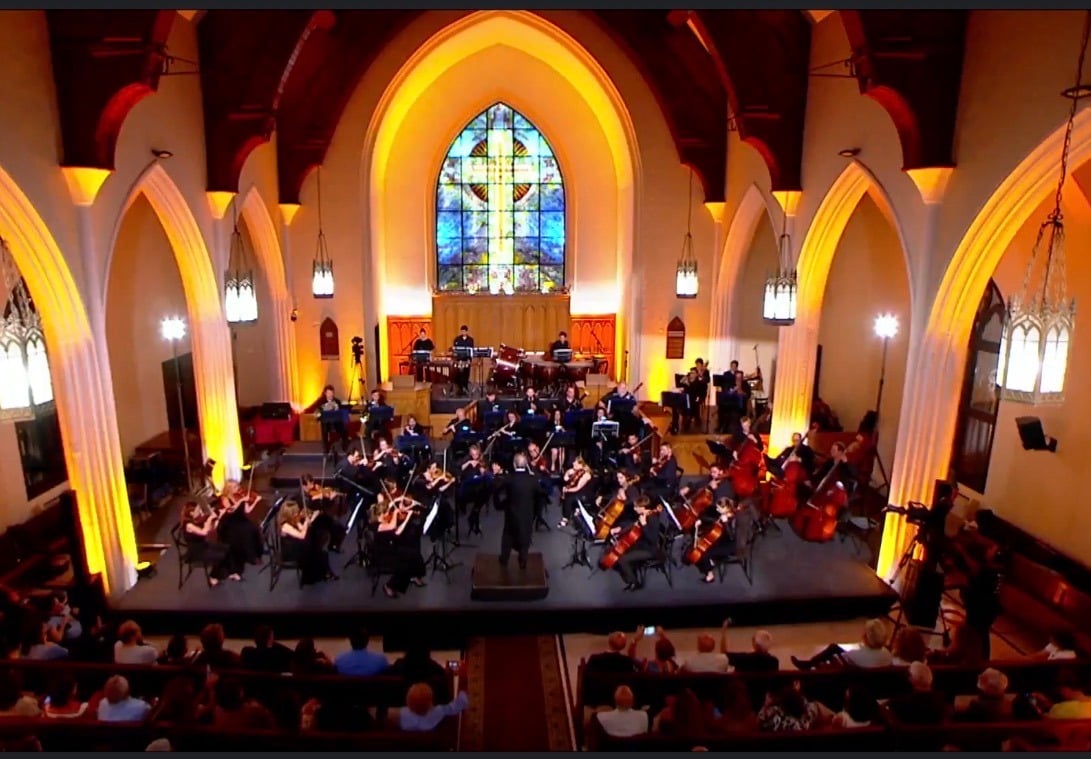
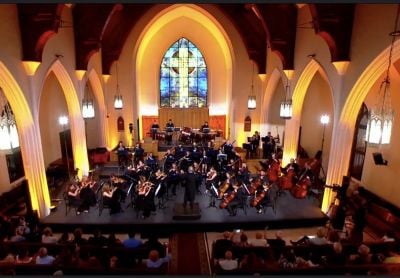
Maestro Harout Fazlian conducts the Lebanese National Philharmonic Orchestra at the Armenian Evangelical Church of Kantari. (Credit: Lebanon Conservatory)






The Lebanese National Philharmonic Orchestra, under the direction of Maestro Harout Fazlian, offered an evening at the Armenian Evangelical Church of Kantari featuring works by Aram Khachaturian, Ludwig van Beethoven and Walid Gholmieh. The concert thus served as a tribute to the latter, who died in 2011 and is regarded as one of the most significant figures in contemporary Lebanese classical music.
A composer, conductor and musicologist born in Marjayoun in 1938, Walid Gholmieh led the Lebanese National Higher Conservatory of Music for nearly 20 years. He was also behind the creation of the Lebanese National Symphony Orchestra and the Lebanese National Orchestra for Oriental Arabic Music, two institutions that have contributed greatly to shaping the nation's musical life. The program notably highlighted "The Martyr," the third movement of his Fourth Symphony.
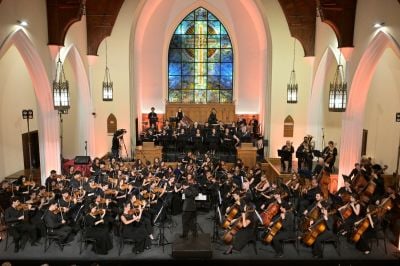
Indeed, Harout Fazlian wielded a very distinguished baton, especially since he clearly had the score in his head — not his head in the score. It is only regrettable that the concert began almost 20 minutes late. When directing a national musical institution, punctuality is also part of the respect owed to the audience, especially to those who had taken their seats at 8 p.m.
As an opener, the "Saber Dance," the "Dance of the Young Girls," "Aisha's Monologue" and the "Lezghinka," all excerpts from Aram Khachaturian's ballet "Gayane," immediately set the tone for the evening. This performance stood out for its particularly brilliant orchestra, sustained dynamism and genuine vitality. The conductor perfectly conveyed his affinity for this world so familiar to him.
The third movement of the Fourth Symphony, "The Martyr," by Walid Gholmieh, occupies a special place in the work's structure. One could perhaps regret a certain harmonic caution and an occasionally respectful attachment to the 20th-century model.
But it would be unfair to mistake this stylistic fidelity for a lack of inspiration. Gholmieh has an authentic, immediately recognizable voice, nourished by his personal story and his roots in Lebanese culture. By conducting this movement, Harout Fazlian paid a vibrant tribute to the composer. His interpretation convinces by its seriousness and compelling allure.
"However often we hear it, Beethoven's Fifth Symphony exerts over us an unvarying power." That's from Robert Schumann. All the more so as its impetuosity, which overwhelms us like a force of nature, is here multiplied by the power of a youthful, volcanic performance.
Now, a question arises: What is "truth" in a musical interpretation? The score? The musician's reading of it? Our perception of the musical work?
The text from which everything emanates does not say everything. This "lack" of the text will be inhabited by the performer, the listener and by the living, experienced work. More than any other, Beethoven's work — especially his symphonic output — sparks diverse imaginings in each of us and remains open to the interpretations of performers and listeners alike.
In his introduction before the performance of the Fifth, Fazlian mentioned the name of Herbert von Karajan. And this sparked the idea: Who holds the true key to interpretation? Gustav Mahler, Arthur Nikisch — as their contemporaries said — then Wilhelm Furtwängler, Bruno Walter, Felix Weingartner, distant figures who founded and perpetuated, through sublime and contradictory interpretations, the lineage of Beethovenian magicians.
Closer to us, Otto Klemperer, Herbert von Karajan, Karl Böhm, Eugen Jochum, Hans Schmidt-Isserstedt and Leonard Bernstein asserted, with varying degrees of force and luck, their Beethoven, which often becomes ours. Even Pierre Boulez, in his singular version of the Fifth, with all the skill, talent and passion he possesses, approaches the piece with his conviction of being the sole bearer of the one truth, and lets us hear that conviction.
One brings out the essential lines of the orchestra's power, another chisels out orchestral details never before heard. For some, it's slowness; for others, a blazing tempo. And no doubt, to each of them, Beethoven says yes in some way. And he said yes that night to Harout Fazlian.
His vision of the Fifth is essentially dynamic. He starts discreetly with a first movement more inward than resounding, and proceeds to an andante both majestic and meditative, where the sense of time stretches into an extended patience. The scherzo, and especially the trio under his baton, set off splendidly into a mysterious realm. At the culmination of this progression, Harout Fazlian skillfully manages the surprising transition and crescendo that unleash the full vigor of the finale.
The symphony thus appeared as a unified continuum; the poetic content, all the more powerful. Very attentive to his orchestra's sound, he is particularly careful with the winds, ensuring their balance with the strings.
Where he excels — and where his attentive musicians follow his every gesture to perfection — is in the progression of dynamics, from pianissimo to fortissimo, just as much as in respecting and highlighting every indication of silence, whether brief or prolonged.
This article was translated from L'Orient-Le Jour.

 7 p.m. recap: Houthis strike Riyadh airport again; Yemeni forces claim Bab al-Mandeb gains; Abbas postpones Palestinian polls