



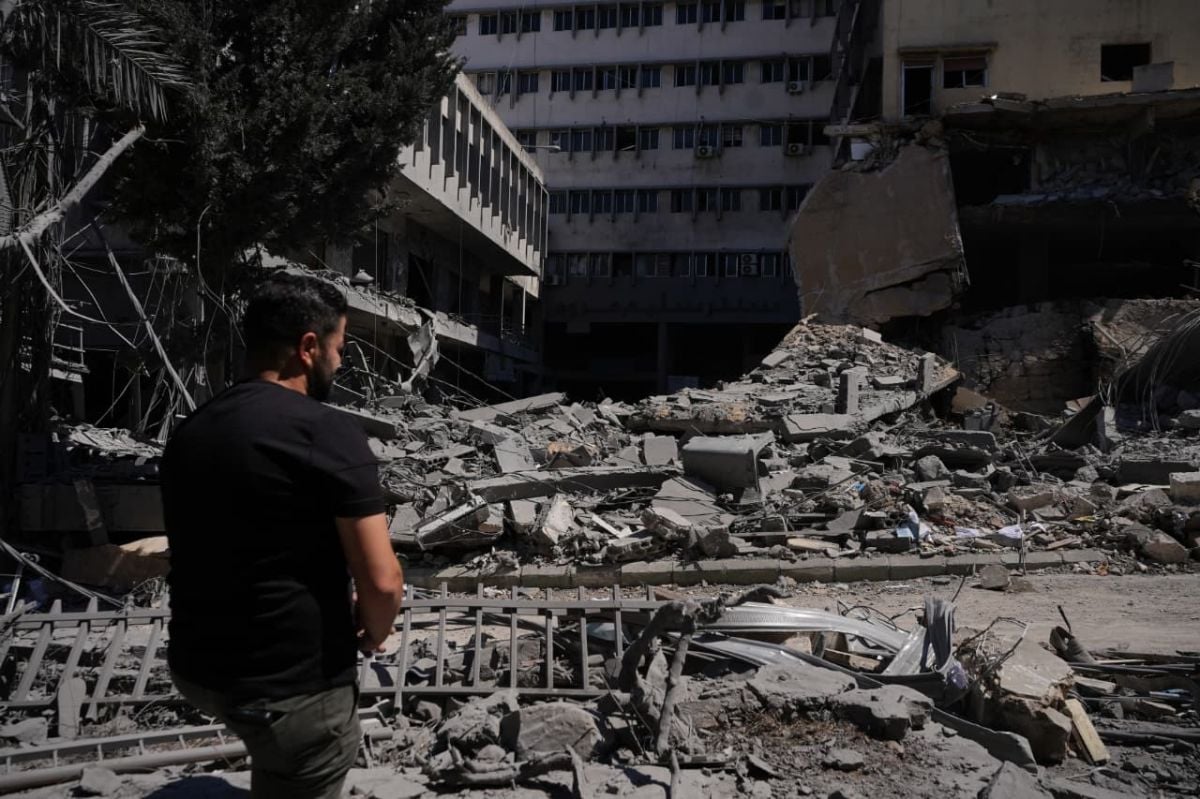
A man standing in front of the rubble of a pulverized building in the city of Nabatieh, on June 21, 2026. (Credit: Mohammad Yassine/L'Orient-Le Jour)






BEIRUT — Calm in south Lebanon since Saturday at 4 p.m. largely held Sunday, except for two strikes in the Nabatieh area during a visit by the Lebanese Army chief.
The fragile lull coincided with ongoing negotiations in Switzerland between the United States and Iran, focused mainly on the Hezbollah – Israel front in Lebanon, but was shaken later in the day by threats from Donald Trump.
According to our correspondent in the south, the Israeli army targeted the outskirts of Nabatieh Fawqa and the nearby Kfar Tibnit roundabout in the afternoon, using bombs dropped by drones.
This is an area where Israeli forces had been trying, until Saturday, to advance toward the strategic Ali Taher hill, although the truce had appeared to extend to that front. Israel is seeking to seize the hill, accusing Hezbollah of maintaining major military infrastructure, weapons stockpiles, and underground networks there.
The heights overlook the surrounding area. Machine-gun fire also targeted the outskirts of Haddatha and Haris, in the Bint Jbeil district. Aside from these incidents, no other major cease-fire violations were reported, except for high-altitude drone overflights across several southern localities, particularly in the Zahrani area.
In the Nabatieh region, the commander-in-chief of the Lebanese army, General Rodolph Haykal, visited troops deployed in several villages that have seen heavy Israeli bombardment and clashes in recent weeks. According to an army statement, he was briefed on ongoing operations, the challenges facing units, and Israeli violations.
Meanwhile, a team of al-Rissala rescuers affiliated with the Amal Movement said it had recovered a body from the rubble of a building in Nabatieh Fawqa. The victim, killed in an Israeli strike, was transferred to the Najdeh hospital at the entrance of the city.
For his part, Israeli Chief of Staff Eyal Zamir also visited troops deployed in south Lebanon, in the Beaufort area, according to Israeli media. He said Hezbollah is in a “very difficult position,” adding that the group has suffered a “severe and significant blow,” and that the Israeli army is ready “to continue its operations to prevent its reconstruction.”
The Israeli army also said it had uncovered a tunnel containing hundreds of weapons and rocket launch platforms in the village of Majdal Zoun (Sour district), which Israeli forces have taken and included in an expanded “buffer zone.” According to Arabic-language military spokesperson Ella Waweya, more than 20 fighters — including 10 members of Hezbollah’s elite Radwan unit — were killed in fighting in the village.
On Saturday, before the cease-fire took effect, the Israeli offensive killed between 40 and 45 people in the south, according to a provisional toll. The city of Nabatieh and several villages had urged displaced residents not to rush back home.
Up until 4 p.m. Saturday, the south had been hit by 97 strikes targeting 42 villages, mainly in and around Nabatiyeh and on the Rihan heights in the Jezzine district. Hezbollah, for its part, did not claim any military operations during that period.
Lebanon is at the center of the negotiations in Switzerland, according to Iranian foreign ministry spokesperson Esmail Baghaei, who said the United States has been unable to guarantee the cease-fire in Lebanon and that this issue will be central to the talks.
Reporting contributed by our correspondent Muntasser Abdallah,