

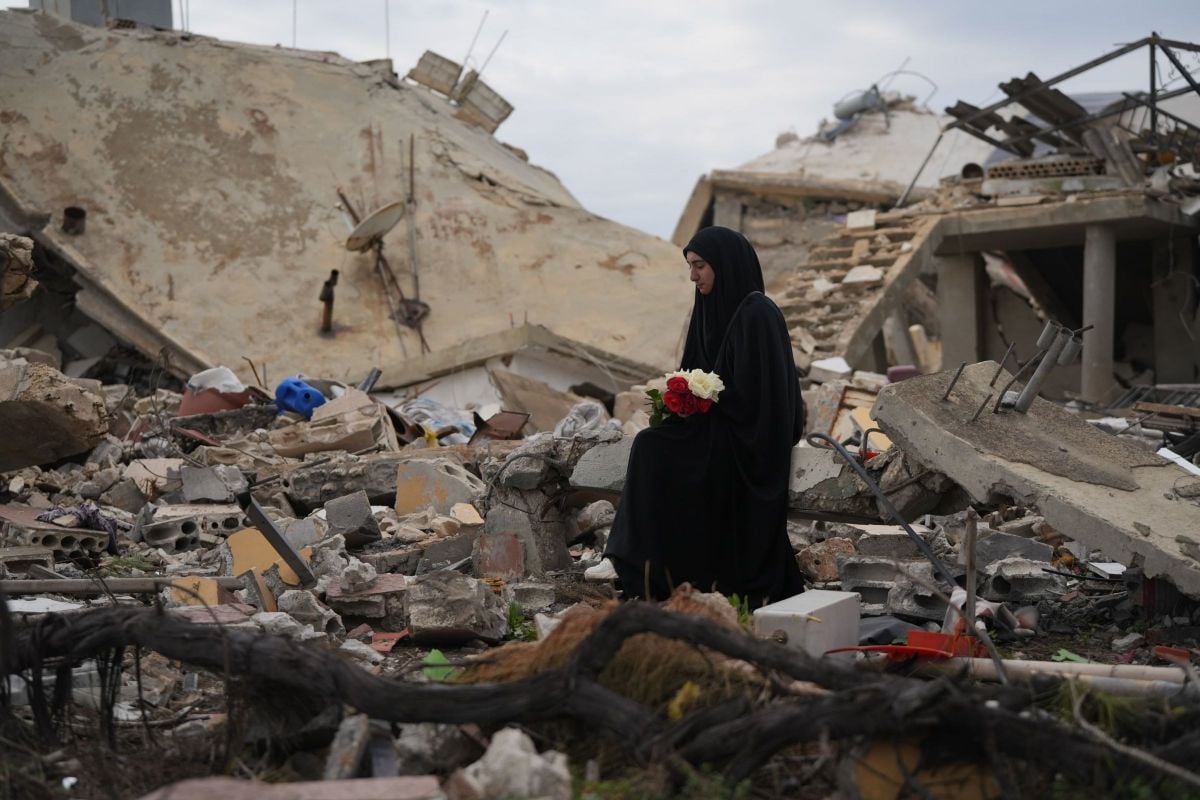
A resident of the village of Aita al-Shaab holds roses amidst the rubble, on Jan. 26, 2025. (Credit: Mohammad Yassine/L’Orient-Le Jour)




In a report published Wednesday, Amnesty International accused Israel of extending to around 6% of Lebanese territory the so-called "no-return" zone it controls in Lebanon. The NGO believes this policy is part of an increase in the use of mass evacuation orders and return bans, which it deems illegal and which have forced hundreds of thousands of people to flee.
According to Amnesty, Israel's use of forced displacement and return bans has intensified significantly in 2026, with residents of southern Lebanon repeatedly forced to leave their villages and then barred from returning once these areas were included in a "no-return" zone unilaterally declared by Israel.
In some areas of southern Lebanon, the forced displacement of civilians and the prevention of "tens of thousands" of people from returning home constitute an "illegal transfer which, as a grave breach of the Fourth Geneva Convention, amounts to a war crime," the organization asserts.
The investigation is based on an analysis of Israeli military orders disseminated to Lebanese residents via the X network since 2024, interviews with displaced people from the affected areas, and open-source research. Amnesty notes that the Israeli army issued more mass evacuation orders in 2026 than in 2024, targeting larger areas and more inhabitants.
"In 2026, just like in 2024, Israel’s indiscriminate orders were issued without measures to ensure the welfare and safety of the evacuees, without providing civilians the information or guidance necessary to make informed decisions about the need or duration of their displacement, and were never lifted, even after hostilities ended in the affected areas, as mandated by international humanitarian law," said Kristine Beckerle, deputy regional director for the Middle East and North Africa at Amnesty International.
"Instead of forcibly uprooting communities and designating large swathes of Lebanese territory as off-limits to civilians, Israeli forces must immediately withdraw from Lebanese territory. Displaced people must be able to return to their land freely and safely, while Israel must provide reparations to the victims of its violations of international humanitarian law, including those whose homes were illegally destroyed," Beckerle added.
According to the report, the "no-return" zone controlled by the Israeli army expanded further in 2026. Three days after the cease-fire was announced on April 17, the Israeli army published a map designating an "advanced defense zone" extending 8 to 12 kilometers inside Lebanese territory and covering about 600 square kilometers of land and sea.
The organization states that this zone now covers about 6% of Lebanese territory, compared to 4.6% on the previous "no-return" zone map published in November 2024. The April 2026 map lists 74 villages, including 53 whose residents were forbidden to return, while movement remained restricted in the others.
The Israeli army has also carried out, since 2024, significant destruction inside this zone. Satellite images show the near erasure of towns and villages along the border. The organization also says it has analyzed 447 Israeli military orders published between September 2024 and May 2026. Of these, 135 were mass evacuation orders issued during the 2026 war and 61 were no-return orders.
A count by L’Orient-Le Jour, published in early May, reported 152 warnings issued by the Israeli army between March 2 and April 16. Of these, 84 targeted a specific building and 68 concerned larger geographical areas.
Israel denies issuing mandatory evacuation orders
The Israeli army disputes issuing mandatory evacuation orders. In a response sent to Amnesty, it claimed to have issued only "advanced warnings to civilians," which were not binding orders but "recommendations." It also contended that "there is no prohibition on Lebanese civilians returning to their homes."
However, the report cites statements from Israeli Defense Minister Israel Katz, who declared on June 15 that Israeli forces "will remain in the security zones in Lebanon, Syria, and Gaza indefinitely" and that these zones would be "evacuated of their local inhabitants and all terrorist infrastructure ... including houses in villages near the line of contact that served as forward positions." These statements were made amid reports of a possible cease-fire agreement between Iran and the United States that would include Lebanon.
Amnesty notes that international humanitarian law permits the forced displacement of civilians only under very limited circumstances. Any evacuation must be temporary, carried out in conditions that ensure the safety of the population, and must allow their return as soon as hostilities end.
"Two and a half years later, it is crucial that the international community acts," Beckerle argued. She called on states to "work for a durable and viable cease-fire, to press for an Israeli withdrawal from Lebanese territory, to activate national and international justice and accountability mechanisms, and to suspend all transfers of arms and military equipment to Israel that could facilitate violations of international law."
The organization notes that this investigation is the first in a series devoted to violations of international law committed during the 2026 war in Lebanon. As of June 7, the Lebanese Social Development Ministry reported that more than one million people remained displaced due to Israeli attacks and threats. The Health Ministry, for its part, indicated that Israeli attacks had killed more than 3,700 people since the war escalated on March 2.

 Nabatieh remains at center of Israeli attacks, advances