





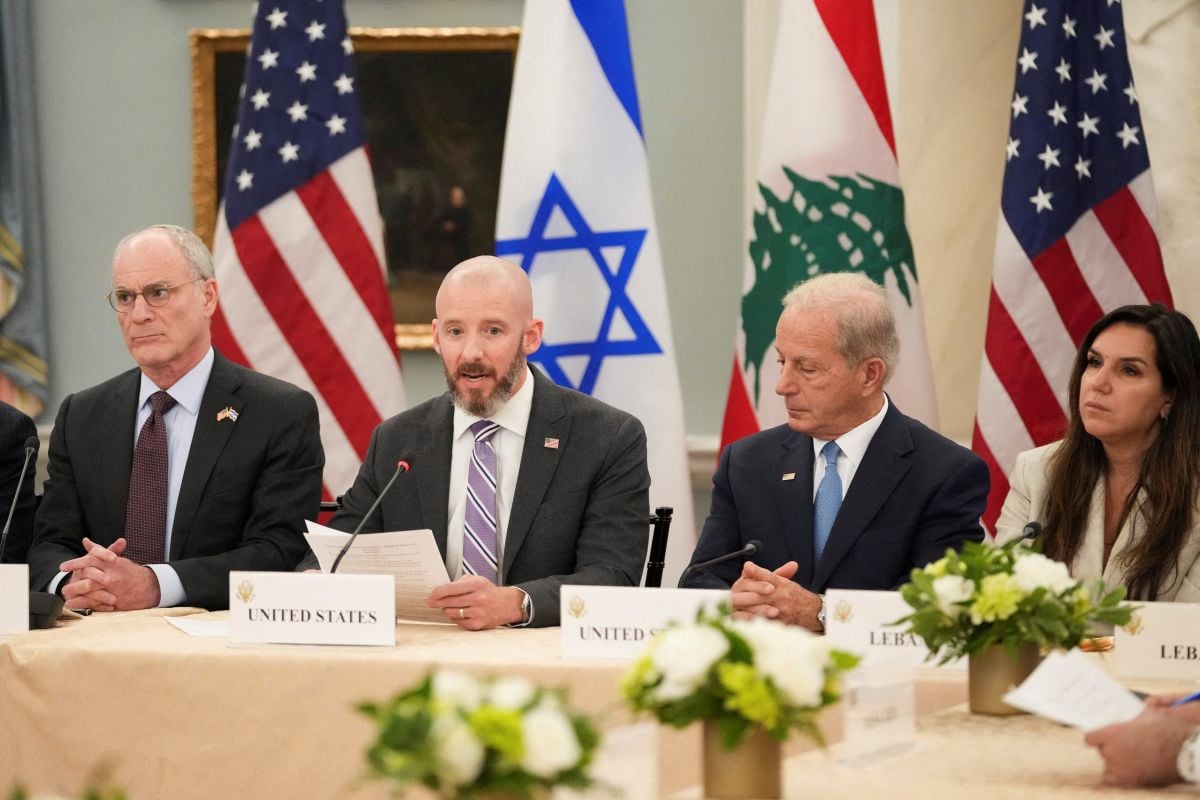
State Department Chief of Staff Daniel Holler speaks as Israeli Ambassador to the U.S. Yechiel Leiter and Lebanese Ambassador to the U.S. Nada Hamadeh, accompanied by U.S. Ambassador to Lebanon Michel Issa, attend a meeting between Israeli and Lebanese delegations hosted by the United States, in Washington, D.C., on June 3, 2026. (Credit: Nathan Howard/Reuters)






Lina Khatib is an expert on Middle East international relations, geopolitics, and security. She is an associate fellow at Chatham House’s Middle East and North Africa Programme.
Many initial Lebanese reactions to the newly announced Iran-U.S. memorandum of understanding (MOU) have focused on its risks for Lebanon. The concern is understandable. If the MOU is seen as including Lebanon in a cease-fire arrangement between Washington and Tehran, it could appear to leave Lebanon once again as a card in Iran’s hands.
Israel’s reaction has also been negative, but for a different reason: the reported agreement does not address Israel’s central concern about Hezbollah’s military threat.
This is precisely why the deal should not be treated as a settlement of the Lebanon-Israel issue. It reportedly stipulates a cease-fire in Lebanon but not the withdrawal of Israeli troops from its territory. Nor does it address Israel’s stated concerns about Hezbollah’s arsenal and cross-border threat. At most, it freezes one dimension of escalation while leaving the core conflict unresolved.
That is why Lebanon needs its own separate negotiations track with Israel.
The silver lining for Lebanon is not in the agreement’s terms, but in their implications. If Israel opposes the MOU’s reported provisions on Lebanon, then Iran and Hezbollah’s support should not be read as evidence that Iran has successfully folded Lebanon into the deal, but that the agreement has exposed the limits of its ability to dictate the terms for Lebanon.
Iran’s immediate core priority is lifting the U.S. blockade. If Tehran’s acceptance of the agreement is to secure that prize, and Hezbollah holds fire in line with Tehran’s position while Israel continues its occupation of Lebanese territory, then the MOU creates an opportunity to separate Lebanon from the Strait of Hormuz file. This is a loss for Iran, not a gain.
Lebanon’s negotiators should highlight that the MOU does not resolve Lebanon’s conflict with Israel to insist on a separate negotiations track, backed by the United States and supported by international partners.
The purpose of that track should be clear: sovereignty for Lebanon, and security for it and Israel. The U.S. should press Israel to halt its attacks and withdraw from Lebanese territory to immediately hand it over to the Lebanese Army alongside an international force deployed in the South.
In return, Lebanon should signal its readiness to declare a formal end to the state of war with Israel and work toward de jure recognition of the Israeli state as part of a comprehensive package.
Such a development would transform the equation. Israeli withdrawal and an end to its attacks would become part of a sovereign state-to-state settlement, not a concession to Hezbollah or Iran.
At the same time, Hezbollah would be deprived of its central argument: that Lebanon remains occupied, under attack, or in a state of war requiring an autonomous armed “resistance.” Once Lebanon formally ends the state of war and recognizes Israel, the political rationale for its independent military role becomes much harder to defend.
Recognition should therefore be presented not as a unilateral concession, but as the final component of a sovereign settlement that restores Lebanese authority over its own territory.
This sequencing would also reduce Hezbollah’s ability to spoil the process. If Hezbollah attacks Israel while it is withdrawing from the South and the Lebanese Army is deploying under U.S. pressure, then it would be seen as undermining a Lebanese state strategy, not defending Lebanon.
If Israel continues to strike or refuses withdrawal, Washington would need to make clear that it would be jeopardizing the very track that could deliver its core security objective: a southern Lebanon no longer dominated by Hezbollah.
The international force deployed needs to do more than monitor a cease-fire. It needs to help create political and military facts on the ground that make both Hezbollah escalation and Israeli unilateralism harder to justify. France and Italy have already signaled interest in this role.
That could provide the transitional security architecture Lebanon needs: first stabilizing the South, then consolidating Lebanese state authority after UNIFIL’s departure. But this force would only work if tied to Lebanese sovereignty and Lebanese Army deployment, not if it becomes another buffer arrangement that freezes the conflict while leaving Hezbollah and Israel to define the security equation.
All this needs to happen with U.S. oversight and guarantees because, without it, Israel will not trust the Lebanese state’s ability to deliver, and Lebanon will not trust Israel’s promise not to spoil the deal.

The U.S. being a guarantor benefits both in the long term. For Israel, U.S. guarantees would offer a path toward addressing the Hezbollah threat through Lebanese state authority rather than through open-ended military action. For Lebanon, it would offer a path toward permanent Israeli withdrawal, restored sovereignty, and international support for state control over the South.
The MOU does not solve Lebanon’s problems. But that is exactly why Lebanon should not allow it to define its future. Its limitations should be used to double down on a separate diplomatic track: one that addresses Israeli withdrawal, Lebanese sovereignty, and the restoration of the Lebanese state’s authority over its own territory.