






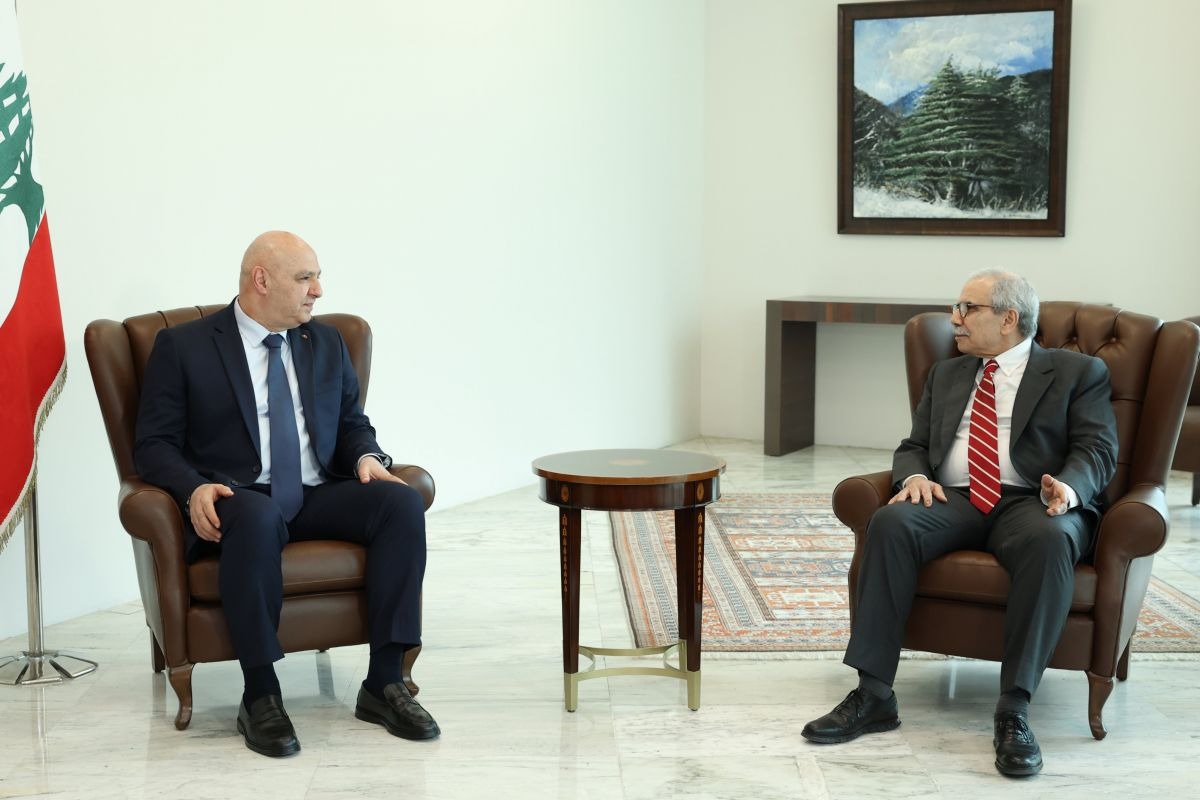
President Joseph Aoun and PM Nawaf Salam, on May 20, 2025, at the Baabda Presidential Palace. (Credit: X/@LBpresidency)






BEIRUT — President Joseph Aoun, and PM Nawaf Salam on Tuesday praised the U.S.-Iranian agreement framework during a bilateral meeting in Baabda, seeing it as "a positive factor for reducing tensions in the region," according to a message on X from the Lebanese presidency.
The agreement aims to put an end to the war in the Middle East which began on Feb. 28 with an Israeli-American attack on Iran, and has seen a fragile regional truce since April 17.
The understanding between the two powers "echoes peaceful solutions and the end of the state of war," they said, at a time when Tehran insists the agreement must include an end to the war in Lebanon, where fighting between Hezbollah and Israel has not ceased since March 2, the day the party joined the regional conflict, as well as the withdrawal of the Israeli army from the south.
The two leaders of the executive branch also discussed the upcoming session of Lebanese-Israeli negotiations under American auspices, scheduled to take place in Washington next week, which Beirut aims to conduct in parallel with talks between Washington and Tehran.
They reiterated that the goal of direct negotiations with Tel Aviv — which Hezbollah categorically rejects — was "a definitive cease-fire, the withdrawal of Israeli forces from the territory they occupy, the deployment of the Lebanese Army up to the international border, the return of Lebanese prisoners and the launch of reconstruction efforts."

Beirut is betting on this process to secure Israeli withdrawal from the south. "This is the only way forward on this plan," a Lebanese official source told L'Orient-le Jour on Monday.
"Mohammad Ghalibaf [the main Iranian negotiator — ed.] isn't going to know from which village the Israelis should first withdraw or how the Lebanese army should deploy in the south."
On Monday evening, Prime Minister Benjamin Netanyahu declared that the Israeli army would remain in Lebanon "as long as necessary," as in Syria and Gaza. This Lebanese official indicated that direct negotiations would continue according to the planned timetable: an expanded meeting of military and political delegations on June 22, followed by a military meeting on June 23 and a political meeting on June 24.
'It is not possible to abandon the resistance,' repeats Qabalan
This position was once again rejected by Hezbollah and its allies. A Hezbollah MP, Hassan Ezzeddine, said Tuesday at a memorial ceremony in Bir Hassan, in Beirut's southern suburbs, that "Lebanese authorities must reconsider their illusory choices" of believing that "the United States will help Lebanon and put pressure on the enemy," while asserting that "Iran has achieved a clear strategic victory" and is now "a great regional power."
According to him, it was the Islamabad discussions that truly enabled implementation of the cease-fire, "despite some violations."
Ezzeddine urged officials to "turn back to their people and their choices," which, in his view, "have proven themselves on the ground" in forcing Israel to "live in anxiety and instability" and being capable of "compelling it to withdraw from our occupied territory."
He further called on them to "correct their political trajectory" and to prioritize "national understanding," which he considers "the guarantee of stability and civil peace." He also argued that Netanyahu and Donald Trump were the main losers of this confrontation, having "achieved none of their stated objectives."
For his part, Jaafarite mufti Ahmad Qabalan, known to be close to Hezbollah, reiterated Tuesday that he rejects direct negotiations with Israel, in which, he said, "political power delivers Lebanon's head to Tel Aviv."
Having called the previous day for a change in government, Qabalan affirmed that "it is not possible to abandon the resistance, because the political or security alternative is not ready," in remarks reported by the state-run National News Agency (NNA).
"Those who have prevented the army, for decades, from ensuring national defense cannot be entrusted with the national borders or the defense of sovereignty," he said. "Because Lebanon is the country of Islam and Christianity, we will not accept any explicit or disguised project aiming to Zionize our country," the Qabalan added.

 8 p.m. recap: Israel again threatens Beirut’s south suburbs; 2 ships hit near Hormuz; Riyadh football matches canceled