


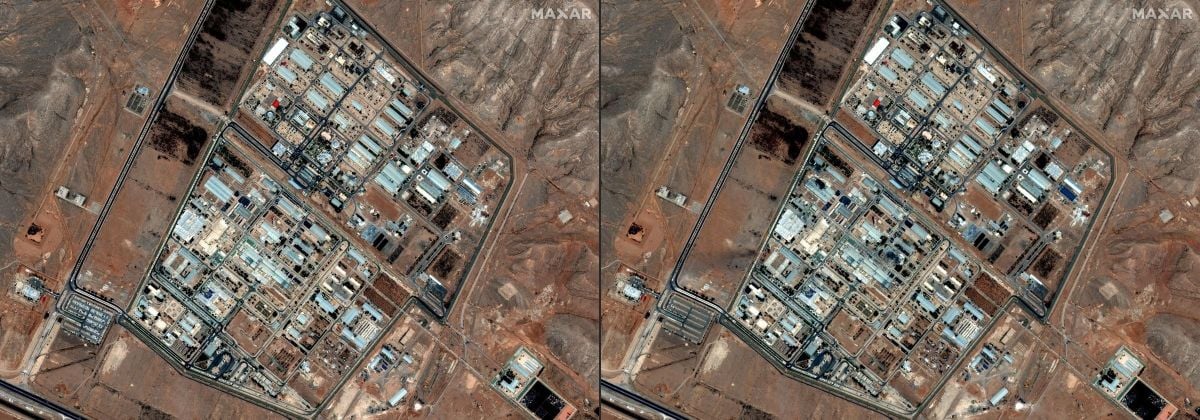
Combination of photos showing the uranium enrichment center in Isfahan, Iran, before (June 3, 2025) and after (June 14, 2025) an Israeli strike. (Credit: AFP.)






Iran has dramatically escalated efforts in recent weeks to “seal off its stockpile of near weapons-grade uranium, deliberately collapsing tunnels and booby-trapping entrances with explosive mines,” CNN reported on Saturday citing five sources familiar with US intelligence.
According to the sources, “accessing the roughly half-ton of highly enriched uranium [HEU] is now far more difficult, dangerous and time-consuming than it already was just a month ago", when U.S. President Donald Trump hinted that he might order the US military to seize it.
The new fortifications add an additional layer of complexity to the Trump administration’s proposed deal with Tehran to remove and destroy its uranium, and the move raises questions about who will take on the dangerous task of digging it out, according to CNN.
Washington and Tehran have offered a markedly different account of the proposed agreement. Among other points, the U.S. says the deal would require the dismantling of Iran's nuclear program and allow the United States to take possession of highly enriched uranium, which would be destroyed and removed from the country. However, Iran's Foreign Minister said on Friday that Iran's stockpile of uranium enriched to 60 percent could instead be diluted within the country.
Several sources told CNN that removing the enriched material would now be difficult and dangerous even for Iranians themselves, as it would require heavy excavation equipment and de-mining efforts.
Scott Roecker, who headed the National Nuclear Security Administration’s Office of Nuclear Material Removal from 2017 to 2021, told CNN this could also offer an opportunity for Iran to obfuscate its compliance efforts. He said that "if negotiators require that Iran bring the entire stockpile to a central location for verification and ultimately to remove or downblend the material,” he would worry that Iran would claim that some portion of the HEU was irretrievable."
Iran’s nuclear program has long been a point of tension with Washington, which has consistently argued that Tehran should abandon its uranium enrichment activities and move its stockpile of highly enriched uranium out of the country.
Israel, the United States and other Western states have long accused Iran of seeking nuclear weapons, including pointing to its move to enrich uranium to 60 percent, far higher than needed for civilian uses and closer to the 90 percent needed for a weapon. Meanwhile, Iran denies seeking nuclear weapons.

 7 p.m. recap: Sharaa in Riyadh; Qassem signals openness to cooperation; Ben-Gvir: ‘We demolish, again and again’