







An Israeli tank maneuvers in southern Lebanon, as seen from northern Israel, May 31, 2026. (Credit: Amir Cohen/ Reuters)






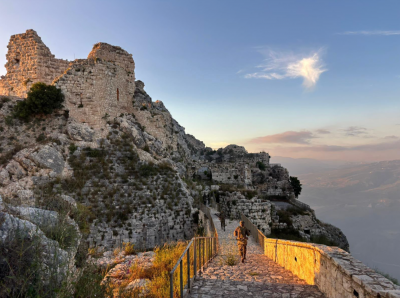
BEIRUT — Shortly after raising its flag over the damaged ruins of Beaufort Castle following a night of intense fighting, — which Prime Minister Benjamin Netanyahu, described as a "decisive turning point" in the ongoing conflict with Hezbollah — the Israeli army carried out an evacuation order affecting all Lebanese residents south of the Zahrani River, reportedly in line with a request from national security minister Itamar Ben Gvir.
Published mid-morning on the X account of Israeli army Arabic spokesperson Avichay Adraee, the order followed a large-scale operation in Shebaa and Wadi Slouki, part of the expansion of Israeli operations ordered by Netanyahu and approved by Israeli Chief of Staff Gen. Eyal Zamir.
The Zahrani River rises in the Jezzine highlands and flows into the Mediterranean south of Saida, around 40 kilometers from the Israeli border. The newly designated operational zone the Israeli state seeks to bring under control, according to Netanyahu, is therefore significantly larger than the roughly 600 square kilometers it already occupies.
Everything at this stage suggests that this escalation is only the beginning, despite ongoing indirect talks between Lebanon and Israel, which have so far produced only a cease-fire framework renewed since April 17 but not reflected on the ground.
Israeli Channel 12 reported that Netanyahu’s government plans to seek an extension of reservist mobilization until July 31, while Channel 14 said the prime minister and Defense Minister Israel Katz are considering large-scale strikes across Lebanon.
Spiraling escalation
The evacuation order marked the beginning of a new spiraling escalation for residents of southern Lebanon and parts of the Bekaa.
Several towns, including Burj al-Shemali (Sour), Arzay (Saida), Loubieh (Nabatieh), and Sarafand (Saida), received Israeli evacuation warnings, while the bombardments claimed the first victims of the day, bringing the toll to 3,412 killed and 10,269 wounded, according to the Health Ministry.
A strike near Hiram Hospital in Sour injured 13 people. Another strike in the same city — the fourth in a series — hit near Jabal Amel Hospital, according to our correspondent Muntasser Abdallah.
Beyond Sour, the towns of Nabatieh, Yohmor al-Shaqif, Babliyeh, Touline, Ghassanieh, Dibil, Jibsheet, Maarakeh and Qalaway were among the long list of localities hit across southern Lebanon.
In the Bekaa, residents of Sohmor and several nearby villages were also ordered to flee, while Bekaa governor Kamal Abu Jawdeh called for additional shelters to accommodate displaced people.
A drone strike also hit the eastern mountain range near Nabisheet in the Bekaa, according to our correspondent in the region, Sarah Abdallah. By the end of the day, Mashghara — already repeatedly shelled in recent days — came under renewed bombardment.
By 6 p.m. on Sunday, Israeli fighter jets had carried out 65 airstrikes across 35 towns and villages in southern Lebanon, in addition to 13 other strikes targeting sites in 10 different localities. The districts of Bint Jbeil, Sour, Nabatieh, Saida and Jezzine were all hit.
In response, Hezbollah carried out nine attacks during the day, according to our correspondent’s tally. The previous day, Israel had struck 45 localities in the South, while Hezbollah conducted 24 operations against Israeli targets in southern and northern Israel, reaching as far as Safed, near the Sea of Galilee.
On Sunday, Hezbollah said it carried out five drone attacks near Beaufort Castle, shelled an Israeli artillery position in Odaisseh and targeted soldiers in Metula. Throughout the day, the Israeli army said it intercepted several projectiles launched from Lebanon. In the morning, it confirmed the death of its 25th soldier killed by an explosive drone launched by Hezbollah.
Nabih Berri speaks out
The expansion of the Israeli offensive unfolded in near-total silence from Lebanon’s political class. Hezbollah MP Ali Fayad said the lack of concrete results from recent indirect talks in Washington between Lebanese officials was proof of “the failure of the gamble on the option of direct negotiations with the enemy.” His colleague Hassan Fadlallah said the raising of the Israeli flag over Beaufort Castle “should stir the emotions of every sincere patriot,” insisting the site was not used as a military position.
By the end of the day, Parliament Speaker Nabih Berri also spoke out: “I guarantee that the resistance is fully, unreservedly, and immediately committed to a cease-fire. But the question is: who will force Israel to end its aggression by land, sea and air, and to stop demolishing villages and homes?” he said on NBN.
France, for its part, has decided to convene an emergency meeting of the UN Security Council, according to Foreign Minister Jean-Noël Barrot, who informed his Lebanese counterpart Joe Rajji. The meeting is scheduled for Monday. The French foreign minister reaffirmed Paris’s solidarity with Lebanon and its firm commitment to respect its full sovereignty, while stressing support for direct negotiations as the only way to achieve a lasting solution to the crisis.
Hezbollah supporters also gathered on Sunday afternoon in Beirut’s Martyrs’ Square for a sit-in denouncing Lebanon’s political leadership and state institutions, accusing them of failing to protect the country and its citizens, according to L’Orient-Le Jour’s correspondent.