







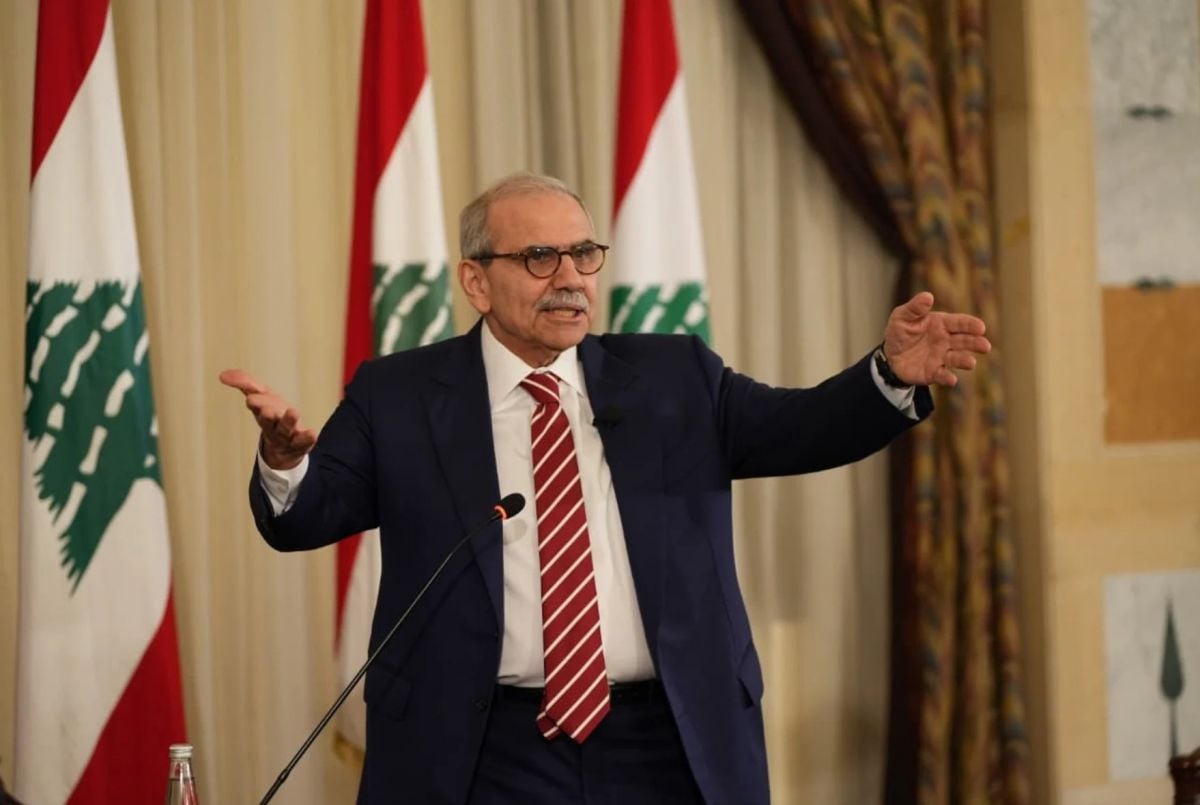
Prime Minister Nawaf Salam during the debate with L'Orient-Le Jour at the Grand Serail, on Sept. 14, 2025. (Credit: Mohammad Yassine/L'Orient-Le Jour)






Prime Minister Nawaf Salam stressed on Saturday the “need to intensify diplomatic efforts to achieve a cease-fire,” noting that Israel is attempting to erase Lebanon’s history through its recent escalation.
“What we have witnessed is not merely an Israeli expansion or incursion. Israel is not just targeting specific sites, but is implementing a policy of comprehensive destruction of cities and towns and all means of life within them, while carrying out mass displacement that amounts to collective punishment against our peaceful population. These are policies condemned by all international norms and laws,” Salam said.
“What Israel is doing is not only a violation of Lebanon’s sovereignty, but an attempt to erase its history,” the prime minister added from the Grand Serail, according to the state-run National News Agency.
“We are determined to stop the war, protect our country, and prevent it from becoming a mailbox and an open arena for others’ conflicts,” he added.
Regarding direct negotiations between Lebanon and Israel in Washington, Salam said their “outcome is not guaranteed, and they are not an act of surrender, but rather the least costly option for Lebanon.”
“The state is leading the negotiations today on behalf of all Lebanese, and the decision of war and peace remains a national one,” he added.
Salam reiterated that the first item on the negotiating delegation’s agenda is achieving a cease-fire, adding that its objective is a full Israeli withdrawal and the release of prisoners, enabling the reconstruction of what has been destroyed and the safe and dignified return of people to their land.
“This path is not easy and will not be short, but it becomes shorter and we become stronger along it when all efforts are unified under the umbrella of the Lebanese state,” he noted.
Hezbollah has repeatedly criticized the negotiations, urging the Lebanese government to withdraw from them. Meanwhile, most political parties in Lebanon support Salam’s government and President Joseph Aoun in their decision to engage in the talks.
Addressing the people of South Lebanon, Salam said: “Your pain is the pain of all Lebanon. Trust that the Lebanese state will spare no effort to secure a cease-fire, the return of prisoners, and reconstruction.”
Earlier on Saturday, Aoun and Salam decided to intensify contacts aimed at ending the Israeli escalation in South Lebanon.
Despite the so-called cease-fire agreement reached on April 16 following 45 days of war between Hezbollah and Israel, fighting continues in South Lebanon and West Bekaa, with more than 1,000 people killed in Israeli attacks since then.
The Israeli army has also stepped up both its strikes and ground offensive in recent days, without sparing cultural sites. Last Thursday, the Israeli military struck a building in Sour located very close to the city’s archaeological area. Furthermore, the area surrounding Beaufort Castle, the medieval fortress locally known as Qalaat al-Shaqif, was hit by a series of heavy Israeli strikes.
Meanwhile, Hezbollah has continued launching daily attacks against Israeli forces occupying and advancing in South Lebanon, as well as against villages in northern Israel.
