


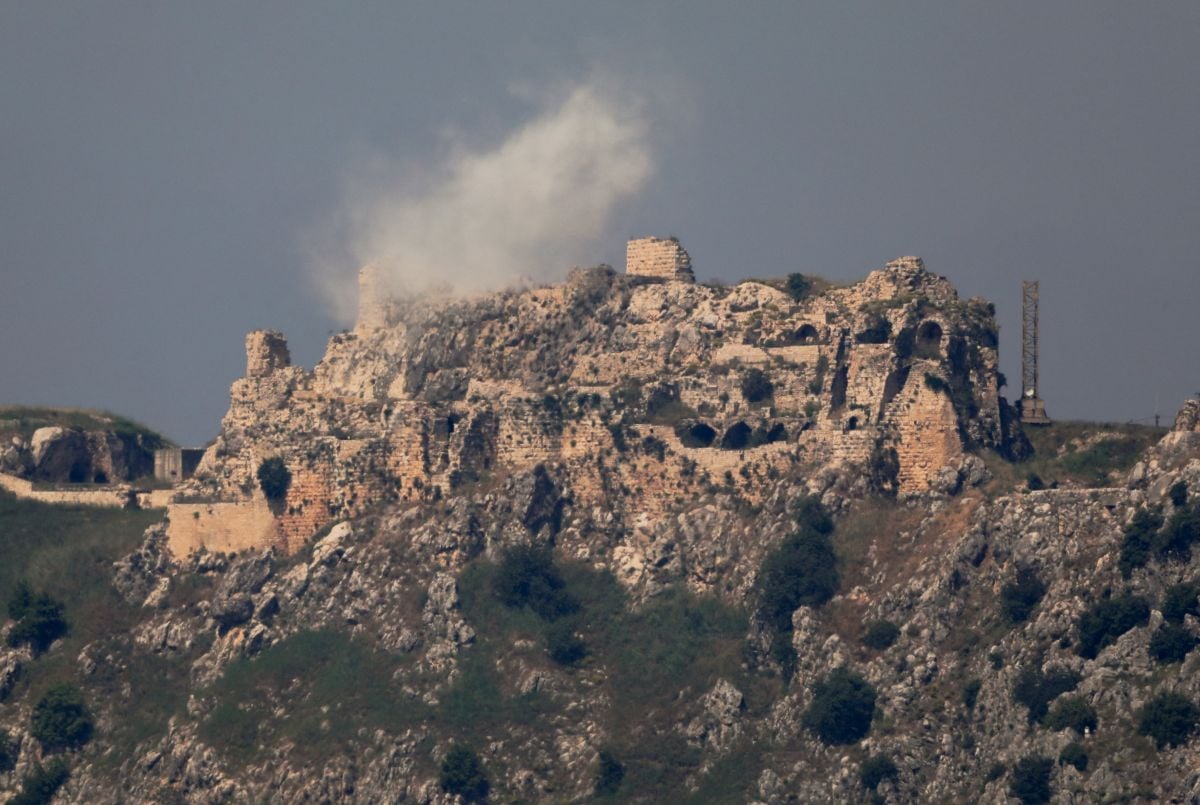
Smoke rises from Beaufort Castle following Israeli strikes in southern Lebanon, May 27, 2026. (Credit: Stringer/Reuters)






The area surrounding Beaufort Castle, the medieval fortress locally known as Qalaat al-Shaqif, was hit by a series of heavy Israeli strikes. Culture Minister Ghassan Salameh shared on X a video released by the Green Southerners collective showing a thick plume of smoke rising above the site.
For now, it has not been possible to establish an official assessment of the damage this historic site may have sustained. The site is listed as a cultural property under enhanced protection by UNESCO, the United Nations Educational, Scientific and Cultural Organization.
"Due to ongoing military operations, the dangerous condition of the roads prevents the Directorate General of Antiquities (DGA) from accessing the site," explains Jad Tabet, architect and adviser to the minister of culture. He added that a UNESCO team is monitoring the state of sites protected by the organization’s protocol in southern Lebanon via satellite.

The war — which is burning thousands of hectares of farmland and destroying villages as well as infrastructure — also threatens to wipe out part of the country’s historical heritage.
In southern Lebanon, five fortresses — Beaufort Castle, Qalaat Tibnin, Qalaat Shakra (also known as Qalaat Doubieh), Qalaat Deir Kifa, and Qalaat Shamaa, the last which Israel severely damaged — are, according to UNESCO, "remarkable examples of cultural and architectural exchanges in the Near East during the medieval period." Together, they represent a rare and authentic testimony to the evolution of fortified architecture over nearly nine centuries, as these strongholds remained in use until the end of the 19th century.
The crown jewel remains Qalaat al-Shaqif, listed on the World Heritage Tentative List under the "The Castles of Mount Amel" file. Also, according to the U.N. agency, it is recognized as "one of the best-preserved Crusader-era fortresses in the Near East ... and is a remarkable archetype of medieval military architecture, particularly associated with military orders."

A geostrategic situation
Built around 1137 by the King of Jerusalem, then expanded and modified by the Ayyubids, Mamluks and the feudal governors of the al-Saabi family, Beaufort Castle stands on a rocky promontory at an altitude of 710 meters. It overlooks a landscape stretching across the entire South up to northern Israel. Because of its geostrategic position, it has always been fiercely contested since the Crusader era.
The 20th century did not spare it. At the end of the 1970s, the Palestine Liberation Organization (PLO) established one of its main bases there. Then, during "Operation Peace for Galilee," launched in June 1982, the Israeli army subjected the fortress to intense bombardments, causing significant damage, before occupying it and remaining there until 2000.
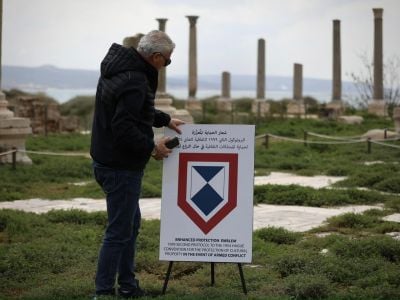
Since its liberation, the Directorate General of Antiquities launched a major restoration and conservation project aimed at preserving the castle’s authenticity and integrity in line with international cultural heritage standards. The project, carried out between 2002 and 2015, was overseen by the Council for Development and Reconstruction (CDR). As state funding proved insufficient, the project’s budget — initially estimated at around $2 million — quickly expanded. Lebanon eventually turned to the Kuwait Fund for Arab Economic Development, which became the main contributor to the restoration effort.
This article was originally published in French in L'Orient-Le Jour.

 7 p.m. recap: Netanyahu seeks mastermind behind Flydubai incident; Washington sanctions 2 French nationals; Ben Gvir's 'I want to kill you' threat