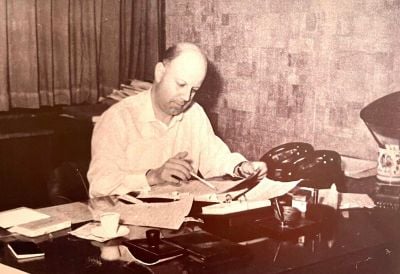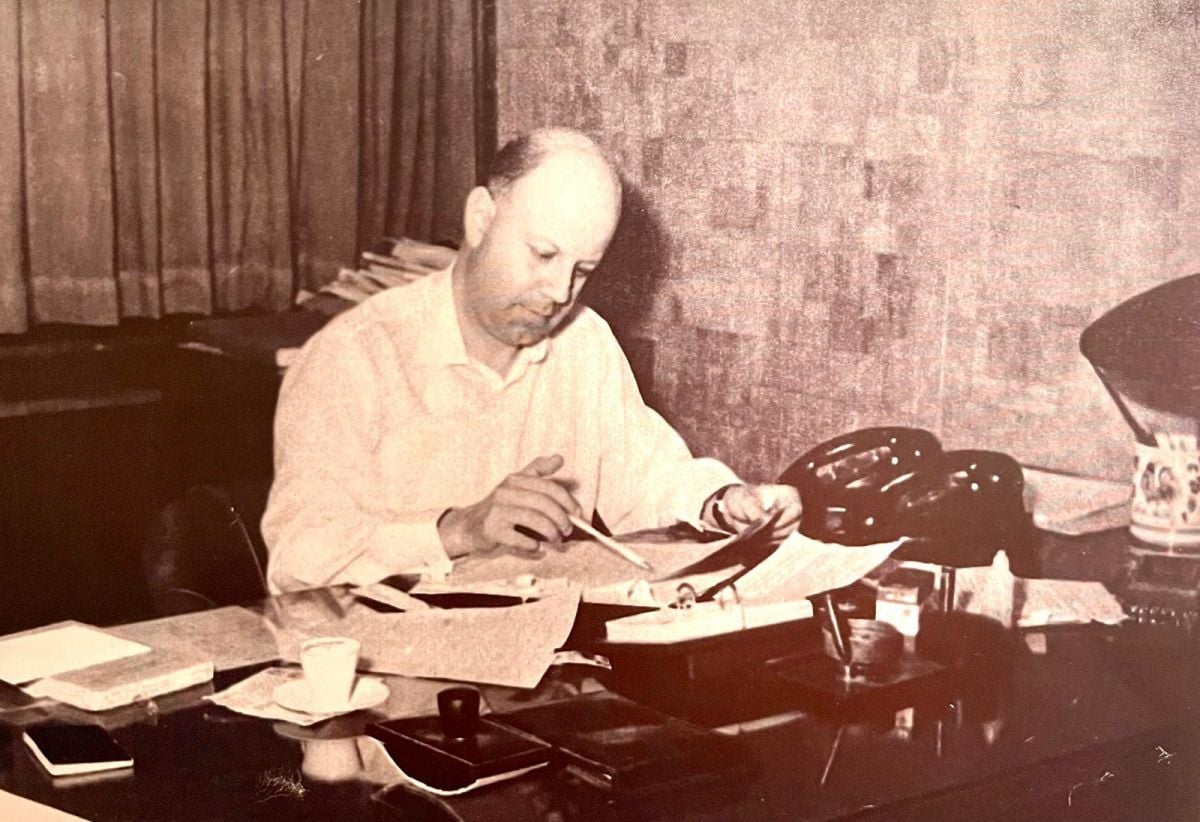
Edouard Saab working. Photo provided by his family.






Myra Frapier-Saab was only 7 years old when the phone rang in the family's furnished apartment in Paris, and her world changed forever.
On May 16, 1976, journalist Edouard Saab brought his family to safety in France while remaining deeply attached to his work in Beirut, refusing to leave the city engulfed by war.
At 3:30 p.m., during curfew, as he crossed the demarcation line near the Olivetti building and the Syriac church, a sniper shot him in the head. New York Times journalist Henry Tanner, who was with him, was wounded. Saab did not survive. According to reports at the time, he was taken to Barbir Hospital by Fateh militiamen.
A Maronite from Baabda, Saab had, paradoxically, been a staunch advocate of the Palestinian cause.
"He had a unique closeness with the PLO and the PFLP leadership. He knew all of them, before breaking off all contact on the eve of the 1975 war," his daughter recalls.
Encouraged by her doctoral supervisor, Dominique Chevalier, Frapier-Saab later devoted her Ph.D. research to her father's work: nearly 2,000 articles written in less than two decades, chronicling an Arab world shaken by revolutions and violence.
"Edouard Saab could be summed up in two words: ethics and courage," she said. "Ethics is a value that is scorned in Lebanon today."
A recently published book by Riveneuve, L'Orient d'Edouard Saab, gathers a selection of his articles and traces his intellectual and journalistic journey.
The just cause — but how far?
Frapier-Saab does not question the legitimacy of the Palestinian cause. But she believes difficult questions remain, particularly given the fractures already present in Lebanon at the time.
The 1969 Cairo Agreement, which formalized the armed Palestinian presence in Lebanon, may perhaps have needed to be rejected, she says, "Courage, sometimes, is saying no."
Did her father's strong support for the Palestinian cause lead him to overlook Lebanon's sovereignty and the fragility of its political balance? "Did he commit the error of excessive idealism? Probably," she says. "I raise the question. I don't answer it."
She insists, however, that his idealism was not naïve.
In 1969, Saab and French journalist Jacques Derogy published Les Deux exodes, examining both the Palestinian refugee experience and what they described as the painful legitimacy of Jewish aspirations for a homeland. Holding both narratives together without dismissing either one represented, in her eyes, "a remarkable exercise in intellectual honesty, the exact opposite of what we see today, where everything has become polarized."
'Resilience is not courage'
Fifty years later, Frapier-Saab says she worries about the repeated praise of Lebanese "resilience."
"What many call resilience becomes, at its extreme, resignation," she says. "Adapting to the absence of water, electricity, a functioning state, corruption, and militias is not courage. It is a slow and voluntary surrender."
She says her father saw Lebanon's crisis coming and warned of it while Beirut continued trying to live normally amid war. The courage she says she inherited from him lies in refusing to accept that reality, whether from the diaspora or from Beirut itself.
That conviction drives her involvement in Change Lebanon, a movement she helped name and that brings together experts each week to examine challenges facing the country and possible solutions.
When speaking of Lebanon's possible disappearance as a state, emotion quickly surfaces. The thought of becoming a person without a country of reference, and of depriving her French-born children of an identity they strongly embrace, remains deeply unsettling.
An enduring legacy
Frapier-Saab says she is not seeking to turn her father into a myth. "If I studied history, it was precisely to approach things through facts rather than emotions," she says. What she discovered in Saab's archives was a man who was anxious, lucid, and deeply committed. Someone who was warning of dangers while fearing he was not being heard.
"What interests me is not paying tribute to someone who died 50 years ago," she says. "It is defending, through one man, a particular vision of Lebanon. A Lebanon where ethics holds a central place and where memory serves as a tool for imagining the future."
She adds that she likely will not be here for the next 50th anniversary. "So I say it now: we cannot build without memory, and we cannot have memory without courage."
Saab, she says, understood that. Perhaps imperfectly, but with conviction.