


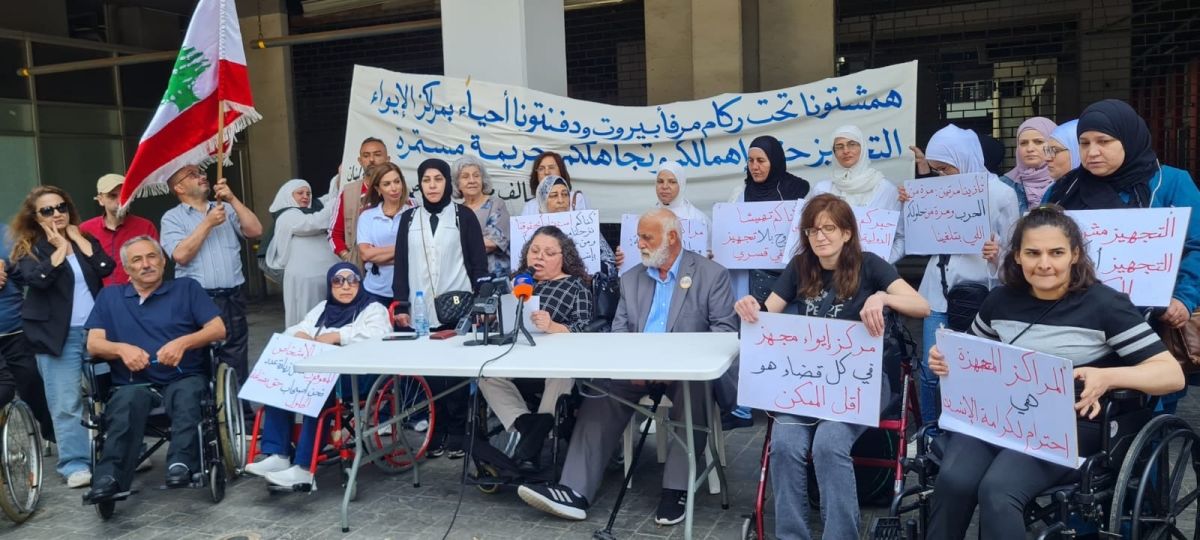
Members of the LUPD, surrounding the president, Sylvana Lakkis, are demanding more facilities for displaced persons with disabilities. (Credit: Photo provided by Sylvana Lakkis.)






"Lebanese authorities do not take people with disabilities into account in the event of disasters." This observation, made to L’Orient-Le Jour by Sylvana Lakkis, president of the Lebanese Union for People with Physical Disabilities (LUPD), has once again brought attention to the issue of supporting people with reduced mobility in the context of war and the forced displacement of hundreds of thousands of families from south Lebanon and Beirut’s southern suburbs.
The issue resurfaced last Monday when around 60 activists staged a sit-in in front of the disused Tariq al-Jadideh wholesale market in Beirut, demanding that the building be made available to displaced people with disabilities and their families. The protest was met with a categorical refusal from the president of the Beirut produce vendors’ union, Souheil al-Moabbi, sparking a controversy that briefly took on a Sunni-Shiite dimension, as the displaced are mostly Shiite while the affected merchants are predominantly Sunni.
"Sheltering displaced people with disabilities in government-arranged centers is problematic. The bathrooms are not adapted, the buildings have stairs, the doors are too narrow for wheelchairs. A person with a disability cannot sleep in a tent because they cannot sit on the ground. Often, when a location meets the standards, the disabled person is forced to be separated from their family. And that’s without mentioning other forms of disability," Lakkis explains.

She says that after multiple meetings with state officials, including Beirut governor, Marwan Abboud, she learned that the produce market had never opened. This is why she is calling for it to be temporarily allocated to displaced people with disabilities.
'Three thousand displaced people with disabilities are waiting'
Built in the 2000s by former Prime Minister Rafik Hariri to accommodate Beirut produce vendors displaced from downtown after the Civil War (1975–1990), the market was completed and equipped but never became operational, reportedly for "political reasons," according to several parties concerned. "Worse still, the theft of equipment is estimated at $600,000," laments Moabbi. "The building needs repairs, but it has elevators and 140 large rooms that could accommodate wheelchair users and their families," notes the activist.
The head of the produce vendors’ union disagrees. He told L’Orient-Le Jour that he had “received assurances from the authorities that the market would open within six months,” after decades of waiting by merchants. “This market is the best way to regulate prices and curb illegal vendors,” Moabbi says, denying having made discriminatory remarks about the Shiite community.
“Why are they demanding the opening of this building in particular, when it is public property designated by the Beirut municipality for produce vendors, and we have been making every effort for months to have it finally open as soon as possible?” he asks, while thanking the authorities for honoring his refusal.
"Three thousand displaced persons with disabilities are now waiting to find a place in a structure suited to their needs," says Lakkis, calling for "the authorities to mobilize." "Some people stayed in their homes in south Lebanon, despite the bombings, because no structure is adequately equipped to host them decently."
However, citing figures from Lebanon’s Disaster Risk Management Unit, she acknowledges that nearly 3,000 displaced people with disabilities have been accommodated in centers run by the authorities or by NGOs specializing in support for people with reduced mobility. “Some meet standards, others do not,” she says.
Authorities working with limited resources
Faced with the controversy, the authorities appear visibly uncomfortable, while insisting they are doing what they can despite a "lack of funding."
Contacted by L’Orient-Le Jour, Marwan Abboud, who is responsible for selecting shelters for displaced people in Beirut, acknowledges the need to improve accessibility. "We are working on the issue, but it is extremely difficult in an emergency," promising "new meetings" on the subject.
The same concern is evident at the Ministry of Social Development, where Marie Ghia, in charge of the dossier, says the ministry has tried to adapt available facilities, including Beirut Sports City and public schools converted into shelters, with the support of international organizations, the United Nations and the Lebanese Red Cross.
“We are mobilized to ensure the rights of people with disabilities. The Ministry of Public Health provides oxygen concentrators and other medical equipment. We have also placed people with specialized NGOs that have availability," she explains.
According to ministry estimates, about 2,000 displaced people with disabilities are currently housed in facilities with their families. Ghia, however, acknowledges shortcomings: inaccessible buildings, shortage of beds, inadequate toilets and impassable steps.
"When we can, we place them on the ground floor and provide the necessary equipment. But sometimes, it’s impossible. One thing is certain: we have not turned away any accommodation request from people with disabilities," she says, adding that places remain available in Beirut and in other regions of the country.

 7 p.m. recap: 1 person killed near border with Lebanon; 200 kilos of explosives carried by mules; Riyadh shuts its airspace