







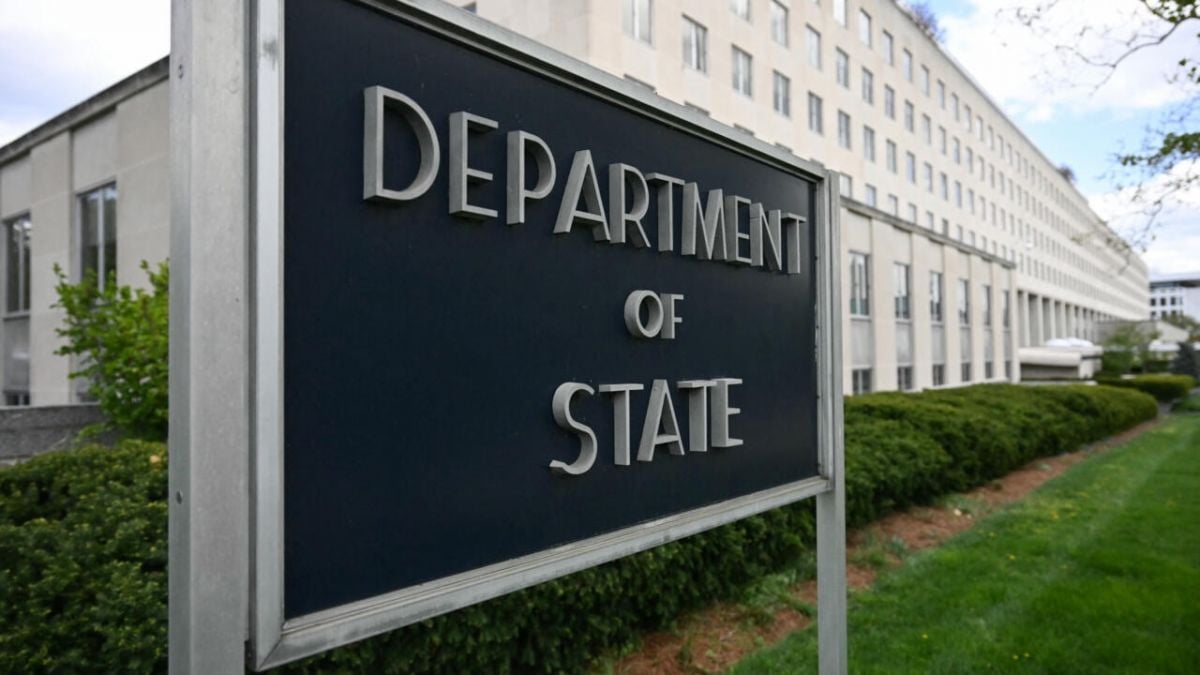
The U.S. State Department headquarters in the Foggy Bottom neighborhood of Washington, D.C., April 15, 2025. (Credit: Jim Watson/AFP)






Lebanon and Israel will extend their cease-fire, which was set to expire on Sunday, by 45 days, the U.S. State Department announced Friday following a second day of direct talks between Lebanese and Israeli delegations in Washington.
These talks, led on the Lebanese side by former ambassador Simon Karam, are being denounced as a "plot" by Hezbollah, which continues to fight against Israeli forces occupying part of southern Lebanon.
"On May 14 and 15, the United States hosted two days of highly productive discussions between Israel and Lebanon. The cessation of hostilities of April 16 [the date on which the agreement was reached] will be extended for 45 days to allow for further progress," said State Department spokesman Tommy Pigott.
He also specified that he "will reconvene the political component of the negotiations on June 2 and 3." “Furthermore, a security component will be launched at the Pentagon on May 29 with military delegations from both countries,” he added.
Washington also stated that it “hopes these discussions will lead to progress toward a lasting peace between the two countries, full recognition of each other’s sovereignty and territorial integrity, and the establishment of genuine security along their shared border.”
Finally, in its statement, the U.S. State Department emphasized that “the United States remains aware of the challenges posed by Hezbollah’s continued attacks against Israel, without the consent or approval of the Lebanese government, carried out to derail this process.”
“Washington welcomes the commitment of both governments to finding a long-term solution despite these persistent challenges,” it added.
Two components: security and political. In a statement released at the end of these two days of negotiations, the Lebanese delegation “welcomed the results achieved today” and referred to “tangible diplomatic progress in favor of Lebanon.” She also mentioned “the launch of a U.S.-sponsored security process on May 29” and stated that “the formal political process has been launched, reflecting Lebanon’s constructive engagement and strengthening the chances of reaching a lasting peaceful solution.”
According to the text, the United States will facilitate “channels of communication and direct military coordination between Lebanon and Israel.” The parties also committed to assessing progress toward a possible further extension of the cease-fire.
According to the delegation, “the extension of the cease-fire and the establishment of a U.S.-sponsored security process provide vital space for our citizens, strengthen state institutions, and open a political process toward lasting stability.” It affirmed that “Lebanon will continue its constructive engagement in the negotiations, while preserving its sovereignty and protecting the security of its people.”
It reaffirmed its commitment to reaching an agreement guaranteeing “the full national sovereignty of Lebanon” and “the security and return of all its citizens.”
The statement concludes by highlighting Lebanon's priorities: "restoration of sovereignty" over the entire territory, "safe and dignified return of displaced persons," "release of detainees and repatriation of remains," and the establishment of a "gradual and verifiable implementation mechanism," supported by the United States, to ensure the fulfillment of commitments.
For his part, Israeli Ambassador to Washington, Yechiel Leiter, stated after the negotiations that their "potential for success" was "significant." "I look forward to the next steps. The peace talks were frank and constructive and should progress on two fronts: security and politics," he wrote on X.
"There will be ups and downs, but the potential for success is significant. Throughout the negotiations, the security of our citizens and soldiers will remain the top priority," he added.
Berri, 'pess-optimistic'
In Beirut on Friday evening, Prime Minister Nawaf Salam adopted a firmer tone than usual toward Hezbollah, implicitly calling on the party to end its “absurd adventures in the service of foreign interests.” “Enough with the one-upmanship and accusations of treason. This will not impress us and will never intimidate us,” he declared.
Before the start of this new day, Parliament Speaker Nabih Berri, who had met with the Prime Minister earlier in the day at Ain al-Tineh, described himself as “pess-optimistic,” a play on words in Arabic. In an interview with the daily newspaper
Al-Akhbar, which is close to Hezbollah, the head of the Amal Movement reaffirmed his preference for "indirect negotiations in order to first reach a genuine cease-fire agreement," asking, "Is there currently a cease-fire?" while emphasizing that "the enemy has not respected any agreement since October 2024." He added that he was not in favor of direct negotiations, reserving his comments for "when everything is over." Finally, he insisted that any agreement must be backed by "guarantees from Saudi Arabia, Iran, and the United States."
For his part, Mahmoud Qomati, a member of Hezbollah's Political Council, denounced a "plot" against Hezbollah, and the positions of President Joseph Aoun, who, he claimed, "abandoned his commitments" to the militia party. The negotiations take place in "a context of conspiracy against the homeland, its sovereignty and its resistance," said the party official.
Lebanese officials "did not keep their word regarding direct negotiations," although they had repeatedly announced they would not attend them "before a full and comprehensive cease-fire," he said.
"Yet, they went and continue to go, crawling on their hands and knees," he added. According to him, Aoun "reneged on his commitments to the resitance and continued his commitments to the Americans, the Europeans, and certain Arab countries aligned with the other camp," thus losing his "attempt at balance."
A similar tone came from Jaafarite Mufti Ahmad Qabalan, close to the Amal-Hezbollah alliance, who felt that with these negotiations, the Lebanese authorities "are putting the country’s sovereignty" at risk and that Lebanon is led "by a power manufactured in Washington."
According to him, the American project to impose a plan to disarm Hezbollah "aims to push the Lebanese Army to confront the resistance and the population, which could spark internal explosion."
Joumblatt backs negotiations, but 'with conditions'
Mediapart reports that Druze leader Walid Joumblatt stated his support for negotiations, "whether direct or indirect," but "with conditions." He asserted that "we must return to the 1949 armistice line, but with a monitoring body on both sides tasked with ensuring compliance with the cessation of incursions and assassinations, and with an international force, which could include the French and Italians."
He added that "as long as the Israeli aggression continues, with this yellow line whose limits are unknown, the murders, the assassinations, the bombings, you can't ask a Hezbollah fighter to surrender his weapons. If I try, he'll tell me to get lost!" He also asserted that "the Israelis have created a mini-Gaza in Lebanon."
The U.N. humanitarian coordinator in Lebanon, Imran Riza, said on Friday that the negotiations were a "unique opportunity" to end the war, as Israeli strikes killed an "unacceptable" number of civilians. "Diplomatic efforts offer a unique opportunity to end the violence," Riza said in a statement, expressing hope that "the ongoing negotiations will pave the way for a political solution." "Airstrikes and demolitions continue daily," causing "an unacceptable toll of civilian casualties, in addition to the damage inflicted on civilian infrastructure," he added.
The cease-fire, which came into effect on April 17, was due to expire in the coming days. Despite this agreement, deadly Israeli strikes continue in Lebanon, in a context also marked by attacks claimed by Hezbollah. Israeli ground troops have also made unprecedented advances in southern Lebanon, where they are reportedly imposing a "buffer zone" covering nearly 6% of Lebanese territory.

As a Jewish American, it astounds me to see the trust that the Lebanese authorities involved in current negotiations have for both Israel
16 May 2026 03:44