





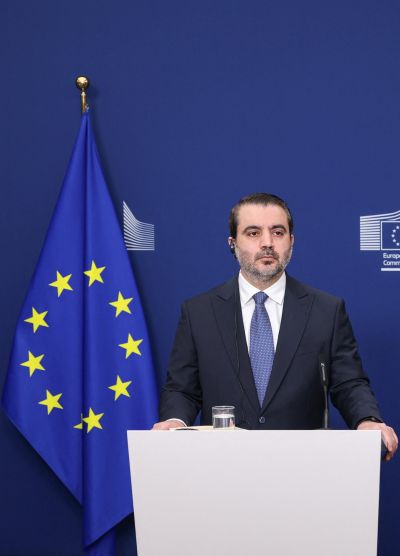
Syrian Foreign Minister Assaad Chaibani, at a press conference with the European Commissioner for the Mediterranean, Dubravka Suica, in Brussels, May 11, 2026. Photo REUTERS/Yves Herman Syrian Foreign Minister Asaad Hassan Al-Shaibani attends a press conference with European Commissioner for the Mediterranean Dubravka Suica (not pictured) following a meeting of the Syria Partnership Coordination Forum, in Brussels, Belgium, May 11, 2026. (Credit: Yves Herman/ Reuters)






BEIRUT — Syrian Foreign Minister Assaad al-Shaibani said Monday that Damascus regards Lebanon as a "partner," while voicing "concerns" over Hezbollah's weapons.
Shaibani made the remarks on the sidelines of a meeting in Brussels with the foreign ministers of the European Union, shortly before the EU-27 reactivated their trade cooperation agreement with Syria.
Speaking ahead of the meeting, Syria's top diplomat described Lebanon as a "neighbor and partner" but said Damascus had "security concerns" stemming from the presence of "uncontrolled weapons in the hands of certain militias," in an apparent reference to Hezbollah, according to the official Syrian news agency SANA.
In recent weeks, Syrian authorities have repeatedly accused Hezbollah of attempting to carry out "hostile" operations in and from Syria to destabilize the country. The Syrian minister said he hoped to "develop relations [with Lebanon] by moving beyond the legacy of the past left by the former Assad regime," which Hezbollah supported during the Syrian civil war (2011-2024).
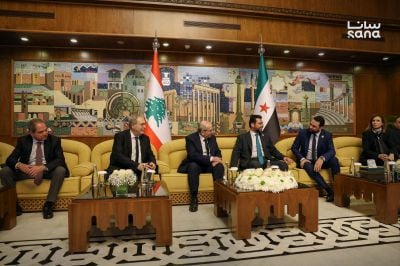
His comments came two days after a Lebanese ministerial delegation visited Damascus. On Sunday, Lebanese Prime Minister Nawaf Salam said Lebanon had "turned the page on disputes with Syria," whose Assad regime, which fell in December 2024, had maintained a tight grip over Lebanon from 1990 to 2005.
He added that "significant progress has been made with the Syrian side" and announced upcoming cooperation across various sectors.
The EU strengthens ties with Syria
The European Union decided Monday to reactivate its trade cooperation agreement with Syria, to support the country's stabilization and economic recovery, and to help create conditions for the return of Syrian refugees currently living in Europe.
"This decision sends a clear political signal of the EU’s commitment to re-engage in dialogue with Syria and to support its economic recovery," the European Commission said Monday.
EU foreign ministers are due to meet Monday afternoon with their Syrian counterpart to begin a high-level "political dialogue," a year and a half after the fall of Bashar al-Assad.
Upon arriving in Brussels, Shaibani urged leaders to be ambitious. "What is needed today is political will, a willingness to move from caution to full participation in Syria’s reconstruction," he said.
The goal is to encourage reconstruction in a country devastated by more than 13 years of civil war, where the situation on the ground remains "horrendous," according to an EU official.
Some 13 million Syrians — nearly half the population — require food assistance, the official added. In January, the EU pledged 620 million Euros in financial aid for 2026-2027.
'Key reforms'
"Our goal within the EU is to support you," said European Commissioner for the Mediterranean Dubravka Suica.
Ursula von der Leyen also pledged in January that Europe would do “everything possible” to support Syria’s reconstruction after meeting Syrian leader Ahmad al-Sharaa in Damascus.
The EU suspended cooperation with Syria in 2011 in response to repression and human rights violations under Assad. Before the suspension, trade between Syria and the bloc totaled roughly 7 billion Euros. In 2023, EU imports from Syria stood at 103 million Euros, while exports reached 265 million Euros.
Brussels also hopes to negotiate a broader association agreement, similar to those it has concluded with countries such as Egypt, Israel, and Lebanon. But Suica stressed that progress will depend on the implementation of “key reforms” by Syria’s transitional government, in particular, "ensuring that all Syrians are involved in decisions regarding the country’s future; secondly, guaranteeing transparent management of public finances;" and finally, "demonstrating a strong commitment to the rule of law and justice" during this transition period, she said.
'Dignified' return
This return to stability in Syria is of particular interest to several EU member states, who host hundreds of thousands of Syrians who fled the war. The vast majority, about a million, have found refuge in Germany, where Chancellor Friedrich Merz has recently called for a tougher migration policy in the face of the rise of the far right.
In early April, when he hosted the Syrian president in Berlin, he expressed the wish that 80% of these refugees return home within the next three years. He later clarified that this was the wish of President Sharaa.
Denmark has also indicated its intention to encourage returns, provided conditions are suitable. "If it is safe, if it is voluntary and if it is dignified, they can return home," the European commissioner stressed, without specifying whether that is the case today in Syria.
"I cannot speak on behalf of the Syrian government," she added. And there is no question of forcing these returns, another EU official said.
"If Syrians feel the conditions are right for them to return, they can go back" home, Syrian Foreign Minister Shaibani cautiously said.

 Evening recap: Netanyahu announces West Bank offensive; 7 killed in Jordan church shooting; tents burned in south Lebanon
 US strike on Iran this weekend? ‘Absolutely,’ says Barrack; ‘I have no idea,’ says Trump