






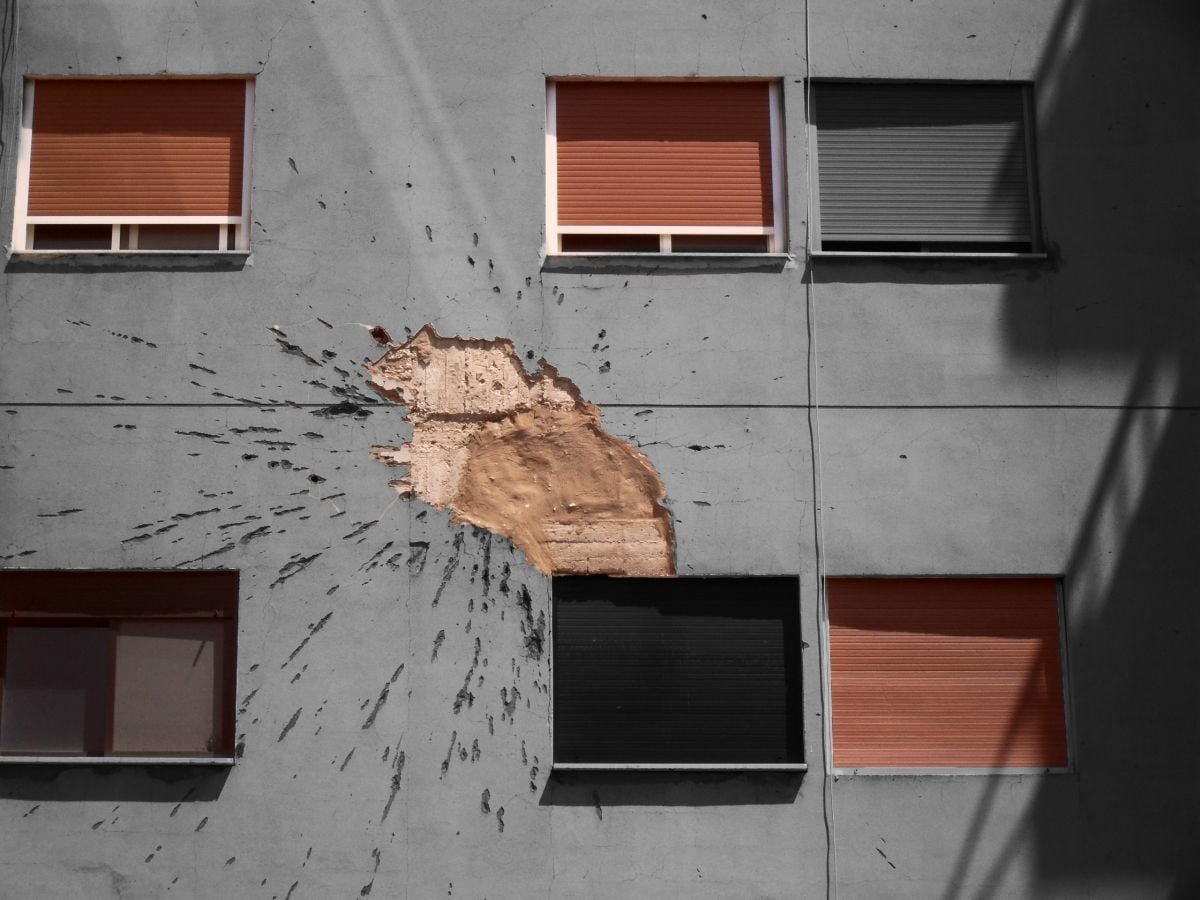
The splatter on the wall, evidently caused by shrapnel, dating back to the civil war. (Credit: Yara Malke/Edited by Celine Bejjani)






This May afternoon, the Israeli MK drone is working overtime rounds of sensorial terrorism. One thing about the street where I live: I can hear the drones, but the birds are louder. Their chirping, in trills and songs, a vibrant burst of technicolor, cuts through the incessant, monotonous buzz.
Sporadic construction sounds and men shouting in the distance. Car horns and traffic noise. A run-of-the-mill end to a bustling city workday. Balmy Beirut weather.
I look around at the other neighborhood balconies; some are clamped shut, others are overflowing. Frayed curtains and old shutters. A family sits at their red plastic table. A shirtless man hangs his laundry. A woman flicks her cigarette off the railing, unfazed.
I tilt my head as I fixate on the battle scar etched to the building opposite mine, like a splatter on the wall. It begins at the center, deep and rough, and violently pulses outward like mold. Then it spreads in uneven tendrils, branching into thin, short, erratic lines. At first glance, it looks organic, like an ecosystem that burst on impact and fed on the cement.
I’ve been plagued by intrusive thoughts about core rot. I picture a ghost apple in early spring, hanging loosely from a tree. A crimson delight slips from its grasp and falls to the floor. I pick it up and bring it home, unaware that its glossy red surface conceals hidden decay — rotting at the core and spreading stealthily until the apple is beyond saving. I bite into it ravenously, then my lips turn black, and my insides follow.
It all started when my sister Karen casually said something to me on the phone the other day, and it still hasn’t left my mind.
Everything we’re living through today started in 1948, probably earlier. Once something is infested from within, the decay doesn’t stop until it consumes everything. It’s only a matter of time. It’s like core rot, you know, when an apple mysteriously molds from the inside. We’re doomed.
Before this last war, I used to gaze at the stars from my balcony, writing in a used notepad I had swiped from my parents’ house. Now, I stare at this grotesque mark on the wall. A wave of despair washes over me. I, too, feel like damaged goods.
I then remember my father once brought an empty suitcase to Lebanon on a visit to fill it with wild apples from the mountains. He went through them like a wood chipper.
Whenever I felt down, he would ask, “Akalteh teffeha?” That would piss me off. It also made me laugh.
But it’s my Hail Mary now. I get up, rinse one under the tap, then splash it with white vinegar for good measure.
I cut it carefully, slowly, symmetrically. I prudently inspect each piece's guts before I eat it, of course. I’m not insane.

 Evening recap: Netanyahu announces West Bank offensive; 7 killed in Jordan church shooting; tents burned in south Lebanon
 US strike on Iran this weekend? ‘Absolutely,’ says Barrack; ‘I have no idea,’ says Trump