







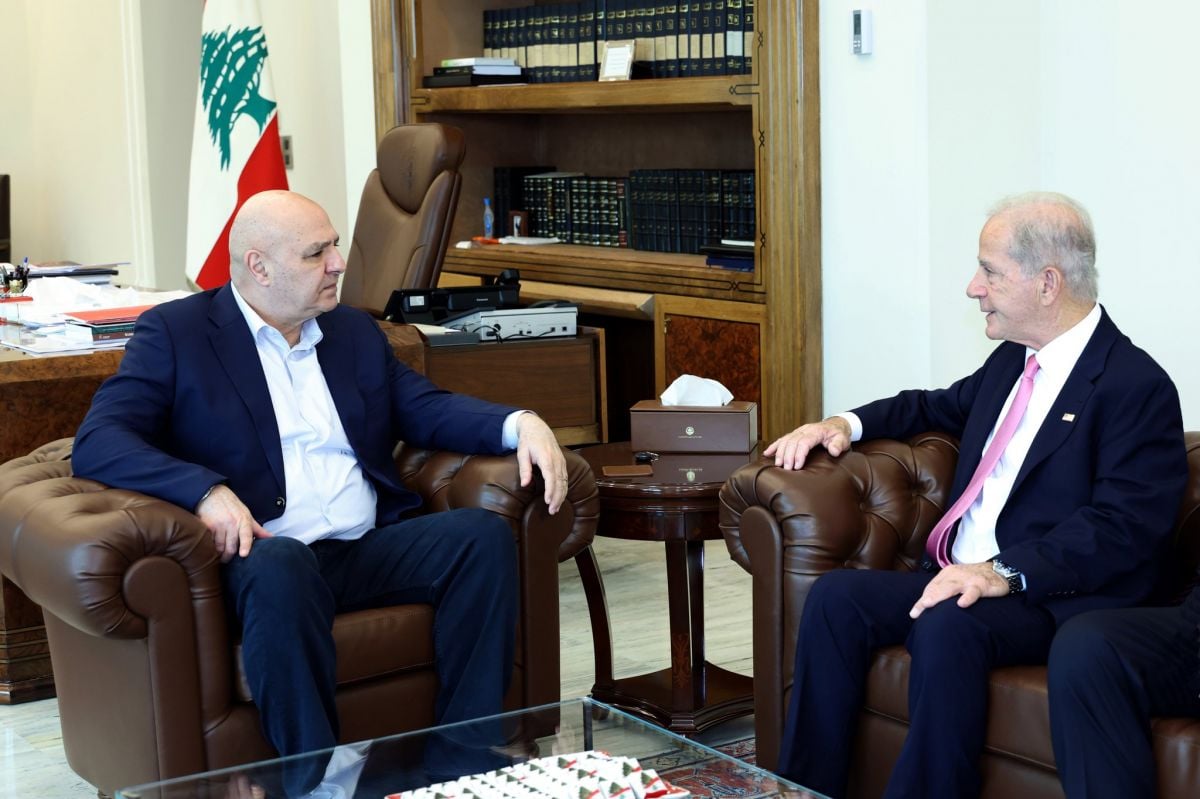
President Joseph Aoun receiving the American ambassador, Michel Issa, in Baabda on May 1, 2026. (Credit: @LBPresidency/X)






Lebanese President Joseph Aoun responded Friday to U.S. pressure for rapid direct negotiations with Israel and a deal within the next two weeks, by reiterating Beirut's demand for a halt to Israeli strikes on Lebanon.
The end of these attacks, Aoun told U.S. ambassador to Beirut Michel Issa, would mark the "resumption of meetings" in the United States to ensure "peace and stability" in the border area, which could then be announced "from" Washington.
The head of state did not specify at what level these meetings would continue after two gatherings between the Lebanese and Israeli ambassadors at the State Department and the White House.
For its part, Hezbollah said these negotiations "do not concern it in any way," while Parliament Speaker Nabih Berri rejected any negotiations "under fire."
At the Baabda Presidential Palace, the discussions between Aoun and Issa focused, according to the presidency, on "strengthening the cease-fire and ending attacks on civilians and civilian infrastructure" in southern Lebanon.
The end of these strikes would be a "prelude to continuing meetings in Washington, which should lead to peace and stability at the border and their announcement from Washington," according to the presidency.
The meetings held so far in the United States, at ambassadorial level, were intended as "preparatory" to direct negotiations between the two countries, for which President Aoun has already appointed former ambassador Simon Karam as head of the delegation.
Before his meeting at the presidential palace, Issa was received at the Grand Serail by Prime Minister Nawaf Salam.
President Donald Trump insisted Thursday night that these negotiations take place within two weeks, and on organizing a meeting between Aoun and Israeli Prime Minister Benjamin Netanyahu. This ultimatum was issued after phone calls between Trump and Netanyahu, during which the latter demanded that a two-week window be set to reach an agreement; otherwise, Israel would resume and expand military operations in Lebanon, planning a ground invasion of about 15 kilometers and taking control of the area south of the Litani in order to pressure the Lebanese state into acting against Hezbollah.
Meanwhile, the U.S. embassy in Beirut had, prior to Michel Issa's tour, published a message on X Thursday night stating that an Aoun-Netanyahu meeting "would offer Lebanon the chance to obtain concrete guarantees from the United States," notably "full sovereignty, territorial integrity, border security" and the "complete restoration of the Lebanese state's authority over every inch of its territory."
Hezbollah 'not concerned,' Berri 'turns off the engines'
Hezbollah's parliamentary group reiterated in a statement that it "rejects and condemns" any direct negotiation between Lebanon and Israel. "Any outcome or result from this (diplomatic) process does not concern us in any way," wrote the Shiite party's lawmakers. The head of the legislature and Hezbollah ally Nabih Berri, for his part, said there was no point in negotiating with Israel under combat pressure, recalling in an interview with the pan-Arab daily Asharq al-Awsat that the cease-fire allowed Israel to "continue its offensive and perpetrate massacres at an unprecedented pace." In response to the U.S. embassy's statement in Beirut, the parliament speaker said he had "turned off the engines," suggesting he had ceased his diplomatic efforts and coordination with President Joseph Aoun. That is the reason, he said, why he refused to take part in the meeting at Baabda on Wednesday with the head of state and Prime Minister Nawaf Salam to discuss negotiation modalities.
Hezbollah drew Lebanon into war in the Middle East on March 2 by launching attacks against Israel in revenge for the death of Iran's supreme leader Ali Khamenei, killed in the Israeli-American offensive against Iran. Israel retaliated with deadly strikes. A cease-fire has been in place since April 17, but both sides have continued fighting, accusing each other of violating the truce.

 8 p.m. recap: Israel again threatens Beirut’s south suburbs; 2 ships hit near Hormuz; Riyadh football matches canceled