






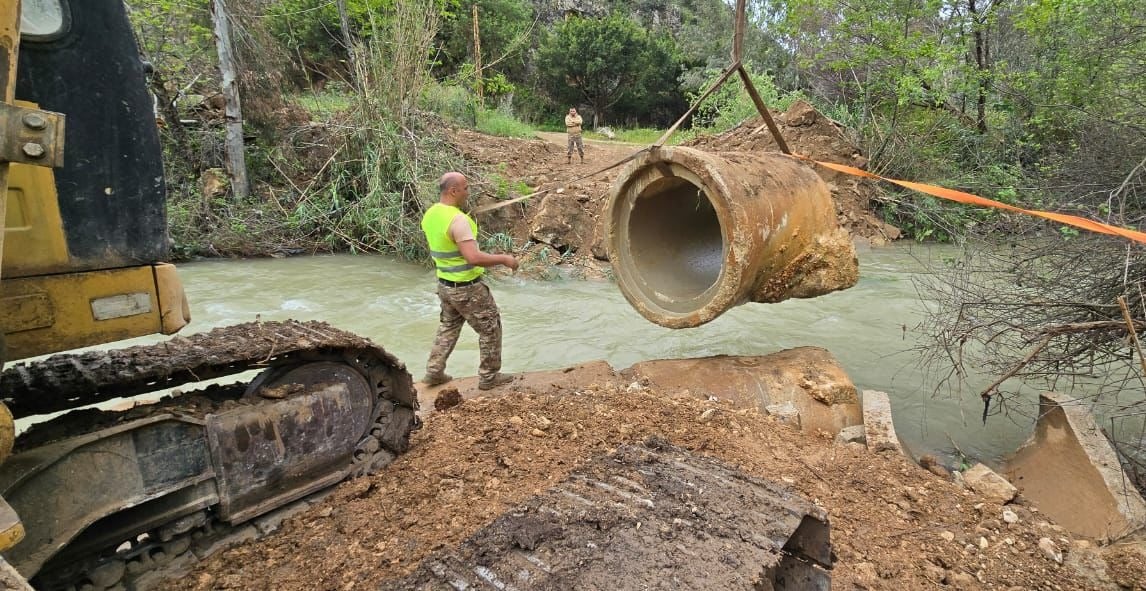
The Litani Office and the Lebanese Army are carrying out work to install a temporary bridge over the Litani River in Tayr Felsay (Sour district). (Credit: Photo sent to our correspondent in south Lebanon, Mountasser Abdallah)






BEIRUT — The Lebanese Army announced on Sunday morning that it had reopened, or was continuing work to reopen, several access routes, roads, and bridges between South Lebanon and the rest of the country, including the construction of a temporary bridge in Tayr Filsey (Sour) over the Litani River, on the third day of the cease-fire between Hezbollah and Israel. Many road infrastructures had become unusable due to Israeli strikes in south Lebanon during nearly seven weeks of war, cutting the south off from the rest of the country.
The army, which has been repairing several damaged routes since Friday, said it had “completely reopened the road between Khardali and Nabatieh,” according to a statement. It also “partially reopened the Burj Rahal–Sour bridge,” while “work is underway to restore the bridge between Tayr Filsey and Sour.” This work is being carried out in coordination with the National Litani Office, to ensure connectivity between the northern and southern banks of the river and facilitate residents’ movement. It includes the completion of temporary structures and the installation of concrete pipes, with the aim of quickly opening an alternative crossing, according to our south Lebanon correspondent.
Israeli strikes on bridges over the Litani River, around 30 kilometers north of the Israeli border, had nearly isolated South Lebanon from the rest of the country, according to the army. The reopening of the Qasmieh bridge on Friday morning allowed a large number of displaced residents to return to their towns and villages to inspect their homes.
Returns to Saida and Beirut
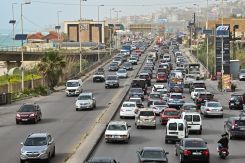
On Saturday evening, an influx of displaced people returning from south Lebanon was observed on roads across the country. Traffic was particularly heavy around Saida, where many residents from the South were returning to their temporary housing after inspecting their villages, according to our correspondent. According to our photographer, Mohammad Yassine, traffic was also heavy on the road from the South toward Beirut.
Earlier, Mahmoud Comati, vice president of Hezbollah’s Political Council, had asked residents who had fled the southern suburbs of Beirut or South Lebanon to wait for the group’s green light before returning home.
The Israeli army has bombed all bridges connecting the south of the Litani River to its northern bank, hindering the return of many displaced residents to their homes since the cease-fire came into effect on April 16.
The conflict between Hezbollah and Israel began on March 2, with a ten-day cease-fire declared following mediation efforts led by U.S. President Donald Trump.
Despite the truce, the Israeli army announced on Saturday that it had established a “yellow line” of demarcation in south Lebanon.
The war has displaced more than 1.2 million people from south Lebanon, the southern suburbs of Beirut, and parts of the Bekaa.
